

The US Navy's Next Frontier Is The 'Unexplored Seafloor'
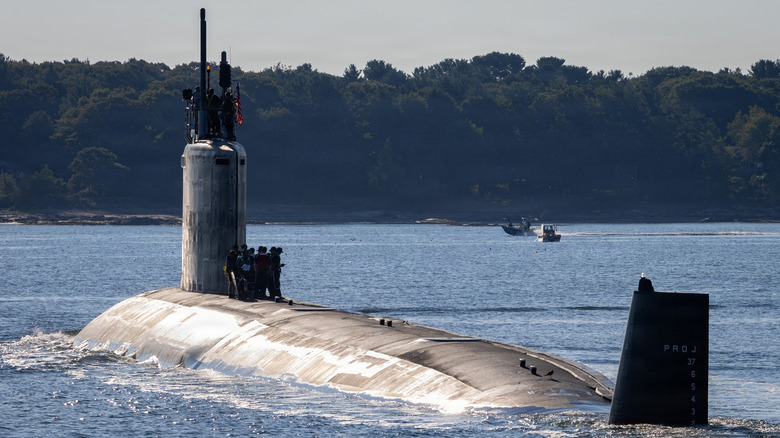
The U.S. Navy is no stranger to the surface of our oceans, and indeed, its fleet of submarines means this familiarity extends to the murky depths. However, traditionally the submarine fleet's roles include surveillance and deterrence, missions that involve spending much of their operational time trying to avoid the seafloor. This is beginning to change. As noted by Naval News, the U.S. Navy has begun to treat the seafloor not as something to avoid, but as a new battle space. This raises an interesting point — what is there on the seafloor that the Navy feels strongly enough about to consider it as its next frontier?
As it happens, there are solid reasons why the Navy is converting one of its future submarines to become an "elite seabed warfare" vessel. The USS Baltimore is the submarine in question; the Virginia-class submarine is expected to be completed by 2036. It was a recent job posting that suggested that one of the U.S. Navy's deadliest submarines is being redesigned to operate in the Navy's "new frontier." In the listing, potential candidates were invited to apply for a position as a systems engineer test lead to work on converting the submarine's role to that of a seabed warfare platform.
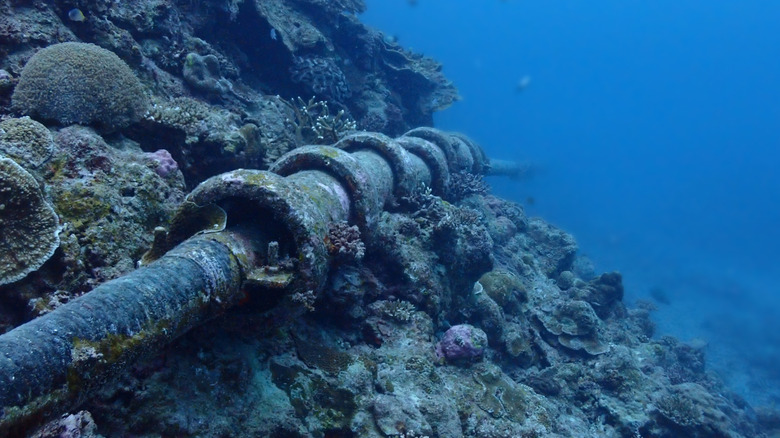
While the seabed itself is of little interest to the navy, the undersea data cables that keep the internet alive are, as are the oil and gas pipelines that are also routed along the seafloor. While about 70% of damage to these cables can be attributed to accidents, there are several reports of state-backed sabotage. It's this sensitive and critical infrastructure that the Navy's new program is being designed to protect.
The Navy's evolving seabed role
The Navy's interest in the seafloor is not new; it has a history of operating submersibles, including being involved with the mission that found the Titanic. It also has unmanned systems that can operate at great depths to rescue submarine crews should the unthinkable happen. However, these scenarios are different from the current situation.
The new program is focusing on the surveillance and defense of critical undersea infrastructure. This isn't for protection against a hypothetical situation either; there are documented examples of data cables and gas pipelines being severed deliberately. It's also not a new phenomenon; as early as 1898, a U.S. Navy operation lifted and severed a communications cable off the Cuban coast. More than a century later, there are over 900,000 miles of fiber optic cable running along the seabed of our oceans and seas.
This is the domain the Navy's SSW program hopes to dominate, both defensively and offensively. The program has widespread Navy and congressional support, a point corroborated by Vice Admiral Seif, the commander of U.S. submarine forces. Speaking at the 2026 Combined Naval Event he noted, "On defensive and offensive seabed warfare capability, this really, really is a growth area and something we're really moving out on."
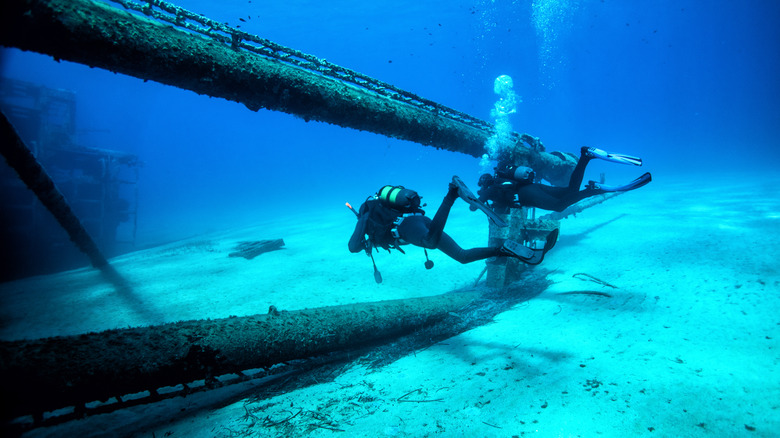
Exact details on the changes haven't been provided, but it will almost certainly involve changes to the standard Virginia-class layout. A submarine built for deep-ocean engineering will likely need to be configured for saturation diving operations, operating remote vehicles, and other specialized systems.
How real is the threat?
The fact that this program has strong across-the-board support tells us that this is an area that the U.S. is taking very seriously. It isn't just the U.S. that's worried either; the Center for Strategic & International Studies (CSIS) describes the threat as being the "soft underbelly of the global economy". NATO is also concerned; during the 2024 inaugural meeting of its Critical Undersea Infrastructure Network, the organization noted that challenges to undersea cables and infrastructure are rising, and that Allies have already increased patrols following recent incidents in the Baltic Sea.
But proving whether attacks are deliberate is a contentious issue. For instance, in October 2023, two data cables and a pipeline were damaged at the same time. As reported by the CSIS, a Swedish Government official stated at least one of the cable incidents had been damaged by external force or tampering, and Estonian officials concluded that the incidents were all linked. Investigators looked at two ships in particular, the NewNew Polar Bear, a Chinese container ship, and the Sevmorput, a Russian nuclear-powered cargo ship. Russia denied any involvement in the incident, while China admitted to the damage, but maintains it was accidental. This is only one of many incidents that have occurred in the same region. China has also been implicated in a string of similar incidents in the Taiwan Strait.
In such circumstances, the repurposing of the USS Baltimore makes sense. The same can be said of the Navy's assertion that the seafloor is indeed the latest battle space it has to patrol. The Virginia-class submarine is one of the most advanced submarines in the world, and this project could make it more relevant than ever.