

Square Vs. Round Trailer Axle: Which Should You Use?

There are some important rules regarding the use of a trailer, and it's good to know about them before hooking one up to your vehicle. But an element you may not have considered is the axle of the trailer you're using and whether or not it's the right one for your needs. The truth is that the answer can vary, as both square and round axle beams offer different advantages.
Square axle beams are often found on torsion axles, because their shape provides a stable surface for mounting the torsion arms. Torsion axles use these arms to connect the trailer's wheel assembly to the suspension inside the axle, thus allowing the wheels to move on their own. The square design can also be useful when using other attachments or giving more clearance around the trailer's ground gear. By comparison, round beams are used for applications where the axle needs to remain stable and resist any bending forces it may encounter.
So in terms of the right choice, it can depend on what you're using the trailer for. Square axles are often used on heavy-duty trailers for construction and agricultural work. Round axles are more commonly used on light-duty utility trailers, as well as recreational trailers for loading motorcycles, boats, and ATVs. But understanding the capabilities and limitations of a specific trailer model is just as important when making a decision, so you can determine which one is the best fit for your needs.
What you should know about replacing trailer axles
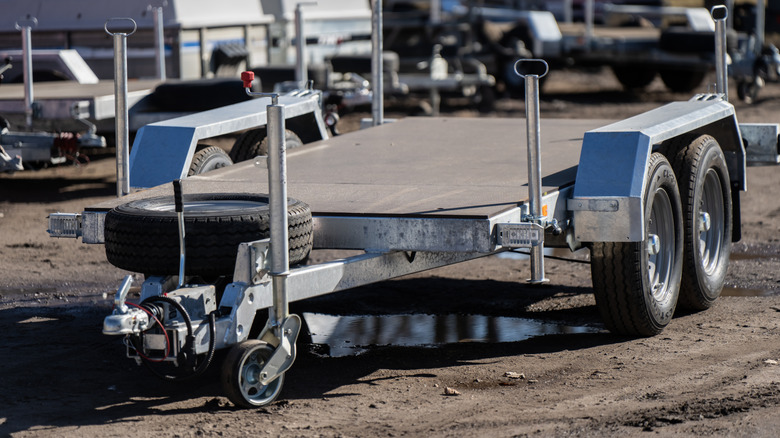
You can change your trailer axle for another type, but there is a caveat. A square and round axle can be swapped one for the other in both directions, as long as the replacement has an appropriate weight capacity. For example, a 2-inch square axle rated for 2,000 pounds can be replaced with a round axle of the same capacity, while a 3,500-pound round axle can be replaced with a square axle rated for 3,500-pounds. But despite which direction you go, be sure to use the correct hardware to connect the replacement axle to your trailer.
Special U-bolt mounting kits are available for specific axle tube sizes and spring configurations. Kits typically include the U-bolts, tie plates, and nuts needed to secure the axle, though setups can vary based on the manufacturer. For example, a Lippert kit designed for a 2,200-pound axle uses 3/8-inch U-bolts for a 1 3/4-inch axle tube and can accommodate either 2-inch-wide slipper springs or 1 3/4-inch-wide double-eye springs.
If you're replacing an axle on a tandem-axle trailer, you should consider replacing both of them at the same time. This is especially true when both axles have experienced a similar level of use, along with everyday wear and tear. By replacing them together, you can help keep the trailer's load balanced from that point on, while also ensuring that the trailer's suspension and brakes continue working on a consistent basis.