

What Is The 100-Feet Rule In Boating?

Can you visualize 100 feet in front of you? It's about a third the length of a football field, or about seven to ten car lengths lined up bumper to bumper. If you're behind the helm of a boat, you have to know how to picture it for the sake of the 100-feet rule, a boating safety regulation that puts a limit on how fast your boat can travel around people, property, other boats, or the shoreline.
The exact wording and distance requirements tend to vary from state to state, but the basic idea is the same in every body of water in America: If you're passing through a designated area or maneuvering around certain obstacles or people, you have to reduce your speed. It's about going beyond the rules of no wake zones to prevent collisions, avoid damaging wakes, and ultimately keep people safe out there on the water. A boat moving too fast through a confined area or around other boats or swimmers can create a dangerous wake, even if boat itself never even came close to hitting anything.
Different states have different distance laws
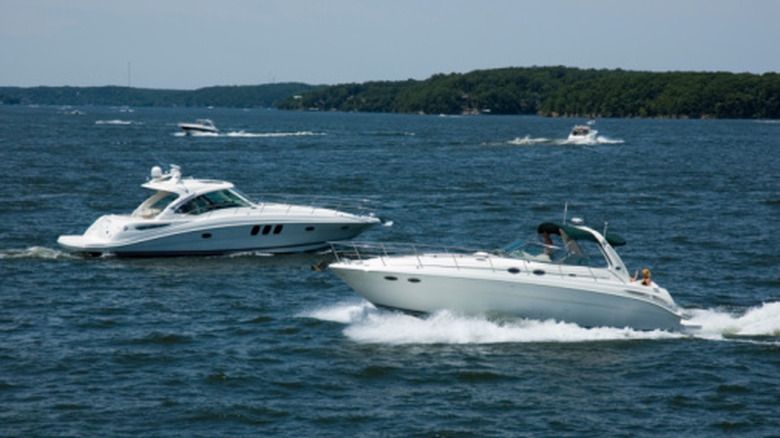
Some states take the 100-feet rule even further. Georgia, for example, says wakesurfers and wakeboarders have to stay 200 feet away from structures, vessels, and swimmers; that's in addition to the 100-feet rule for boats. Michigan has something similar, enforcing the 100-feet rule as well as a 200-feet rule for personal watercraft (or PWC), a 500-feet rule for wakeboarders, and a 150-feet rule for crossing behind other vessels (regardless of if they're towing or not). Missouri is especially strict with a 50-feet rule around any vessel or person on/in the water.
It might sound like a lot to keep track of, but the fact remains: If you're going to take a boat out on the water, it's your responsibility to make sure you know the laws. Boats don't have brakes, so it's really in the operator's best interest to go above and beyond the 100-feet rule whenever possible. Not to mention, most people tend to drive their boat less than they drive their car, so reaction times are likely going to be slower. Cars have the the 3-second rule, but boats don't, so it's in your best interest to regard the 100-feet rule as a minimum, not a maximum.