

Why Did Most Car Manufacturers Switch From Cast Iron To Aluminum Engine Blocks?
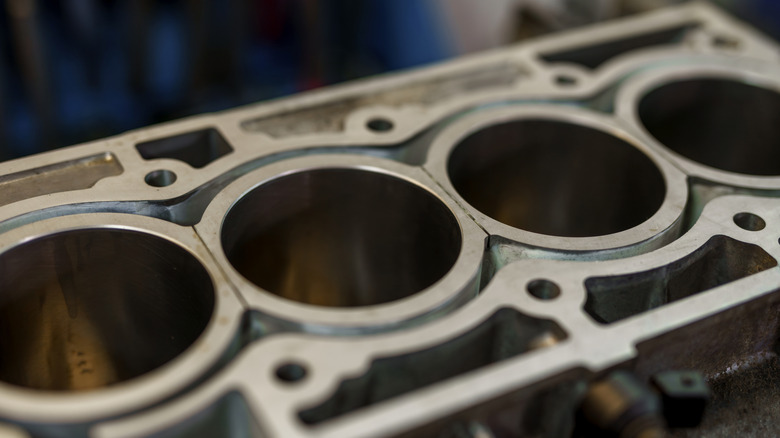
For vehicle enthusiasts, understanding the difference between cast iron and aluminum engine blocks can be pretty straightforward. That may not be the case for everyone else, however, especially when it comes to why the auto industry began shifting from cast iron to aluminum in the late 1970s. Ultimately, this comes down to what automakers needed from an engine block and the limitations of cast iron.
Car makers needed to find a way to reduce vehicle weight due to stricter emissions standards. Since the engine block is the heaviest part of the engine, it became a focal point for cutting that weight, which is where aluminum comes into play. According to the Society of Automotive Engineers (SAE), replacing traditional cast iron with aluminum casting alloys can result in a block weight decrease of around 40 to 55%. By making this move, car companies could lower vehicle weight, thus reducing emissions.
Weight wasn't the only advantage that aluminum had over cast iron, however. The two materials also differ in terms of thermal conductivity. Compared to cast iron, aluminum more efficiently transfers heat into the engine's coolant. This allows the engine to dissipate heat effectively, helping to manage high temperatures generated during engine operation. Using aluminum with other aluminum engine components such as cylinder heads also has its benefits, as matching materials helps automakers avoid the thermal stress caused by aluminum and cast iron expanding at different rates.
Why some automakers still use cast iron engine blocks
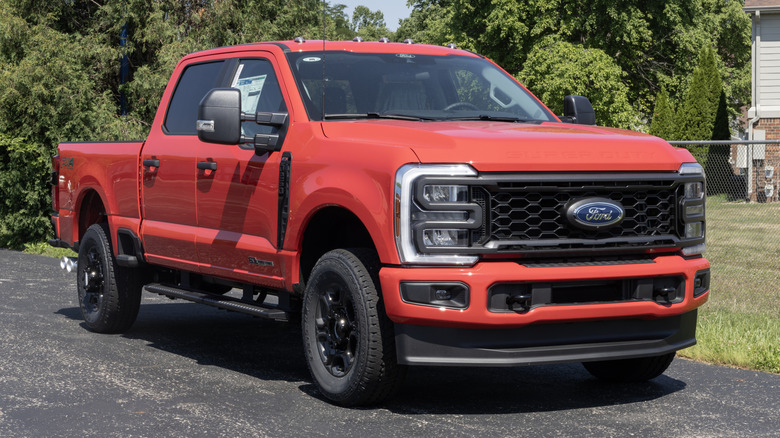
Cast iron engine blocks haven't completely disappeared, and they're still being used in heavy duty vehicles. That includes the Ford F-250, which uses a cast-iron block for the 7.3-liter V8. Ford also uses a cast-iron block in the F-350 Super Duty. GM still uses cast-iron blocks as well for both its 6.6-liter L5P Duramax diesel and L8T gasoline V8 engines. In both cases, the cast iron blocks are used with cast-aluminum cylinder heads.
There's a reason why cast iron is still being used for some engines, and it has to do with capability. For example, diesel engines generate a tremendous amount of torque through quick combustion at high temperatures and pressures. This places a greater demand on the cylinder block itself, which needs to be able to hold up under that workload. Because of this, diesel cylinder blocks tend to be made of cast iron due to its greater level of strength.
Strength isn't the only thing that is keeping cast iron relevant, though. Gray cast iron also has good noise-dampening properties, which can help cut down the amount of engine noise that reaches the inside of the vehicle. Gray cast iron is easy to machine, and also has properties that can help with overall lubrication. In the end, cast iron is still useful in certain engines, even as aluminum has become the more common choice for automakers.