

What Does EP Mean When It Comes To Gear Oil?
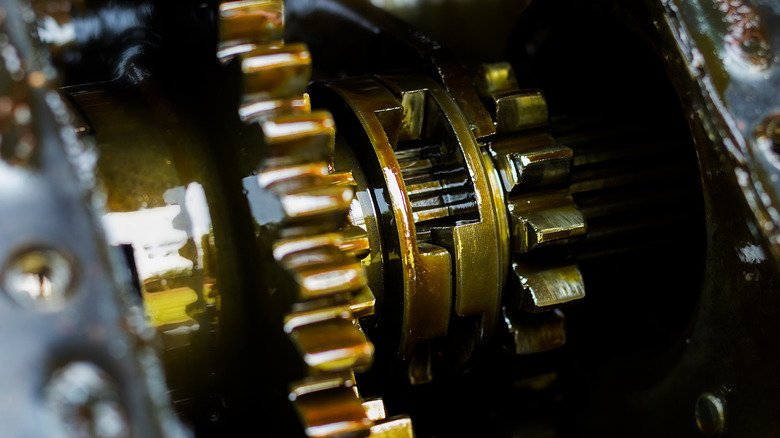
It's easy to dismiss oil as a liquid meant to keep machinery running smoothly. However, today's oils can be highly engineered for specific purposes, as becomes apparent when we consider the additives that make gear oil smell different from motor oil. These additives are meant for the conditions within a gearbox, which vary significantly from those in an engine.
One class of additives included in many gear-oil formulations is extreme-pressure (EP) additives. These protect components that operate under very high loads. To understand how these work, let's take a step back and look at how oils work. In simple terms, oils create a lubricating film that prevents two surfaces from directly rubbing. In certain gearboxes, however, the loads are high enough that this barrier collapses. This creates a condition known as boundary lubrication, a well-understood condition that typically occurs in high-pressure gear applications such as those with hypoid gears found in many vehicle differentials. This is one of the reasons why there are also differences between hypoid gear oil and regular gear oil.
Put simply, the sliding action and high working pressures of hypoid gear systems create an environment where EP additives are needed. Oils that are designed for extreme-pressure conditions are classified as GL-5 lubricants. These contain high levels of EP additives. The gear oil used in most manual transmission systems is classified as GL-4 and contains fewer EP additives.
How EP additives work
Boundary lubrication occurs when the lubricant layer no longer protects the metal surfaces in a gear system. In severe cases, the surfaces can essentially weld together. EP additives prevent this by maintaining a protective barrier between the surfaces. To understand how they do this, we need to get the microscope out and have a look at some molecular wizardry.
EP additives are polar molecules. Essentially, one side of the molecule is attracted to the metal, while the other side is attracted to the lubricant. Of course, this is an oversimplification, but it gives a basic demonstration of the theory behind how EP additives work. Many EP additives also need high temperatures to work. When friction increases, the temperature within the gear system also rises. This is what activates the EP additives. Once activated, the additives — typically sulfur, boron, chlorine, or phosphorus compounds – react with the metal surface and form iron sulfides, iron phosphides, or iron chlorides.
These create the thin lubricant layer that coats the metal, reduces friction, and ultimately prevents rubbing, scoring, and gears from welding together. Non-temperature-dependent EP additives also exist, which don't require elevated temperatures to function. All this is why you need GL-5 gear oil for high-load situations where extra protection from extreme operating pressures is the order of the day.