

Why Are 6-Cylinder Motorcycles So Rare?

When it comes to major motorcycle engines, six-cylinder setups are capable of delivering an impressive amount of power and smooth operation. However, the added cylinders also make these engines wider, heavier, and more complex. As a result, six-cylinder motorcycles just aren't as common as those with other engine configurations. This has actually been the case for years, and was even true all the way back with the 1978 Honda CBX.
This model of the CBX had a six-cylinder engine and the only way to make that design work was to rearrange several engine components; its chassis even had to be built around the engine's dimensions. This meant that while the CBX's six-cylinder made for both a strong and smooth ride, its weight and size could make it harder to operate. In fact, when Honda developed its 2002 RC211V MotoGP racing bike, a six-cylinder engine was ruled out because of its added weight, which could also cause greater tire wear.
The same issues continued to be problematic for other manufacturers in the decades that followed, notably with the BMW K 1600. When the company designed the bike in 2010, the inline-six had to be much narrower than previously produced six-cylinder motorcycle engines; earlier engine designs were either too long or too wide, which created problems with weight distribution, the physical size of the chassis, and the center of gravity. So, while BMW overcame these challenges, the difficulty of making six-cylinder motorcycles work properly remains.
6-cylinder vs 4-cylinder motorcycles
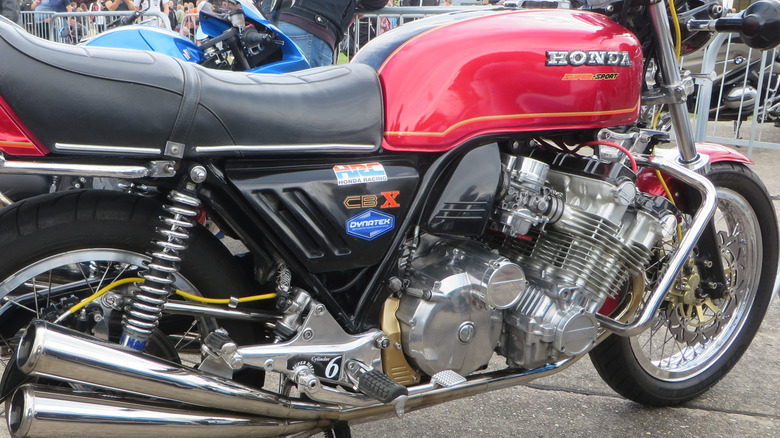
Despite their challenges, six-cylinder engines are still being used in modern motorcycles. Honda, for example, continues to utilize a six-cylinder engine in the Gold Wing, while Kawasaki and Banelli have also used six-cylinder engines in motorcycles such as the Z1300 and 750 Sei, respectively. The overall appeal of the six-cylinder engine isn't just about performance, but also about the smoothness and flexibility of the ride itself.
But while adding two more cylinders can improve smoothness and power, it perhaps isn't enough to persuade some buyers to choose a six-cylinder engine over an inline-four engine. That's because a four-cylinder engine is already capable of delivering plenty of power, while also remaining less complex and more lightweight. This also means that the benefits of having a six-cylinder don't always outweigh the negatives, which could make this engine type a less ideal choice, depending on the situation.
Six-cylinder motorcycles may also be less appealing because of their retail price. The added complexity and manufacturing costs of a six-cylinder engine can lead to a higher price, which may be a deal-breaker for some riders. Additionally, these bikes are often aimed toward the more expensive end of the motorcycle market. This could make it harder for manufacturers to justify using a six-cylinder when a less expensive four-cylinder can deliver performance at a lower price.