

Ryobi Made A Gas-Powered Sawzall In The '90s – Now It's A Collectible
We may receive a commission on purchases made from links.
More than three decades ago, cordless battery-powered tools weren't as useful as they are today. In the 1990s, nickel-cadmium batteries powered tools and they weren't as powerful and didn't last as long as lithium-ion, which wouldn't be introduced until after the year 2000. This meant certain tools at the time didn't have a cordless option, and when the first battery powered versions did come to market, they could barely complete certain tasks.
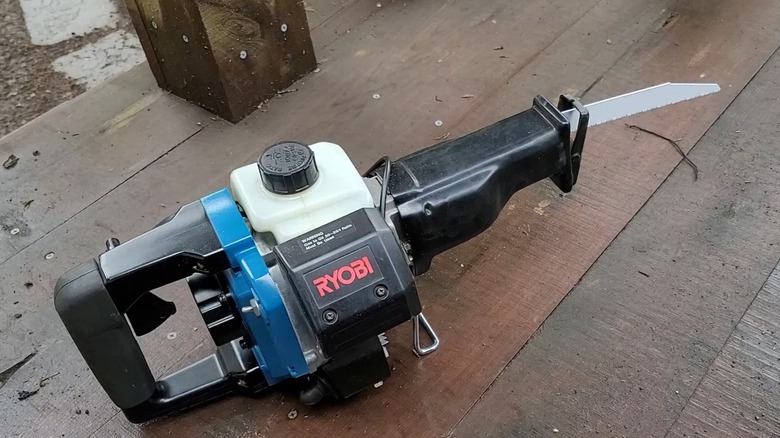
This forced some professionals to rely on long runs of extension cord to use more powerful options. One tool you don't want short on power is the reciprocating saw, or Sawzall, which features a sawtooth blade that extends outward and quickly moves back and forth when engaged. With its narrow blade more like a manual hand saw, this power tool can get in and cut places other tools can't reach. Ryobi came up with a cordless solution before they pivoted into battery power: a two-stroke, gasoline-powered Sawzall that offered strong performance without the ridiculously long extension cord. While an effective tool, you're unlikely to see one today as an auction item up for bid.
Why did Ryobi stop making their gas-powered Sawzall?
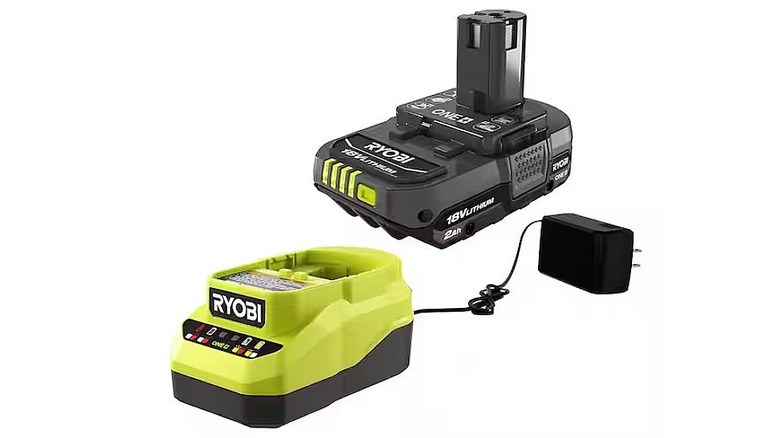
Back in the mid-1990s, tool manufacturer Ryobi began shifting toward battery powered products. With the launch of their first cordless drill in 1996, the company has never looked back, diving into lithium-ion batteries in the early 2000s. Although, believe it or not, there are still some gas-powered Ryobi products available today. Over the last few decades, Ryobi has expanded its cordless battery-powered products, with the ONE+ 18V line offering more than 300 different tools at this point. The company even makes large electric lawn equipment, with riding lawn mowers running off of 80 and 48 Volt batteries.
Why did the company shift to electric? According to exclusive partner Home Depot, the lime-green-colored brand is committed to sustainability. Ryobi seeks to reduce the excess noise and emissions emanating from traditional gas-powered equipment, and has leaned heavily into rechargeable battery technology. And one thing their gas-powered Sawzall wasn't was quiet. Sounding similar to a gas-powered weed whacker, which can register between 90 and 110 decibels, Ryobi's old saw tool would certainly not go unnoticed amidst a quiet neighborhood setting.
Powerful battery-powered reciprocating saws that can safely be used indoors
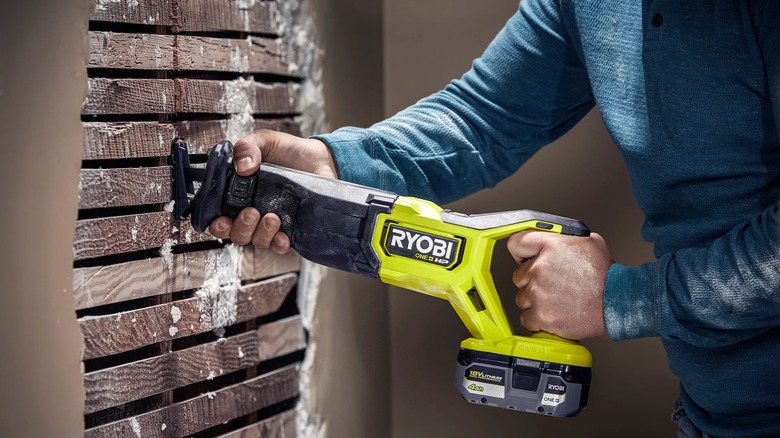
While you may never get your hands on a gas-powered Ryobi Sawzall, the brand offers plenty of battery-powered alternatives. In the ONE+ 18V product line, you can find a full-size high-performance model for about $116, a standard unit for about $89, or more compact alternatives like the one-handed model listed for just under $60. The high-performance version, for example, offers a back-and-forth cutting stroke of 1 1/4 inches and performs 3,200 strokes per minute. It can handle up to 380 cuts on a single charge, making it suitable for of a variety of projects.
In addition to being robust enough for many construction tasks, the battery-powered reciprocating saw from Ryobi can also be safely used indoors. While the gas-powered Sawzall offered cord-free power, it also pumped out toxins as it operated, making it suitable only for outdoor use unless you risk carbon monoxide poisoning. It's not just this old Ryobi gas-powered saw that posed a danger in enclosed spaces; there are a host of other power tools you should never try to use indoors.