

How To Steer Your Zero-Turn Mower & Make Turns Without Destroying Your Lawn
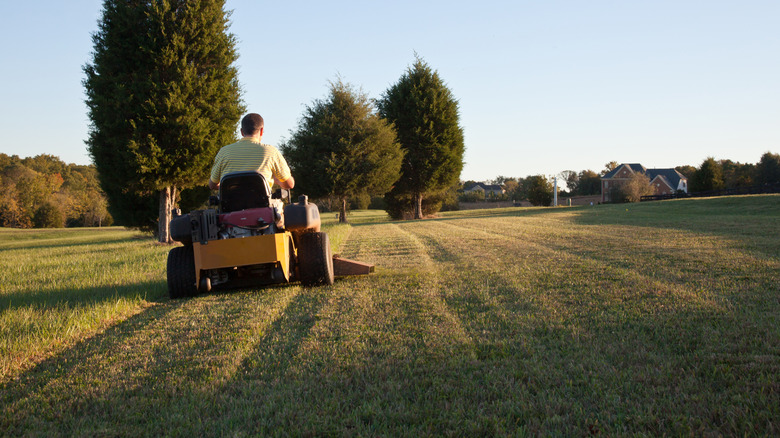
There are many differences between a riding mower and a zero-turn mower. One of the most significant, is of course, how each machine handles turning. Rather than a steering wheel, a zero-turn mower typically utilizes two levers, each independently controlling one of the rear wheels through separate hydrostatic transmissions.
The major advantage of a zero-turn is the enhanced maneuverability the design offers you, as they allow the operator to turn much more sharply after completing a pass. However, if you're not careful, every time you complete a pass and turn around in a zero-turn mower, you'll be leaving large divots or damaged sections of grass caused by the inside wheel as it turns.
These aren't exactly lightweight machines, as even cheaper introductory zero-turn mowers like the Murray Cruz with a 42-inch deck, tips the scale at 500 pounds. That means that anytime you make a sharp swing to head back across the lawn for another pass, the mower's hefty wheel can twist the turf as you turn. To prevent tearing up your grass, this is definitely something you'll want to stop doing if you have a riding mower. The good news is, there is a way to ensure both wheels are always moving and avoid this: namely, a three-point turn, sometimes also referred to as a K-turn.
Use three-point turns to stop tearing up your grass
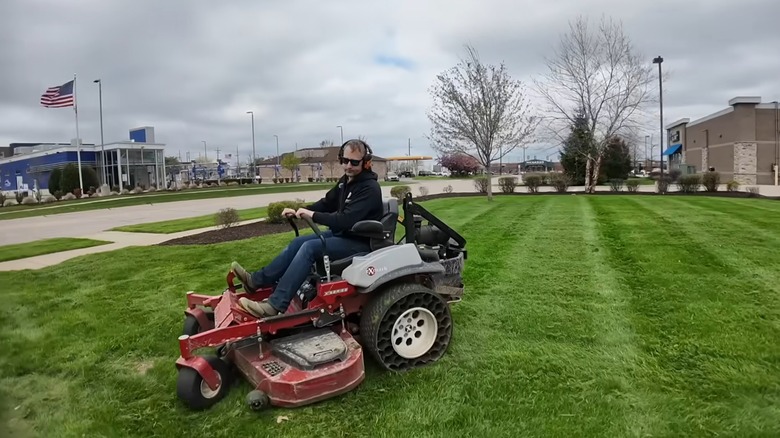
If you want those nice straight passes running back and forth across your grass without ripping up turf at every row's end, you need to employ a three-point turn. What does this look like? Imagine if you were driving your car on a two-lane or narrow road and needed to turn around but didn't have the space to make a full loop. You would first turn left, pulling the vehicle to the roads edge on the opposite side. Then you would reverse, turning the wheel right until the rear of the car was at the other shoulder. Finally, you would turn left again, moving forward and continuing on in the opposite direction you were originally traveling. It's the same series of maneuvers for a zero-turn mower as you reach the end of your pass.
A three-point turn on a zero-turn mower ensures both wheels are moving and the inside tire isn't pivoting in place. This can be especially crucial if conditions have left the turf moist, as soggy soil can lead to worse outcomes. This is one of those hard lessons many new zero-turn operators must learn. Just because the machine is capable of tighter 180-degree turns, doesn't mean you should employ them. While you can save time by pivoting on your inside wheel to turn around after every pass, a little patience and the three-point turn method will garner much better results.