

What Are Chainsaw Chaps Made Of And Who Needs To Wear Them?
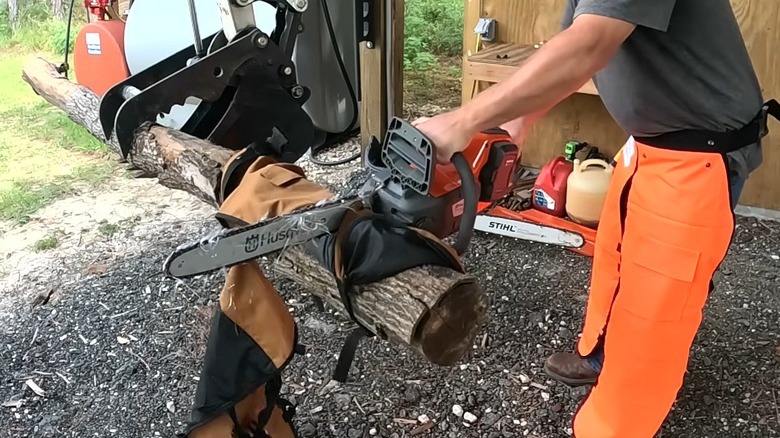
We may receive a commission on purchases made from links.
As handy as a chainsaw is, there is no denying it's a dangerous piece of equipment. This is especially true for those wielding the most powerful modern chainsaw ever made. According to Safe At Work California, around 30,000 people annually will be treated by emergency services in hospitals due to chainsaw accidents, with most of the injuries presenting on the left leg and left hand. Fortunately, in an effort to curb injuries, today's chainsaws have more advanced safety features like protective handguards that engage the chain brake mechanism. One of the cool features on some Stihl power tools is the Quickstop technology built into certain chainsaw models that uses inertia to detect kickback.
But professionals in the lumber industry must go even further with required personal protective equipment (PPE). For example, according to 1910.266(d)(1)(iv) under OSHA's logging operations regulations, an employer must provide leg protection for chainsaw operators and make sure they're worn. This can come in the form of chainsaw chaps and chainsaw pants, which are made from material that's difficult to cut, like ballistic nylon.
These chaps are constructed with multiple layers and provide cut-resistant, not cut-proof, protection. The inner layer includes strands of robust material like Kevlar or specially blended forms of polyester that clog up the saw's drive socket, the part that transfers energy from the engine to the chain. This stops the chain from moving, preventing more severe injuries from occurring.
Chainsaw chap's vs. chainsaw pants
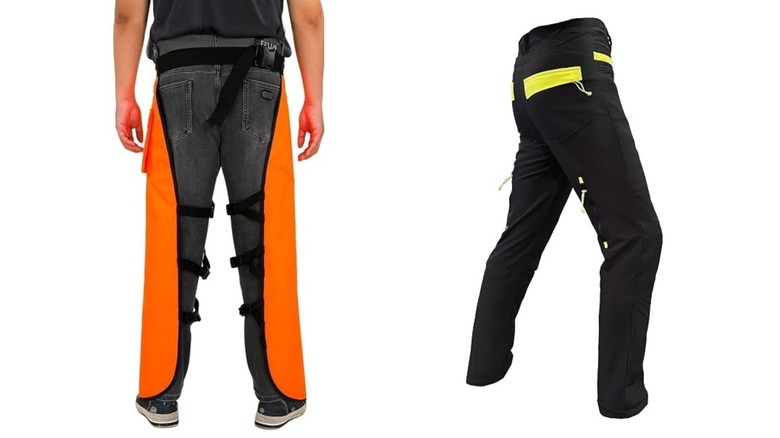
Both chainsaw chaps and chainsaw pants provide additional protection for operators, but each have their own advantages and disadvantages. Chaps are worn over clothing, using adjustable straps that buckle together to remain in place. These provide coverage over the front of the legs from the waist down, and in some cases, also protect the calves, wrapping completely around the lower legs. Chaps are more budget-friendly than chainsaw pants and can be shared between crew members. The open back design also permits some airflow in hot temperatures. However, they can easily get snagged on branches, which is why they aren't good if your task requires climbing.
Chainsaw pants are worn in place of standard clothing and are washing-machine safe like a normal pair of trousers. Similar to buying jeans, the size is important for a good fit, which means they're typically more comfortable than chaps. Because they wrap completely around the waist and legs, there is a greater level of protection against all manner of cutting angles. Chainsaw pants also won't get hung up as much when climbing. But they can't be removed like chaps, which may not be a bad thing. Brandon Nance, Sherrill, Inc. manager of marketing and ecommerce, told TCI Magazine, "It's too easy when it's the end of the day to take off your chaps and leave them in the truck, and then you don't go back for them when you need to make that last quick cut. That's when accidents happen."
What's the difference between Class A and Class B chainsaw chaps?
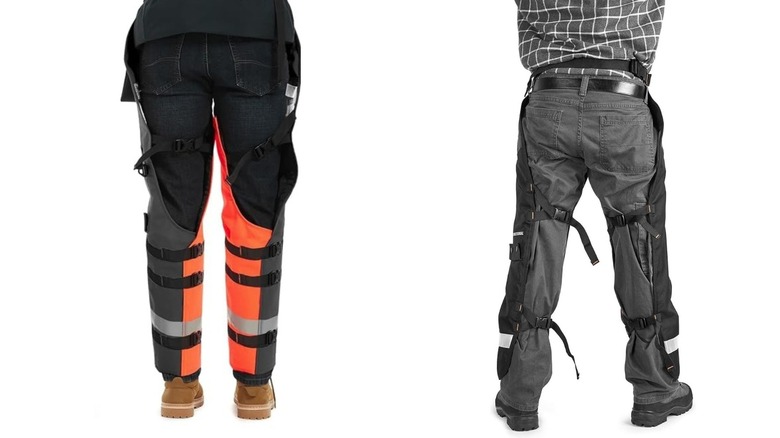
Either class of protective chaps provides a defense against the business end of the cutting tool, but only once, as they aren't good for continued protection after making contact with a chainsaw. Class A covers more of the legs than class B and is only open from the waist to just below the knee in the rear. Both provide coverage in the front from belt buckle to boot, but only class A adds a section that wraps around the calves. Class B is essentially completely open in the back, exposing the backside of the legs to potential injury.
Lower leg coverage becomes important during certain types of cuts, which must be performed at an unusual angle. This presents in scenarios like breaking down a fallen tree, which requires the cutting to be performed lower, near the ground. Many professionals, such as arborists, opt for the greater coverage of class A chaps for this very reason. However, a homeowner performing some routine tree trimming with a cordless mini-chainsaw probably doesn't need the additional protection of class A chaps.