

Why Did Some WWII Bombers Have Glass Nose Cones?
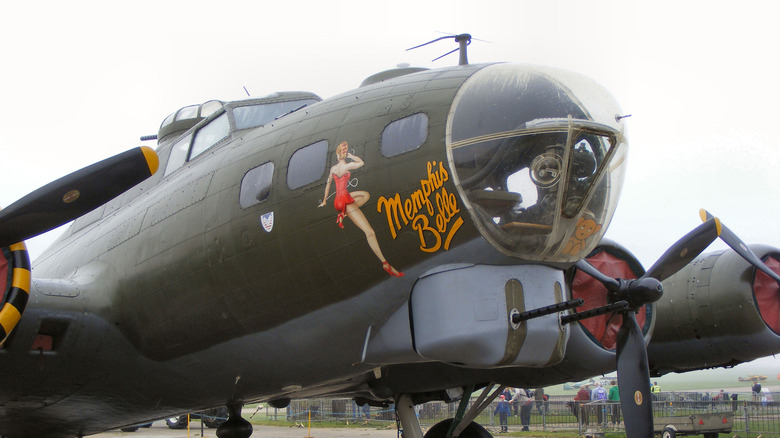
During the Second World War, the United States built over 30,000 four-engine B-17s and B-24s. Another 3,970 B-29 Superfortresses were constructed as well, the type that dropped the atomic bombs on Hiroshima and Nagasaki. Although the B-17, the bomber that helped win WWII, was the smallest of the three, it was known as "the flying fortress" because it could take the most punishment. A single B-17 was built every six hours at the Douglas Aircraft Company in Long Beach, California. Meanwhile, the B-24 Liberator — with 1.5 million parts (an average Ford had a mere 15,000) — rolled off the line every 63 minutes.
The bomber's key role was, well, to drop bombs. Bombardiers were tasked with manually — and by manually, we mean visually (more on that later) — aiming their ordnance using a top-secret device known as a Norden M-9 Bombsight. There weren't precision-guided munitions that used onboard computers capable of calculating trajectories or smart bombs that could steer themselves with articulating fins to home in on a target. Aviators were dropping what amounted to "dumb" bombs using only their Mark I eyeballs — totally by sight. To do so, however, they needed to see the target they were trying to hit physically. This led to the prevalence of glass nose cones.
Yet traditional silica-based glass would shatter if used in these new modern bombers. DuPont invented Lucite, a tough acrylic plastic, in 1931, and German chemist Otto Röhm came up with Plexiglas in 1933. Both were widely used by Allied and Axis powers during WWII instead of glass for things like windows, plane canopies, ball turrets, and nose cones because they weighed less and were bullet-resistant.
Bombs away!
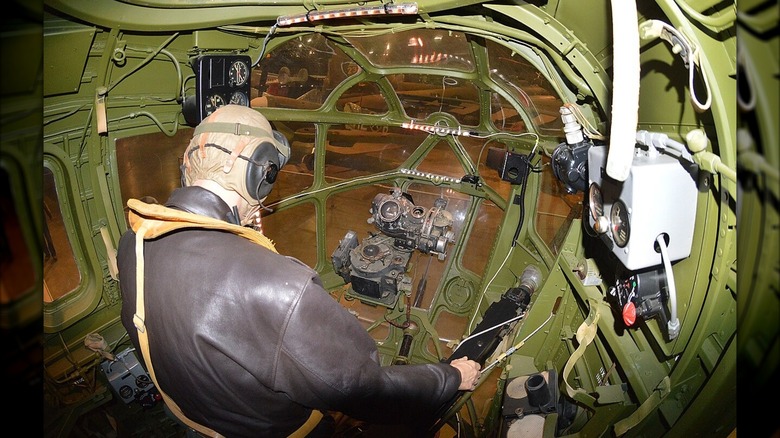
Often called glazed glass noses, these see-through domes were part and parcel of most iconic WWII bombers, including the B-17, B-24, and B-29. The Germans used them on the Heinkel He 111, Junkers Ju 88, and the prototype Amerikabomber Messerschmitt Me 264. The British also equipped their Avro Lancaster and Handley Page Halifax with them. Even after the war, some U.S. planes like the B-47 Stratojet and Douglas A-3 Skywarrior continued to use them, as did Britain (i.e., the Blackburn Beverley and Armstrong Whitworth Argosky). The Russians kept utilizing them mainly because they lagged behind both technologically and philosophically.
Keep in mind that WWII was greatly shaped by technological innovation and is considered the most industry-driven war in history, much of which is quaintly archaic by today's standards. Bombers in World War I were nothing more than wood-and-fabric biplanes that either used very basic mechanical levers, primitive drift sights, or someone simply reached out and dropped bombs over the open sides — all of which amounted to nothing more than blind guesswork.
However, the Norden M-9 Bombsight was an exponential leap because it was something else entirely. Developed by Carl Norden for the U.S. Navy, it was first used by the Army Air Corps in 1932 and supplanted the inferior Sperry S-1 bombsight. A trained bombardier entered wind direction, airspeed, and altitude into the analog computer, which then took into account wind drift and spit out the optimal target location. Stability was provided to the telescopic sight (used in high-altitude runs) by a built-in gyroscope. It might sound like the ancient Greek Antikythera mechanism, but by WWI standards, it gave bombardiers extraordinary precision.