

5 Electric Vehicles That Can Leave Sports Cars In The Dust
It might be hard for some of us who grew up loving the smells, the shrieks, and the technology behind the most accomplished ICE sports cars to accept it, but the batteries and motors in electric vehicles are becoming increasingly powerful. There are some things that EV haters still get wrong about electric cars, and there's one truth that no detractor can deny: electric vehicles, by their very nature, have the potential to outperform comparable ICE vehicles in some important areas.
The reason that EVs are broadly quicker off the mark, in terms of the 0-60 times they can achieve, than their gas counterparts is that they deliver their maximum torque from a standstill. A gas engine cannot do that, so the 0-60 of a model with comparable specs is widely going to be quicker.
Where conventional gas vehicles tend to make up the difference is in sustained top speed over time, which just means that, overall, both types of vehicles are capable of remarkable things. What we'll see today, though, is some of the most capable electric vehicles ever made. Though the models on the list may not have the quickest 0-60 speeds, and they may not beat every gas sports car in that regard, they can leave a wide range of them in the dust.
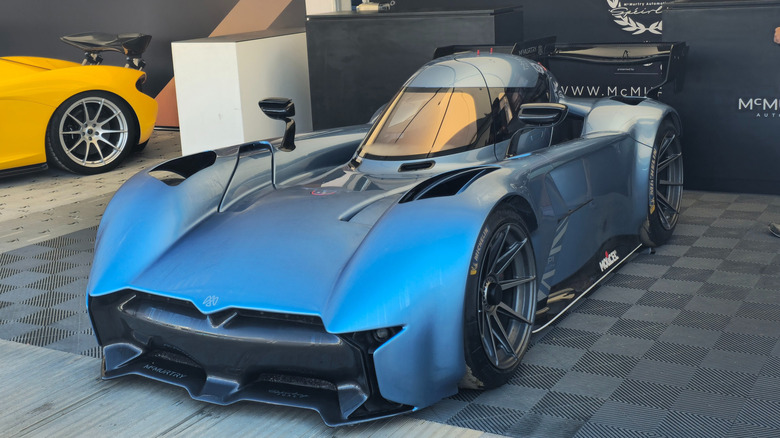
McMurtry Spéirling
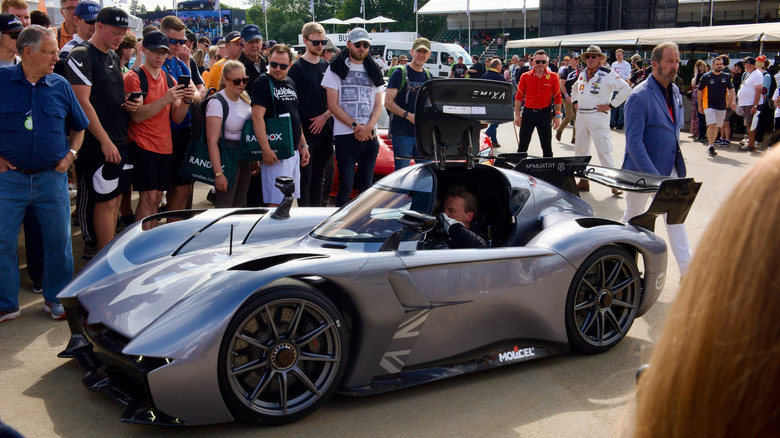
If you're a gas or diesel driver who questions the potential capacities of these electric models, just one statistic is all you need to know to make you think twice: McMurtry's Spéirling can go from 0-60 mph in a ludicrous 1.40 seconds. These aren't just ambitious estimates from startup McMurtry, either, but figures independently recorded by Carwow. Reporting the news, McMurtry boasted that "This makes it the fastest accelerating car they have ever tested, surpassing some of the World's greatest cars: the Bugatti Chiron, an F1 car and the Rimac Nevera." Esteemed company indeed.
The car achieved this feat, unsurprisingly, in the most optimal conditions. The marvelous Hangar straight at Silverstone was the scene of the success, and the surface had been treated mechanically to ensure that external factors wouldn't hamper the efforts of the bold driver, Carwow's own Mat Watson. Other incredible times, also independently verified by GPS that day, include a quarter-mile in just under eight seconds (7.97) and a 0-100 mph in 2.63 seconds.
The McMurtry Spéirling weighs less than 1,000 kilos, making it deceptively lightweight. Nonetheless, it packs 1,000 bhp, all of which ultimately plays a huge part in what it's capable of. But how does it fare outside of its extraordinary acceleration? After all, that's just one facet of a car's performance. McMurtry also states that the Spéirling has a top speed of 190 mph, coupled with formidable 3G cornering. The makers of another remarkable model, the NIO EP9, explain what a powerful force the latter is: "Cornering at 3G exerts three times the force of Earth's gravity onto EP9 and its passengers – something only typically experienced by F-22 fighter pilots."
Pininfarina Battista
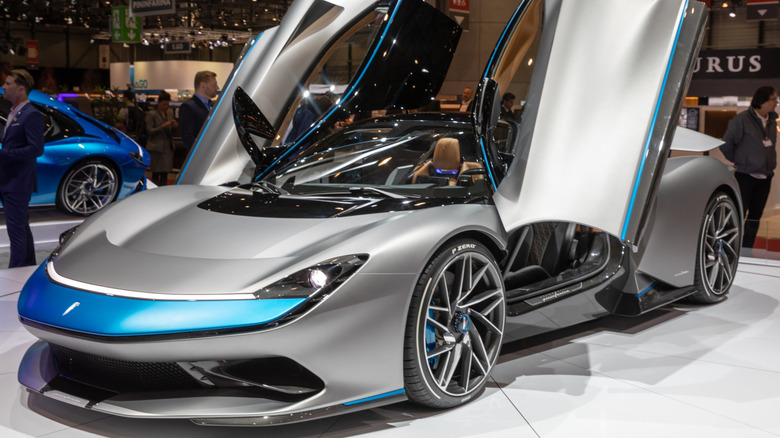
A product of Automobili Pininfarina GmbH, this car was born from the brand's aim to create "an ultra-low volume zero-emissions luxury hypercar," as it described the machine in a 2018 press release, with some truly remarkable specs planned for when its production began in 2020. The targets for the finished vehicle included a wild top speed of 250 mph, a range of about 310 miles, and a 0-62 mph time under two seconds. Again, these were not just fanciful figures, as the specs of the finished Pininfarina Battista would attest.
Automobili Pininfarina sees no need for modesty, calling it "the most powerful Italian sports car ever." To live up to the specs the manufacturer originally promised, the team implemented a scheme in which each wheel has a separate motor, with a hefty 120kWh battery powering the whole system. All that ambition produced extremely impressive results, with the model's final specs speaking for themselves: a 0-62 of 1.86 seconds, a 0-124 mph of 4.75 seconds, and a maximum output of 1,900 horsepower.
Of course, no vehicle will perform at the absolute peak of its potential all the time, or even anywhere close, but extreme high performance doesn't necessarily mean an EV can't last very long as a result. In fact, Automobili Pininfarina adds that the Battista has a range as high as 300 miles in its standard configuration, which means there's still more to be coaxed out of it. It's one of the hypercars with some of the most outrageous horsepower on the market.
Lucid Air Sapphire
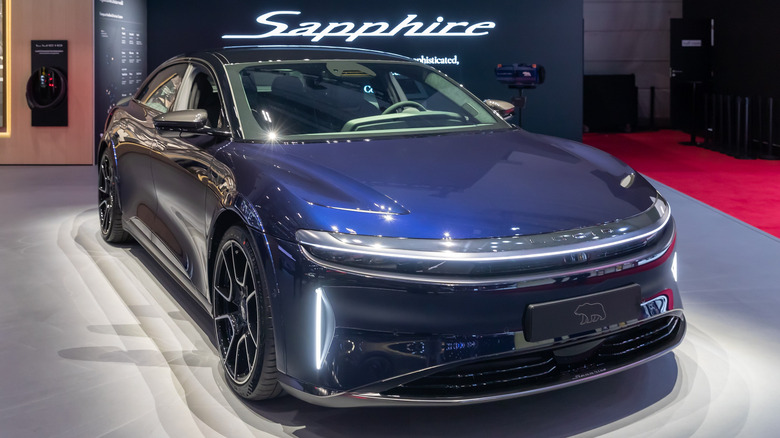
The Lucid Air Sapphire has a projected range of up to 427 miles, a top speed of 205 mph, and a 0-60 mph time of 1.89 seconds. That range alone is something only the very top tier of gas models can match, and it sits around the level other electric powerhouses can achieve. With the Air Sapphire, it's the reality of the experience that really hits home. It's truly impressive that all this potential is packed into a four-door sedan.
The Sapphire is the product of a team that clearly knew how to adapt an existing platform into a true electric powerhouse. The original Lucid Air began deliveries in October 2021 and immediately defined itself as a force to be reckoned with in the EV field. Lucid declared at the time that the "limited-run Dream Edition features a 118kWh battery pack and delivers up to 1,111 horsepower or 520 miles of range," which is truly extraordinary range and power for an EV. This version of the Air, impressive as the Dream Edition was, still had some limitations compared with the later powerhouse that is the Sapphire. In terms of its acceleration, anyway.
The Dream Edition had a reported 0-60 mph time of 2.42 seconds, and the brand goes on, "and a quarter-mile time of 9.67 seconds (with the 21" wheels and tire package)." While that is enough to smoke a wide variety of sports cars, it wasn't the platform's greatest potential for performance. The Lucid Air Sapphire is a difficult EV to top, to put it mildly, which is reflected in our review of the vehicle.
Hyundai Ioniq 6 N
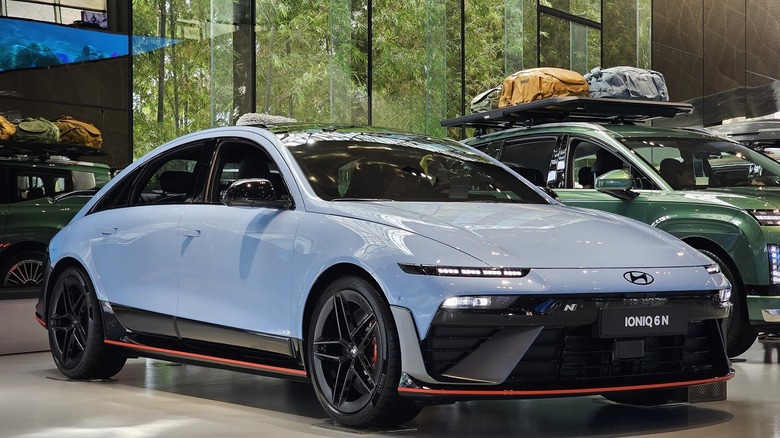
There are some who can tell a specific ICE sports car from the engine roar alone, but you don't even need that talent to be overawed by the sheer sound of some of the world's most powerful vehicle engines in action. Though the most powerful EVs absolutely look the part compared to conventional sports car powerhouses, this is one area where their muted operation lets them down a little when it comes to theatrics. The Hyundai Ioniq 6 N, like many EVs, boasts simulated engine sounds, as though to underscore to all who see it that it's a monster of a vehicle in its own right.
A quick glance at its specs is enough to convince anyone. Its 84.0kWh battery offers a top speed of 160 mph and a 0-60 mph time of 3.2 seconds, plus an N battery capacity that can be set to different performance modes (such as Endurance and Sprint) and adapt battery use to optimize for each case. It's not just about hitting these impressive numbers, though, but about maximizing the model's performance in the process.
A considerable step up from its predecessor, the Ioniq 5 N, it also boasts some other interesting features. N Active Sound+ is a standout: the brand's way of emulating the sounds of a gas vehicle through a system of speakers throughout the vehicle. This feature makes it clear that EVs, from high-performance to everyday models, are trying to broaden their appeal by attracting more drivers. Conventional engines and EVs work differently, but they also share a lot in common, and that should be leveraged.
Lotus Emeya R
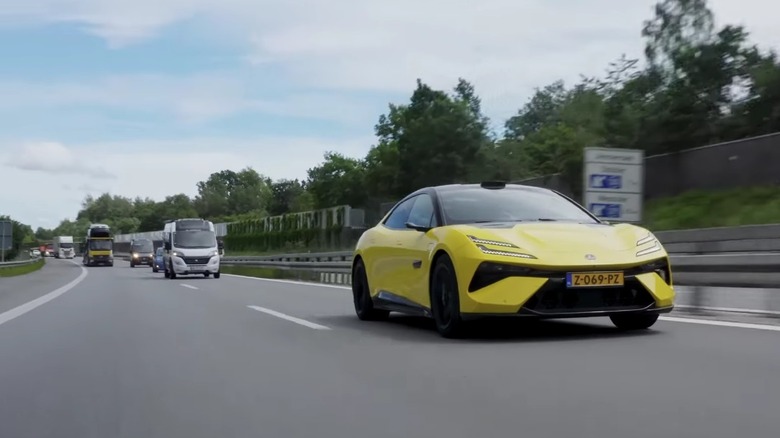
While the standard Emeya is a step up from other Lotus EV efforts, the model still had more to offer. This is why the very special R model was added to the family. With this version of the vehicle, Lotus aims to build on its announced ethos: "Their performance specifications only bolster the idea that every new Lotus in NYC is about more than just 0-60 mph times and top-speed stats. These are cars intent on making driving an art form." The Emeya has 905 horsepower, a 0-62 mph time of 2.78 seconds, and a top speed of 159 mph. The Emeya R hits up to 918 horsepower.
Top Gear notes that the Emeya costs up to approximately £146,740 (almost $200,000). Of course, that may be well beyond the average enthusiast's vehicle budget. The Emeya family shares a 102kWh battery that powers it to these numbers, comparable to those of other models in Lotus' EV lineup. The Emeya R, in particular, is the standout model in the line, and its capabilities speak for themselves.
The battery has an extremely fast 402kW charging rate. Actually hitting this number is dependent on the charging infrastructure being available to support it, of course, but this is another quality that will help to allay the worries of those who still aren't quite on board with the cause of EVs because of range anxiety. It's designed to be a high-performance, comfortable model, with a painstakingly designed interior to ensure it's, first and foremost, a comfortable ride. It's complete with, among other things, ambient lighting for occupants, Alcantara/leather finishes, display options including a convenient secondary HUD as required, and a sophisticated sound system.