

6 Downsides Of Driving A Compact Car
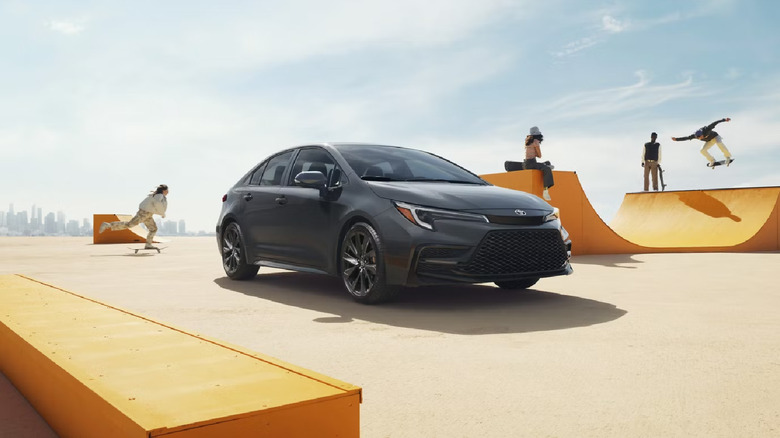
The consensus in the industry is that a compact car is the auto version of eating your vegetables — it might be good for you, but absolutely no one actually wants one. And, on paper, the compact car definitely makes a lot of sense; these vehicles are cheap to run, easy to park, and kinder to the planet, since the car sips fuel where bigger vehicles (like trucks) gulp. That's to say nothing of the other day-to-day problems with compact cars, like not being as comfortable on dirt tracks, not being able to go offroad, or not having as much when it comes to towing capacity.
Perhaps that is why, especially in recent years, more and more buyers are opting for the SUV or crossover in lieu of the sedan, let alone the compact car. We're not here to argue the merits and demerits of the SUV-fication, as we like to call it. For instance, Ford's only model that's not an SUV or a truck is the Mustang. Likewise, Mitsubishi has only sells one car in the U.S., and Lincoln and Buick are SUV-only brands. That aside, perhaps the reason that SUVs are becoming the default choice for most buyers is that driving a compact car comes with some mostly- unavoidable downsides — here are six of them.
You have less protection in a crash
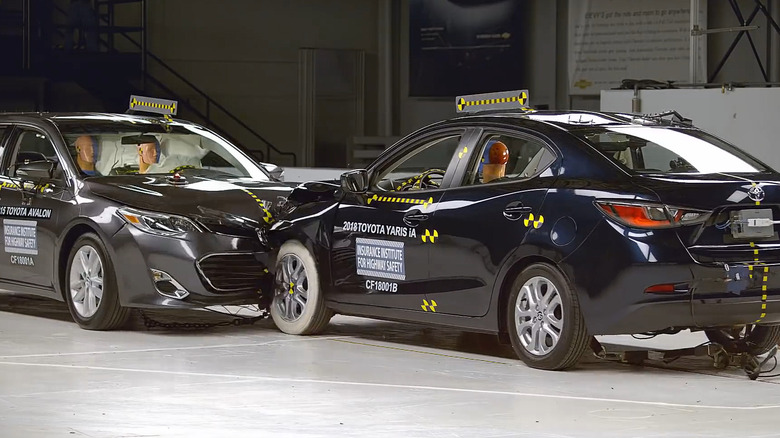
The first big issue that we run into with a compact car is the question of safety. To put things bluntly, you are safer in a larger vehicle on the roads than in a smaller one. Even if the small compact car has good crash ratings, it will be poorer off in an accident with a larger vehicle. In 2019, the IIHS pitted a Toyota Yaris IA (good safety rating across the board from the IIHS, with one marginal and one poor score) and a Kia Forte (good safety ratings, with two poor aspects and one average score) against a Kia Sorento; in the test, the smaller vehicles took the brunt of the impact.
For families, or parents, or people who are otherwise safety conscious, this is a major aspect that needs to be considered. While driver fatalities in crashes have gone down over the years — a trend that points to better safety tech and equipment — it's also very obvious that fatalities are higher in smaller vehicles according to IIHS data. This is not to say that compact — read: smaller — cars are unsafe, but that, in a crash, the larger vehicle is usually safer. Given the statistics, if you drive a compact car, you are numerically likely to be the smaller vehicle on the road — given that of the 25 bestselling vehicles in America in 2025, 20 were either an SUV, crossover, or pickup truck — and one was a cargo van.
Adults may feel cramped in the back
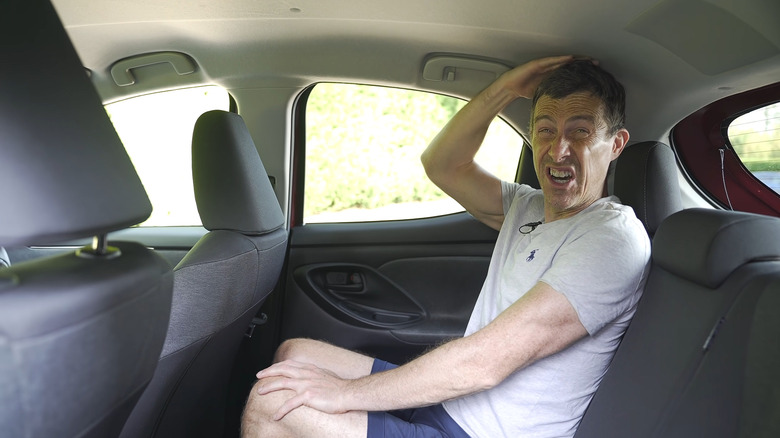
A compact car is, by definition, compact, meaning that it is much smaller than other vehicles on the road. As such, even average-sized adults may find that the rear seats are lacking in the roominess department. Let's look at a couple popular compact car models to see how they fare in this regard — for the record, the U.S. The Environmental Protection Agency (EPA) defines compact cars as those having between 100 and 109 cubic feet of interior passenger space. The now-discontinued Honda Civic coupe came with just 35.9 inches of second row legroom, coupled with a rather cramped 34.6 inches of rear headroom.
The ever popular Toyota Corolla — of which Toyota sold 248,088 units in 2025 — has the same rear headroom, but a marginally poorer 34.8 inches of legroom for second-row occupants. This is not to say that these numbers are unmanageable; still, you wouldn't want to take a long road trip in certain compact car models. However, certain compact cars can have a workable amount of rear space for adults, such as the current-generation Honda Civic sedan, which is still in production. It has 37.4 inches of rear legroom and 37.1 inches of rear headroom. This is why, on many of the internet's tall-people-friendly car lists — including our own guide on the matter — compact cars barely feature, and when one does, it is almost always a compact crossover.
Depending on body style, cargo space might be an issue
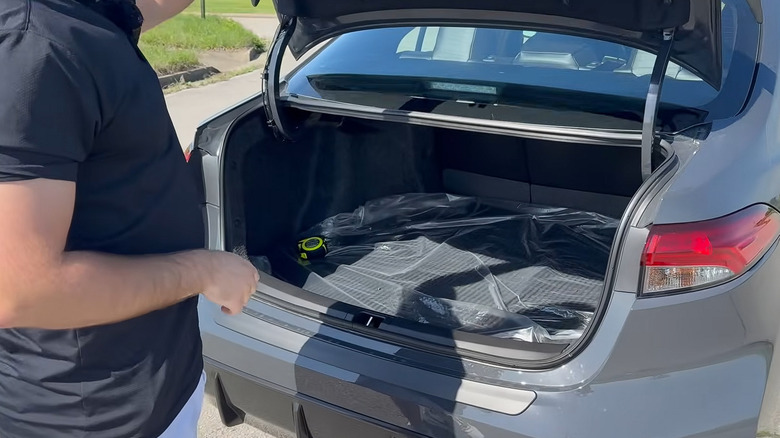
Among the key areas where compact cars fall flat is cargo volume, with many of these vehicles having tiny spaces not good for much more than a weekly grocery haul. Again, looking at some of America's most popular compact cars paints a pretty poor picture. The 2026 Honda Civic sedan is barely usable, coming in at 14.8 cubic feet in total, while its main competitor (according to us), the Toyota Corolla, comes in at an even smaller 13.1 cubic feet. In fact, if we look at America's best-selling car the RAV4 as a baseline, only four compact cars manage to beat it out.
The best-selling Toyota RAV4 has about 38 cubic feet of cargo space, and only four cars — the Mini Cooper four-door hardtop, Hyundai Veloster, Volkswagen Golf, and Mitsubishi Mirage — manage to best that figure, according to data from iSeeCars. Admittedly, the Mitsubishi Mirage is the most impressive, somehow managing to get a cargo figure of 47 cubic feet, though the model has not been sold in the U.S. since 2024. Overall, buyers should understand that they are purchasing a small vehicle, so, in most cases, they'll get less cargo space than with larger cars.
Ingress, egress, and fitting child seats can be problematic
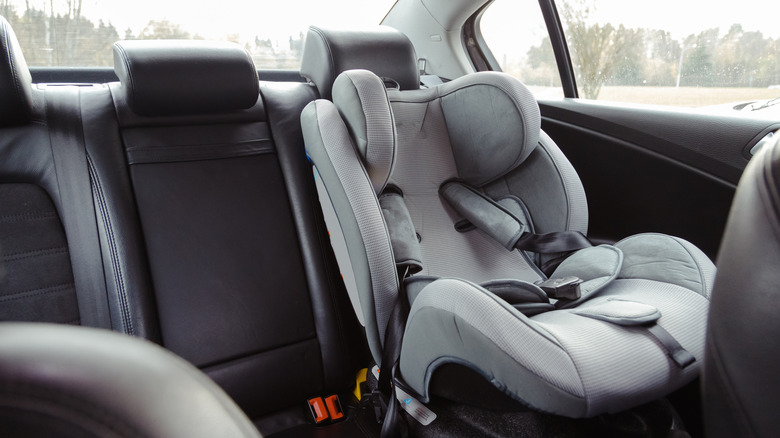
And forget about three child car safety seats fitting into the second row — modern compact cars rarely have the interior width to do so. In fact, we couldn't find a single example where three full-size car seats could be fitted in the back of a vehicle classified as "compact" by the U.S. EPA — if you know of any examples, let us know! The problem compounds when your children need different kinds of seating access arrangements — such as two children in car seats and one with a booster seat, for example. Naturally then, compact cars should be avoided for families with young children, especially if the vehicle is going to be your only conveyance.
With larger, full-size sedans, crossovers, and SUVs, the larger vehicle footprint and (in some cases) more rows and number of seats makes fitting car seats that much easier. Compact cars simply have fewer anchor points for car seats that use the standardized Lower Anchors and Tethers for Children (LATCH) mounting system. Furthermore, the low(er) vehicle height and limited interior space on compact cars can make the installation and removal of car seats that much more bothersome for parents who already have their hands full. And for people with mobility issues — particularly those of the hip, knee, or back — the low seat profile in this class can make daily use that much more demanding.
Engines in base models are often underpowered
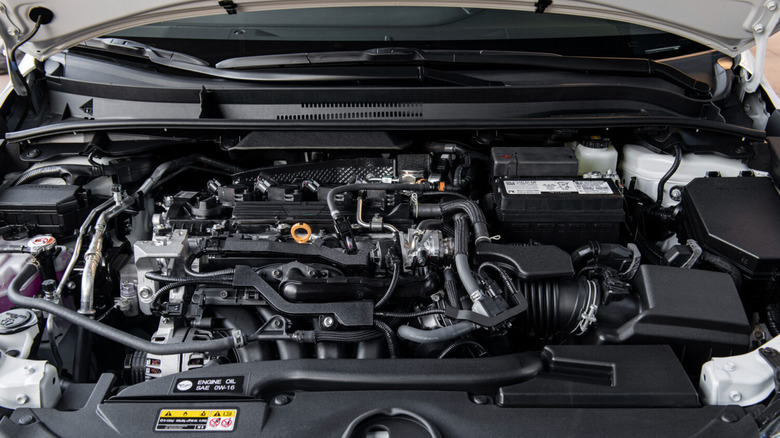
A standing tenet of compact cars is that the class of vehicle is usually (much) more economical than a larger one. This is to be expected — a smaller vehicle that's not as heavy consumes less fuel with all other variables being the same. However, to that end, compact cars often come with some of the smallest engines on the market — which often feel like the bare minimum. As a result, many of the compact cars on the market today, especially the base trims, can feel extremely underpowered while out and about. Day to day driving might be manageable, but many times, doing routine things like attempting to pass someone on the freeway might require some strategic thinking.
Personally, my area got flooded in March 2026 and I had to send my Toyota RAV4 for repairs, and the agency gave me a 1.6-liter Toyota Corolla as a loaner vehicle. While driving home from work, attempting to pass a Honda Odyssey doing 70 on the freeway in the third lane resulted in my rpms climbing to north of 3,000 — and I was already at 55 mph, mind you. It's not a major problem, but you certainly won't be able to ignore the engine power — or lack thereof — on compact cars. On a lighter note, this has been the case for decades now, basically since the compact car class has existed. No matter how far back you go, people will complain about the agonizing dearth of power in this class of vehicle — that's just how it is.
Highway noise can be (much) more noticeable

On smaller cars, road noise on the freeway (or at least at freeway speeds) can be much more noticeable than on other classes of car. This is to be expected; since compact cars are usually quite cheap, costs and corners will be cut on trivialities like cabin insulation, better-than-needed tires, and more. To that end, Loughborough University in the United Kingdom found, in a 2012 study, that compact cars were reported to have a high degree of tire road noise, and an average degree of interior cabin quietness.
Note that the study was based on user reports, and there have been many advancements to cabin insulation (and adjacent tech) since then, but the points stand. Just like with the safety-in-a-collision point we made, things have gotten better across the board, but the compact car segment is still bottom of the barrel when it comes to road noise infiltrating the cabin.