

The US Navy's Newest Torpedo Has A Serious Upgrade And Is Unlike Anything Used Before
Torpedoes have been around since the 1860s with the introduction of the Whitehead torpedo, and many more models followed in its footsteps. The United States Navy has used several since that time, and it currently operates the deadliest torpedo in the world. You'd think with that kind of firepower, the Navy wouldn't need to look for a new model. Like most militaries, however, the Navy has various torpedoes for different purposes.
Torpedoes can be deployed via numerous means, including being fired from a submarine, dropped by an aircraft, or fired by deck-mounted launch systems. Different deployment types shoot different ordnance, and the Navy is looking to develop the Silent Anvil Air-Launched Torpedo (SAA-LT), which aims to do something that no U.S.-made torpedo has done before. If the Navy gets what it's looking for from defense contractors, the SAA-LT will be air-drop deployable as high as 60,000 feet.
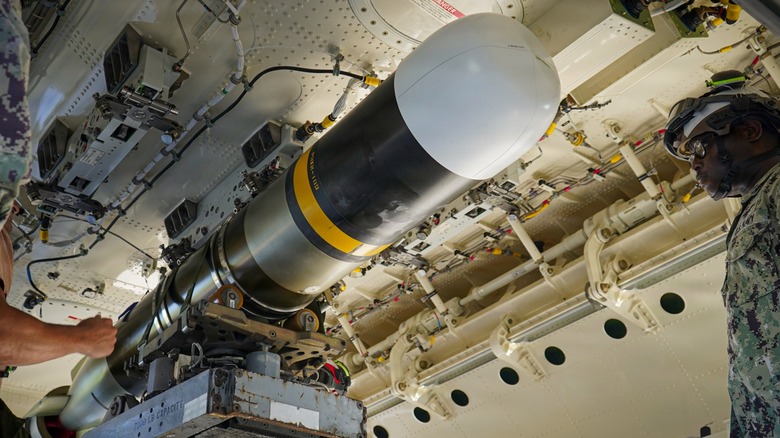
That's almost twice the altitude that commercial airlines fly at, and most fighter jets have a service ceiling of around 50,000 feet. To put it into further perspective, the High-Altitude Anti-Submarine Warfare Weapon Capability (HAAWC, pictured) has a maximum air-drop altitude of 30,000 feet, making the SAA-LT twice as capable as what came before it. While much smaller than an Mk. 48 torpedo, the SAA-LT will be able to be carried by numerous aircraft. If successfully produced, the SAA-LT would be a next-gen anti-submarine warfare weapon with unparalleled standoff capabilities.
The Silent Anvil Air-Launched Torpedo the Navy seeks
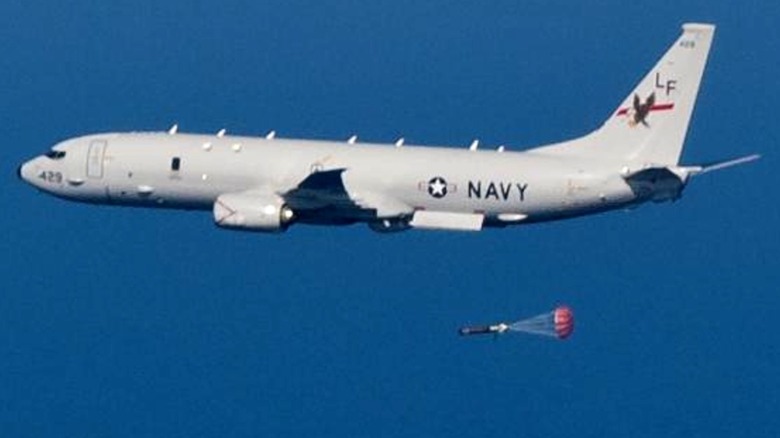
The Navy is exploring options for its next-gen air-dropped torpedo, including one that glides into the water to locate its target. Another is a glide kit that can be installed on an existing torpedo. The latter is how the HAAWC system currently works, as the weapon system is a Mk. 54 lightweight hybrid torpedo with a glide package installed. These can be dropped by a Navy P-8 Poseidon (pictured), but have the aforementioned altitude limit.
Whether the Navy upgrades an existing system to double its height capacity or adopts an entirely new one, the SAA-LT will be deployable from crewed and uncrewed aircraft capable of conducting anti-submarine warfare (ASW). This restricts what the torpedo can look like, as it will have a maximum weight of 268 lbs. and a diameter of no more than 7.5 inches. These restrictions are in place so that the SAA-LT can be deployed from aircraft that are already capable of dropping GBU-39 Small Diameter Bombs. Creating the SAA-LT in that image makes it deployable from a variety of aircraft.
To fit the Navy's desires, a torpedo with a glide kit would be able to enter the water at 45 to 90 degrees at a velocity of between 40 and 120 feet per second (or 27 to 82 mph). It must also be launchable at speeds of Mach 0.25, 0.5, and 0.85 (or 192, 384, and 652 mph, respectively). The Navy hopes production will result in 60 SAA-LTs delivered each year within the first 36 months of awarding the contract to whichever defense contractor it selects.