

What Does 'Service Ceiling' Mean On A Fighter Jet?
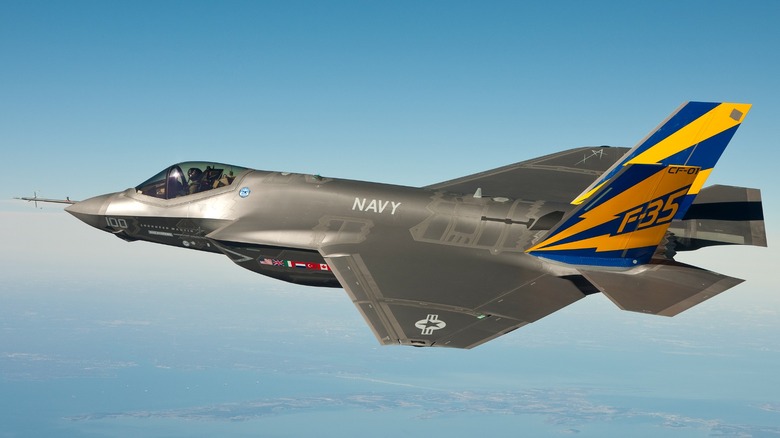
Fighter jets have been around since the Messerschmitt Me 262 flew for the German Luftwaffe at the tail end of World War II. In the years since then, these aircraft have improved significantly, with advancements in key areas such as speed, maneuverability, and lethality. Fighter jets are a key part of any air force's lethal capabilities, providing offensive and defensive support to deployed units, whether they're in the navy, army, or other services.
Like any military technology, there are tons of specifications and annotations that the general public doesn't know much about, and service ceiling is chief among them. To put it simply, a service ceiling is the maximum altitude at which an aircraft, such as a jet fighter, can still climb at a steady, minimum rate. Think of a service ceiling as being the limit at which an aircraft can safely operate, though it can technically climb a little higher. An absolute ceiling is a plane's true upper limit, and it usually isn't much higher than its service ceiling.
Military strategic bombers are some of the highest-flying military jets ever put into service, and, for the most part, fighter jets' service ceilings are usually much lower than bombers. Let's look at some fighter jets that stand out for their service ceilings, whether they're impressively high or remarkably low.
Examples of fighter jets with incredibly high or unusually low service ceilings
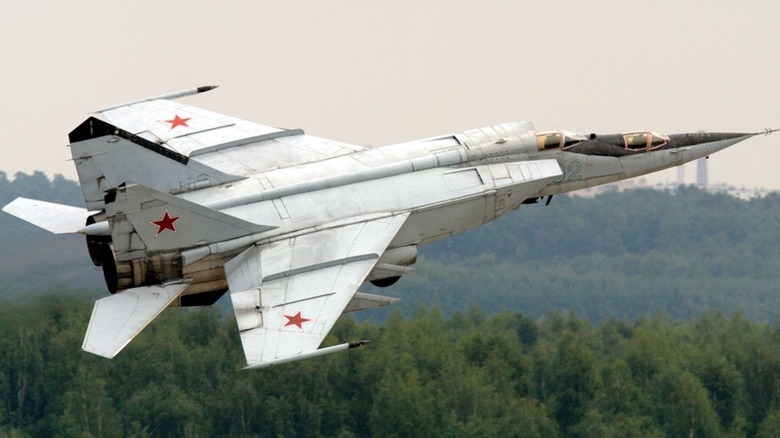
Having a high service ceiling offers several advantages to a fighter: it helps it fly above certain anti-aircraft measures and reduces atmospheric drag, the latter of which also helps the missiles it fires. That said, jets and their pilots require oxygen, and the higher a fighter flies, the greater the potential for stalls and other issues. Thus, most are limited to flying between 50,000 and 65,000 feet. Some, however, have exceeded or failed to meet those thresholds.
One such example is the Soviet-made Mikoyan-Gurevich MiG-25 "Foxbat," which had a service ceiling of an astonishing 75,000-plus feet. Compared to the aircraft the United States and Europe operated at the same time, that's incredibly high. It was nearly as capable as the legendary SR-71 Blackbird recon plane, which had a service ceiling of over 85,000+ feet. A significantly lower service ceiling of 50,000-plus feet is attributed to the far newer F-35 Lightning II, although that isn't much of an outlier when compared to other 5th-generation fighter jets.
The Aero L-159, which arrived in the mid-1990s, has a comparatively low service ceiling of only 43,000 feet. Conversely, the United States' F-47, which will be its first 6th-generation fighter, is expected to have a service ceiling of 70,000 feet, though this is speculation as of writing. Ultimately, a fighter jet's service ceiling is determined by several factors, including its engine(s), operational use, and more, and, as such, it can vary greatly between platforms and nations.