

Why Hyundai Is Suddenly So Serious About Body-On-Frame Trucks
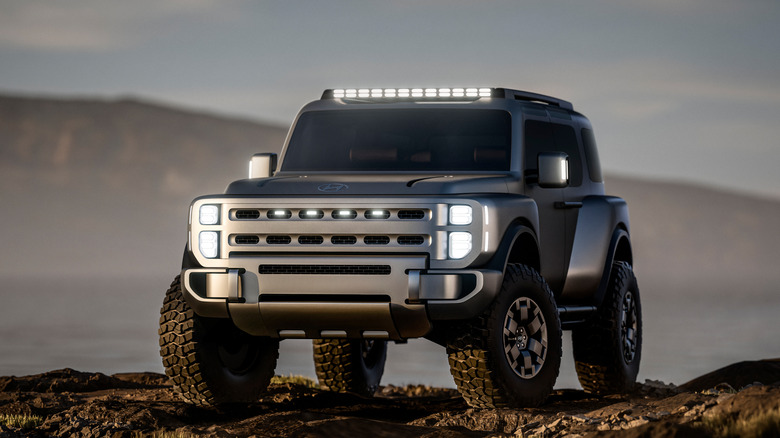
Something unusual happened at Hyundai's investor meeting in Seoul held on August 26 of 2026 when it started talking about pickup trucks. The presentation flagged what Hyundai calls "white spaces," segments where the brand has barely any presence. Given how broad the brand's umbrella is, you may think it's not much, but the gaps actually add up to roughly 29% of everything sold across the industry. At the top of these categories sit body-on-frame vehicles, including a midsize pickup.
Body-on-frame and unibody are the two ways to build a vehicle. Body-on-frame is the classic way to build a truck, involving bolting the body onto a separate steel ladder that runs the entire length of the vehicle. Trucks built this way tow heavier loads and are generally more rugged. Unibody, on the other hand, is a single welded shell — its advantage is that it's lighter and cheaper to design. While Hyundai does sell the unibody Santa Cruz pickup in the U.S., there's no body-on-frame model on offer. That's a huge gap for a country where the best-selling truck is the body-on-frame Ford F-Series.
So now Hyundai, as revealed by President and CEO José Muñoz, not only plans to build body-on-frame trucks but also do so in the U.S. itself, and then ship them out to other markets. In doing so, it would not only tap a popular genre of vehicles, but also set the country up as an export base for such trucks.
The money behind Hyundai's truck push
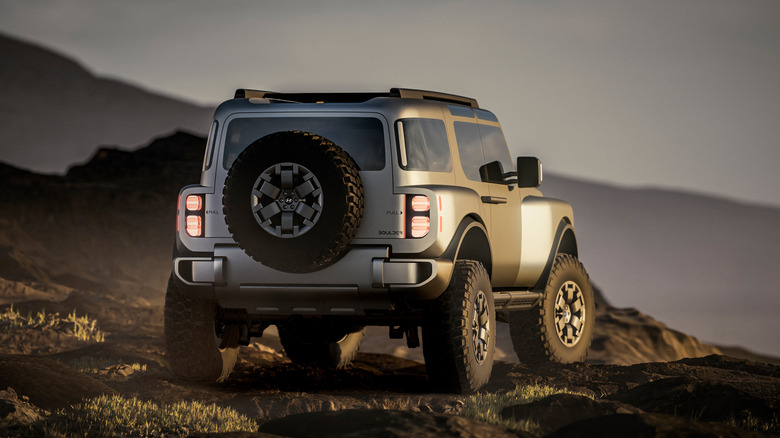
Hyundai already showed off its body-on-frame flair in April with a concept called the Boulder, a boxy off-roader SUV, meaning that it would have some downsides worth knowing about if it was a production model. Now, the company has confirmed that a mid-size pickup truck will be arriving before 2030.
Pickup trucks are where the money is in America, and for a company working on lifting profit margins, it's the best opportunity. In the same Seoul briefing, Hyundai had announced it's raising its 2030 profit margin target to above 9%. Hitting that number wouldn't come from simply selling more Elantras. The company is likely learning from rivals like Toyota, which sold a whopping 143,848 Tacomas in the first half of 2026. Similarly, Chevy sold 47,693 Colorados.
It's not just Hyundai either, as sister brands Kia and Genesis have also committed to body-on-frame models of their own. Sharing the same platform would allow three brands to capture more of a lucrative market, benefiting each other. For this to happen, Hyundai Steel, the group's steelmaking arm, is putting $5.8 billion into a mill in Donaldsonville, Louisiana.
What the Santa Cruz taught Hyundai about trucks
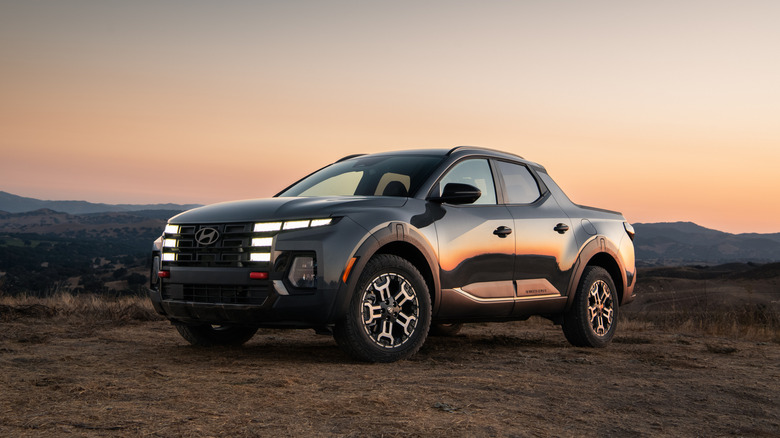
Hyundai has also seemingly learned from its previous failed attempt to enter the market in the form of the Santa Cruz. It launched in 2021 as a car-based truck, but was completely overtaken by the Maverick, a similar car-based pickup that cost less. While Ford managed to move 81,711 Mavericks in the first half of 2026, only 9,981 examples of the Santa Cruz were sold during the same period. Eventually, Hyundai decided that the time is up for the Santa Cruz, with production set to end sometime in 2027.
Another reason why the Maverick was so successful was that it came in a hybrid option — something the Santa Cruz never offered. Going body-on-frame, the way Hyundai envisions the platform, would allow it to achieve powertrain flexibility. Indeed, Muñoz has said that this capability is the cornerstone of the new platform – it will take gas engines and hybrids, plus an extended-range setup that drives like an EV, while a small combustion engine keeps the battery topped up. Neither the Tacoma nor the Ranger offer such levels of flexibility, so Hyundai will have an advantage here.