

Your Old Carry-On Might Not Work With The TSA's New Security Tech
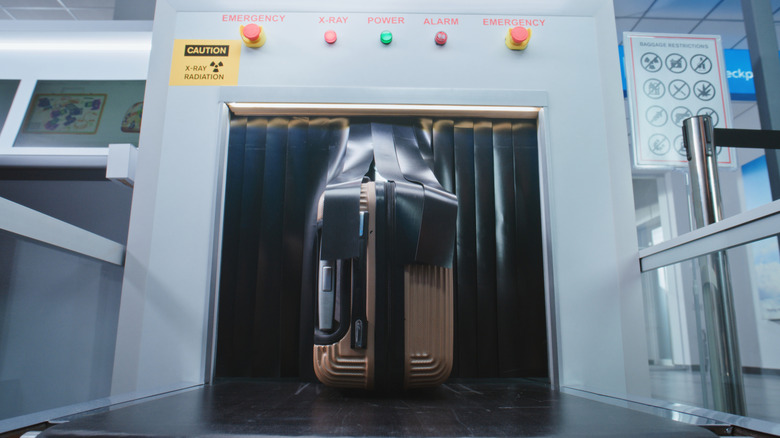
The Transportation Security Administration (TSA) is constantly improving its safety measures, including upgrading its airport screening technology and adding or adjusting regulations in regard to what's allowed on the plane. One of its latest changes could impact which carry-on bag you decide to take on your next trip.
The agency is rolling out advanced 3D computed tomography, or CT, scanners that take three-dimensional images of your carry-on bag. Using a 360-degree view, TSA agents can view everything inside your bag so that you don't have to take things like a laptop or liquids out. This is most definitely a welcomed improvement, as it is designed to help you get through the security checkpoint more efficiently.
However, you may need to make some changes to your carry-on bag because these new scanners are a bit smaller, measuring 24.5 inches wide and 16.5 inches tall. Your bag must fit inside of this to make it through security. If your bag is larger than 22 inches long, 14 inches wide, and 9 inches tall, you may have to check your bag instead.
The reason behind these new 3D CT scanners at airports
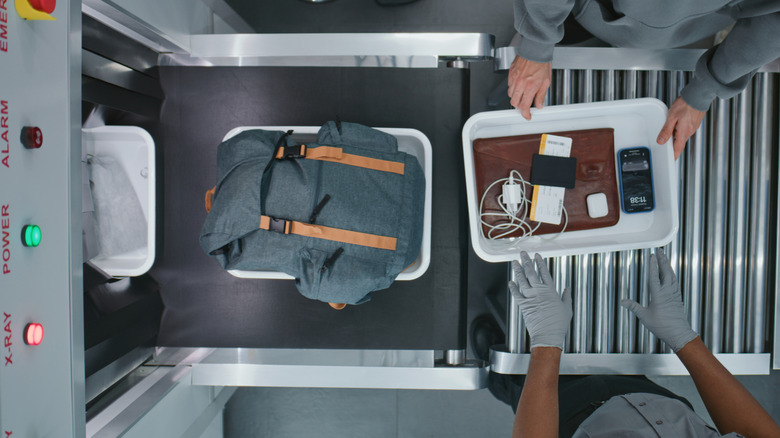
TSA's new 3D CT scanners were specifically implemented so flyers no longer have to take laptops and liquids out of their carry-on bag at the security checkpoint, TSA Spokesperson Daniel Velez told The U.S. Sun. "This technology speeds up the screening process with fewer hands-on bag checks, enhancing security, and improving the overall traveler experience," he said.
Previously, these machines worked with 2D images. The new scanners work by using more sophisticated X-rays in a similar was that technology used in the medical field does. By sending a beam of radiation through the carry-on, the machines can create an image of what's inside the bag. The scanner also uses a series of algorithms to detect explosives and other dangers, including liquids. Unfortunately, cameras and film will still need to be taken out before passing through these new machines.
While CT scanners are new in the United States, other countries have already implemented similar systems. For example, the Brussels Airport plans to have all 19 screening lanes using CT scanners by the summer of 2029. As for the U.S., there were 1,162 CT scanners across 296 airports as of mid-2026 thanks to a $781.2 million contract. It's part of a larger $2 billion program that eventually aims to replace older X-ray machines with this new technology.