

3 Downsides Of Ceramic Brake Pads
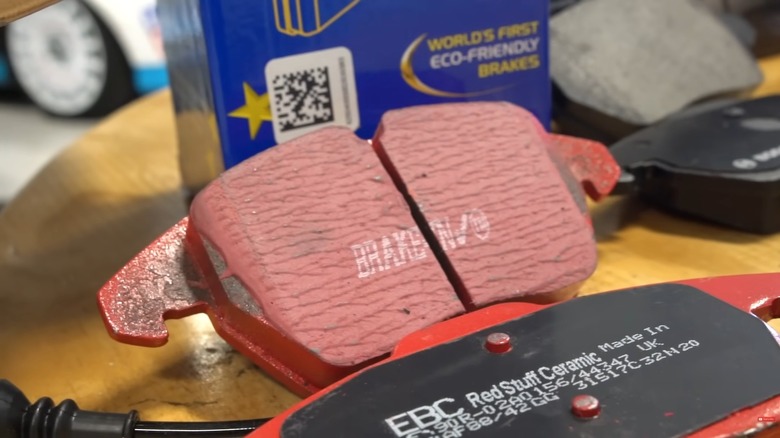
Among the most critical of vehicle components, the braking system can be the difference between an uneventful drive and one that ends in disaster. While there are different types of automotive brakes, many of today's vehicles use disc brakes. These utilize rotors, calipers, and pads, leaning on the power of friction to bring things to a stop.
Breaking down brake pad materials, you'll find organic, semi-metallic, and ceramic, with each offering certain pros and cons. Ceramic brake pads use something close to the material you'd find in dinnerware, only made more robust with fibers like alumina. Alumina does contain both aluminum and oxygen atoms, but its characteristics classify it under the category of ceramics not metal. You can find ultra-premium ceramic brake pads from brands like Akebono, one of the best brake pad brands according to drivers.
Ceramic brakes do have some advantages over other options, but conversely, also features some notable drawbacks. Ceramic pads tend to be much pricier and may require additional component upgrades, aren't suited for heavy-duty situations, and in cold weather they warm up slowly, reducing braking performance.
Ceramic brake pads are costly and may require additional upgrades

There's a reason that ceramic brakes are more associated with premium luxury and performance vehicles than with economy models; they're expensive. Take the gas-powered version of the Porsche Cayenne for instance, which is just under $90,000 to start. If you choose the optional ceramic brake package in high gloss black, you're looking at an additional $10,700. However, this price includes includes carbon fiber reinforced ceramic brake discs, 10-piston front calipers and 4-piston rear calipers, in addition to the ceramic pads.
If you're just opting for the ceramic pads alone, not every product is created equal. While you can find ceramic pad sets for around $30, products that exceed original equipment (OE) standards can run over $3,400 for a set of ceramic pads.
You may also want to look at the compatibility between ceramic brake pads and your current rotors. The rotor, which is the part these ceramic pads are going to grab when applying the brake, may also need an upgrade. A low-quality rotor may begin to show signs of uneven wear after adding these pads to your car, as ceramic is a harder material when compared to organic or semi-metallic pads. A rotor composed of OE-equivalent metals, and includes additional means to vent heat, may provide a much better experience in some instances.
Ceramic brake pads aren't ideal for heavy-duty applications
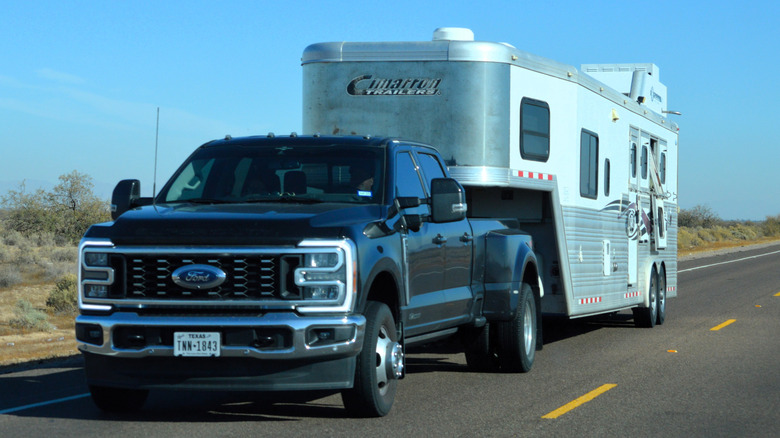
A 1-ton pickup is great for towing weighty equipment trailers, campers and livestock. You can also haul several thousand pounds of material in the bed as well. However, the one thing you probably don't want on a hard working truck is ceramic brake pads. All that extra weight places significant stress on the braking system when slowing or stopping, generating additional heat.
The problem stems from the fact that ceramic isn't as good at dealing with extra heat as alternative materials. This is important because rising temperatures can cause brake fade, which produces a notable downgrade in stopping capability. Metal is much better at dissipating heat and features a dense arrangement of metal ions formed into a grid pattern, creating what's called a lattice. Within this lattice, free electrons can move about, absorbing and transferring energy from one particle to another, in the form of movement (kinetic energy). As the metal heats up, thermal transfer occurs quickly as a result. Conversely, many forms of ceramic material lack these free electrons, slowing thermal conductivity.
Because ceramic can't dispel the rising heat quickly enough under stress, it passes through into the rotor, potentially causing them to warp. In addition, overheated braking systems can also cause a condition on the pads called glazing, where the material on the pad becomes so hot that it develops a smooth finish, no longer able to create decent friction for stopping.
Ceramic pads don't work as well in winter cold and need additional time to warm-up

Just as excessively high temperatures can cause problems with your braking system, severe cold can also wreak havoc. The material on the pad, whether its ceramic or another type like semi-metallic, stiffens or hardens in frigid winter weather. In this state, the pad can't generate the same level of friction until it has warmed up. This presents a problem for ceramic brake pads in particular, because they don't absorb heat as quickly as semi-metallic pads do. This means it'll take more time for ceramic to reach the optimal temperature that allows them to perform at their peak.
With ceramic brake pads, you might notice the brakes feel strange after starting up your vehicle on a cold morning. The sensation has often been described as "mushy," as if the typically firm grip or bite of applying the brakes is gone. Stopping distance may be greater than normal, and you'll have to put more effort into pressing harder on the brake pedal to feel any meaningful result, at least initially.
You might also discover the typically quiet ceramic pads start squealing when applied during winter weather. Often times, the squeal has to do with a thin layer of moisture that's formed on the rotor in combination with the pad material hardening in the cold. When the pads make contact during stopping, they have to remove that layer through rapid evaporation before proper contact with the rotor's surface is possible.