

Can You Smell A Brake Fluid Leak?
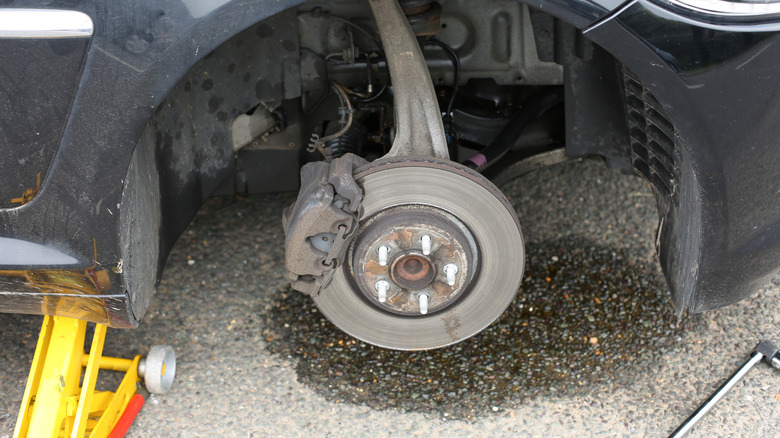
If there's one system on your car that absolutely must be working at all times, it's your brakes. You can have your transmission stop working, your engine explode into a million pieces, your steering fail, but you'll generally be alright as long as you can get the thing stopped. That's why keeping brakes well-maintained is so crucial to not just your safety, but the safety of everyone else around you, and central to this is knowing if your brake fluid is leaking.
Brake fluid comes in many different flavors (no pun intended), depending on the grade. Most modern cars use DOT 4 brake fluid, which generally comes in a clear or yellowish color that darkens over time. The fluid itself has a sharp, chemical-like smell reminiscent of fish oil; it's pretty noticeable if you get a puddle of it next to your car on a warm morning. Basic DOT 3 fluid commonly-found in classic cars has a slightly sweeter smell, albeit it's still in that same ballpark. Higher-performance stuff has stronger, more artificial smells.
Your brake system is meant to be a sealed unit — no air should get in and no fluid should come out. A good brake system has no leaks, therefore no smells. It's somewhat like a plate of food. If you look at the edges of a dinner plate and notice a foul-smelling oil by your food, it's unsafe. Likewise, your car should be considered dangerous to drive if there's a strange-smelling puddle by the wheel or your car smells funny under braking. Let's break it down more and discuss the specifics and why it's so dangerous, as well as what to do if your car is leaking.
How to tell if your brake fluid is leaking
Sometimes it's not immediately obvious if your brake fluid is leaking; maybe it was raining for a few days, or you've been doing a lot of driving and the system just started leaking while you were on the road. The first thing you'll notice, in either case, will likely be the smell, which emanates when the fluid comes in contact with outside contaminants like water vapor. It's a built-in warning system, in essence, owing to brake fluid's vital functions in your car.
Aside from the smell itself, the most obvious tell that your fluid is leaking is a spongy feeling in your brake pedal. Brake fluid is a hydraulic oil designed to be incompressible, whereas air is compressible. Every time you press the pedal, you're pushing fluid out of where it's leaking and replacing it with air bubbles. Accompanying this will likely be a brake warning light, along with reduced braking performance when the system does work.
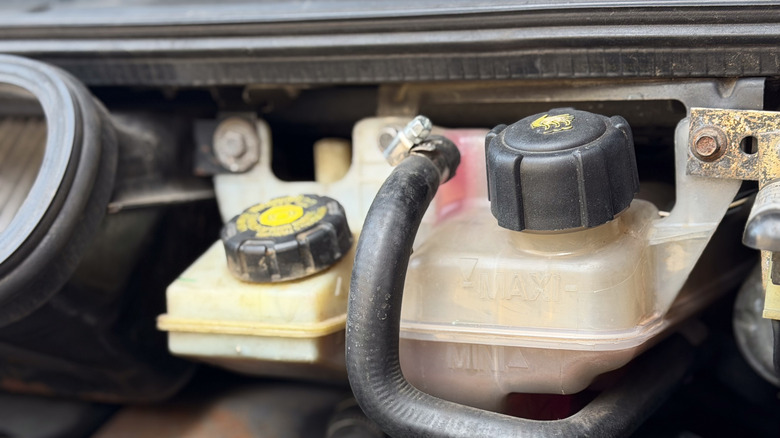
Brake leaks can occur anywhere where there's a brake line. Your brake pedal connects to the brake master cylinder and booster, both under the hood — it looks like a big, round bowl up against the firewall with a fluid reservoir labeled "brake fluid" sticking out the end. Brake lines run along the underside of the car to all four wheels, terminating in the brake calipers on disc brakes or drum cylinder on drum brakes. In either case, the caliper or lines may also spring a leak due to corrosion or poor fitment.
What to do if a leak is detected
If you find a sizeable brake fluid leak and your vehicle is parked in your driveway or a parking lot, absolutely do not drive it under any circumstances. Leaking brake fluid means your car may not have any brakes at all, and even if it does and you suspect it's a small leak and you just have low brake fluid, it's better to play this one safe.
If you're on the road, let's assume the worst-case scenario. You're driving along and your car suddenly bursts a line, the master cylinder blows up, a line to your caliper randomly detaches, whatever. You're traveling at highway speeds and now have zero brakes. What is the correct thing to do? Obviously, you need to get the car stopped as safely as possible, and that's where your shifter and parking brake come in.
Your car actually has two other methods of stopping — engine braking and the parking brake. Engine braking involves shifting your car into a lower gear so the engine itself decelerates the car through vacuum pressure generated in the cylinders. This slows the engine and, thus, your car, since the engine and wheel speeds are directly tied to one another.
For the parking brake, make absolutely sure you're traveling slow enough that you can control the car to a stop. This may mean having to coast it for a while. Just avoid abrupt maneuvers and, if your parking brake is electronic, don't use it until you need it, otherwise you can lock your tires and lose control.