

These Traffic Cones You See Every Day Have Some Oddly Specific Rules
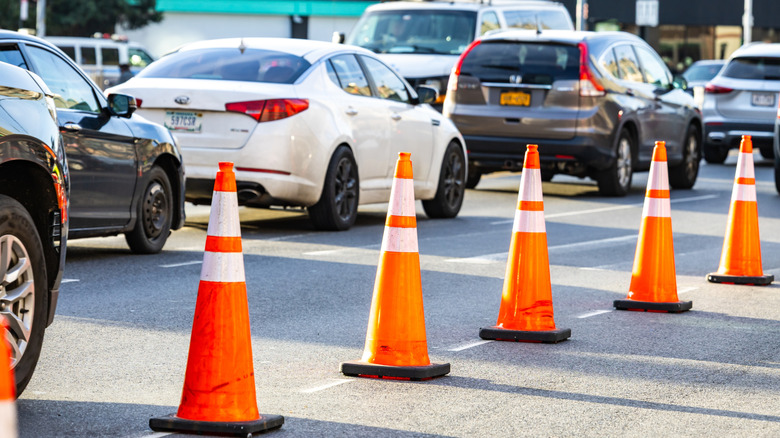
Traffic cones are a ubiquitous part of every road construction project. It's estimated that, on average, driving on deteriorated and congested roads costs drivers more than $1,400 every year in vehicle maintenance costs and lost time. While some roadways are better than others, overall, the 2025 report card from the American Society of Civil Engineers (ASCE) on America's infrastructure earned a woeful D+, far from a passing grade.
According to ASCE, approximately 39% of the major roads in the U.S. are in poor or mediocre condition, which is an improvement over 2020, when it was 43%. Given that, it should come as no surprise that, as of November 2021, states have spent $198 billion on improving existing infrastructure and building new roads and bridges. What's more, through June of 2026, states have dedicated another $286.6 billion in additional funds to support almost 125,000 additional projects.
Believe it or not, these simple, brightly colored, lightweight, stackable traffic cones are subject to some seriously odd and very specific rules because, technically, they're considered traffic control devices. As such, everything from their height and weight to their color and spacing is regulated by federal and state standards as outlined in the Manual on Uniform Traffic Control Devices (MUTCD). Published by the Federal Highway Administration under 23 Code of Federal Regulations (CFR), Part 655, Subpart F, the MUTCD helps minimize crashes and ensures legal protection on all streets and highways, as well as on pedestrian and bicycle lanes open to public travel.
Traffic cones must be lightweight but sturdy

At over 1,100 pages, the MUTCD goes into great detail on all things related to traffic control devices. Technically, cones are considered a "channelizing device" along with things like drums, barricades, tubular markers, vertical panels, and lane separators. When not being used to redirect traffic and designate hazardous work zones, cones can be found on people's heads – alive or in statue form, atop random poles and trees, used as a makeshift bullhorn, or to disrespectfully (and illegally) reserve a public parking space.
According to the MUTCD, cones must follow a precise mathematical equation when it comes to placement. They should not "exceed a distance in feet equal to 1 times the speed limit in mph when used for taper channelization, and should not exceed a distance in feet equal to 2 times the speed limit in mph when used for tangent channelization." The wording makes it sound like one of those pesky word problems we had to solve in school. Still, we mention it because it shows how exacting the manual is and how seriously the Federal Highway Administration takes even the smallest of details.
The first iteration of what would become the modern traffic cone was made of concrete or wood. Imagine the kind of damage one of those would have on the underside of a vehicle. It wasn't until the 1940s rolled around that much safer and lighter materials replaced concrete and wood. Additionally, the conical form was tweaked and improved over decades of experimentation, as it needed to balance form and function.
Weight management can be tricky
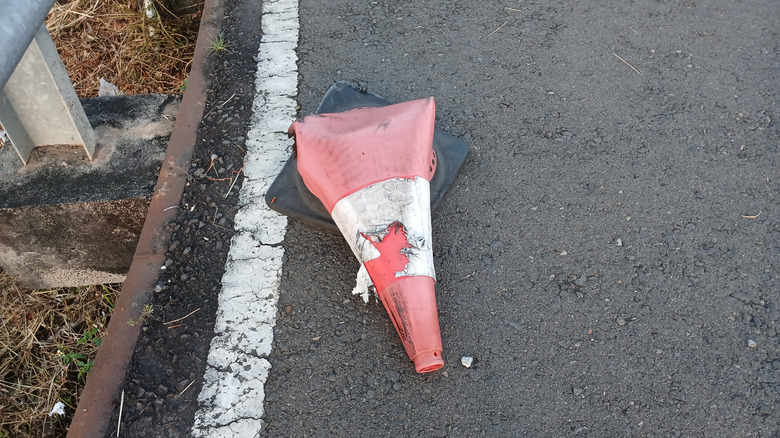
Ballast is a word you might associate with submarines, boats, and hot air balloons, but it's also something the MUTCD uses for the weight of traffic cones. Or more precisely, their bases. While some are made to be filled with ballast a heavy material that adds both weight and stability – while others can have weighted rings dropped onto them, or they can be double-stacked to increase the weight, all of which helps prevent them from being blown over by the strong winds.
The weight of a cone can be tricky because the ballast used must be kept to a minimum. Cones must simultaneously be heavy enough to remain in place as a continuous stream of speeding vehicles scream by, yet remain light enough so as not to destroy the undercarriage of a vehicle when one inadvertently runs over one. Something that happens quite often.
While cones — which must be predominantly orange — can be double-stacked to add weight, doing so also increases their damage potential. Aside from superficial exterior damage (think scratches, dents, and paint scuffs), it can cause far more extensive problems, such as throwing wheels out of alignment, damaging the exhaust system, or creating dangerous fluid leaks by loosening or breaking parts — none of which anyone wants to deal with. So always remain alert while driving in a cone zone, not only to prevent damage to your vehicle, but to protect those working in work zones.