

Do Work Zone Workers Have To Be Present For Traffic Cameras To Give You A Ticket?
The U.S. Interstate Highway System began taking shape in the 1920s. However, all those projects were put on hold in 1929 when the Great Depression hit, and remained so for decades. In 1956, President Dwight D. Eisenhower signed the National Interstate and Defense Highways Act in response to the explosion of automobiles taking to the roads during the post-war boom, with a plan to build 41,000 miles of highways that ran from sea to shining sea.
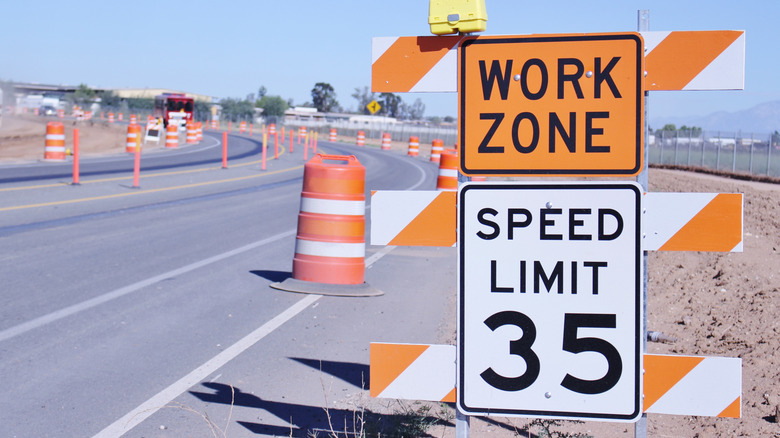
In 1954, 58 million registered motor vehicles were on the road in the U.S. Today, there are over 284 million, and it can sometimes feel like we're all driving around on those same century-old roads. Enter the infamous work zone, where workers don't necessarily need to be present for you to get a speeding ticket if you're caught on camera by an Automated Speed Enforcement (ASE) system. As with standard work zones, state laws vary, so always check local regulations.
For instance, New York state statute 1180-E requires workers to be present, and clear signage leading up to the work zone warning that a photo-monitoring system is being used. Caution is advised in NY as State Police are known to wear hard hats and reflective vests to blend in with road construction crews. Much like New York, the state of Washington also requires signage, and enforcement only happens while workers are present in the zone. In Maryland, however, workers don't need to be present for a traffic camera to issue a ticket. Florida has stringent work zone laws, but by and large doesn't currently use ASEs in work zones. However, state law allows them to be at intersections and designated school zones (which are common).
Work zone speeding fines can add up
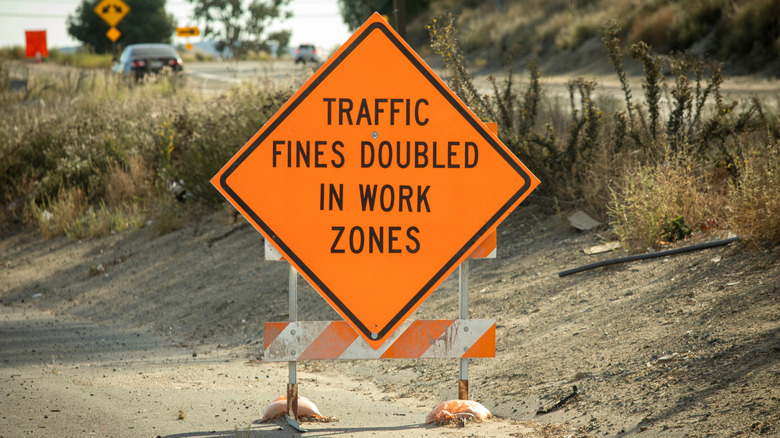
In California, Assembly Bill 289 went into effect in January of 2026. However, it only applies if the appropriate signage stating that it's "photo enforced" is present and must be located no more than 500 feet ahead of where the system is placed. Furthermore, citations can only be issued when construction workers are present.
Fines associated with these relatively new ASE laws can vary widely depending on the scenario. Going 11 to 15 mph over the posted speed limit in California carries a $50 fine (like in New York) and can escalate to $500 for speeds of 100 mph or greater. In New York, though, a second violation is $75 (if it occurred within 18 months of the first), while subsequent violations are $100 (again, if within 18 months of the first). In Maryland, the current tiered schedule starts at $60 for going 12 to 15 mph over the posted limit and goes up to $500 for driving 40 mph or more over the posted limit; those fines double if workers are present. Beginning on July 1, 2026, Washington drivers can expect a first-time infraction to cost $125, with subsequent infractions increasing to $248. On May 1, the state began requiring initial driver's license applicants under 25 to pass an online work zone and first responder safety course before receiving their license.
More and more, states are using ASE systems to keep everyone safe because work zones are inherently dangerous due to uneven pavement, narrower lanes, concrete barriers, and strange orange lines on the road. Ultimately, it's better to be safe than sorry. Stick to the letter of the law when traveling through them because, in the grand scheme of things, it's a momentary annoyance that's not worth a lifetime of regret.