

Which Cummins Diesel Engine Was Called 'Big Cam' & What Made It So Special?
Cummins is a highly recognizable name in the trucking world, responsible for a variety of diesel engines that stood out from the competition. One of those engines is known as the "Big Cam," a designation given to the company's 14-liter diesel. The Big Cam technology was first used by Cummins all the way back in 1976.
The Cummins 855 Big Cam was special mainly because it introduced a larger camshaft, which increased the journal diameter from 2 inches to 2.5 inches. This allowed Cummins to increase injection pressure from about 11,000 psi to 14,000 psi and thus deliver fuel more quickly. This shorter injection period also gave the combustion process more time for expansion, helping the engine use fuel more efficiently. In fact, the Big Cam 14-liter provided a 6% improvement in fuel economy versus the earlier version with the smaller cam. The Big Cam design helped reduce exhaust smoke, noise, and emissions as well.
Beyond its fuel efficiency improvements, the 855 Big Cam became known for operating at low speeds, producing strong low-end torque, and delivering exceptional durability. These characteristics made the engine well suited for heavy-duty trucking, and helped make the Big Cam one of the best inline-6 diesel engines ever made. Its reputation for long service life also helped cement the Big Cam as one of Cummins' most respected truck engines.
How Cummins kept improving the Big Cam
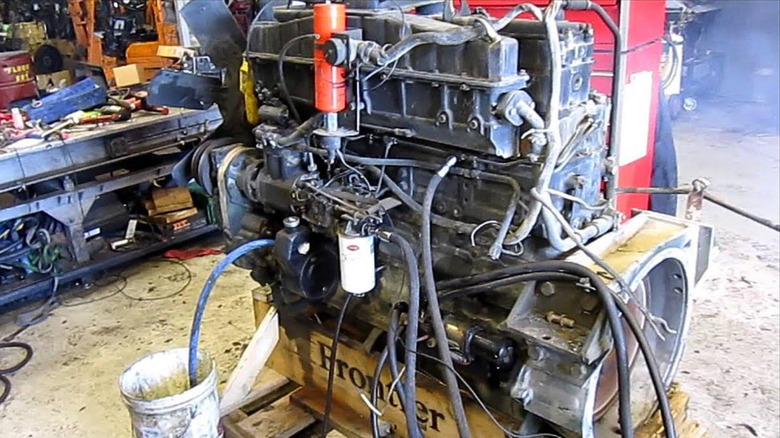
Cummins continued to refine the Big Cam after its introduction in 1976 through a series of updates. This included the Big Cam I in 1977, followed by the Big Cam II just two years later. The Big Cam III and Big Cam IV were introduced in 1982 and 1984, respectively. As the engine evolved, Cummins made improvements to both the fuel system and air handling, while reducing the amount of power needed to operate its internal components.
The Big Cam had its share of problems, however, particularly as Cummins continued to increase injection pressures to meet tougher emissions requirements. This became clear with the 88 Big Cam IV, a later model that introduced reduced drain flow fuel injectors. While these components substantially increased injection pressure, the fuel system struggled with the added demands. As a result, the reliability of the fuel injectors was affected.
The 855 Big Cam eventually gave way to the N14, an engine that Cummins introduced in 1990. The N14 was the next generation of the manufacturer's heavy-duty highway engines, and with it came full-authority electronic controls. This marked the first time Cummins used air-to-air aftercooling in this family, with power ratings ranging from 460 hp to 525 hp. The N14 was eventually followed by the ISX in 1999, which had further improvements to emissions controls for on-highway engines.