

5 Times When It's Better To Use 40V Makita Tools Rather Than 12V
We may receive a commission on purchases made from links.
Makita has several different cordless power tool lines. The brand is perhaps best known for its mid-sized 18V LXT system, which powers hundreds of different tools and can even be doubled up to power the company's 36V tools when more power is needed, but this isn't all it has to offer. Makita also has a 12V Max CXT system and a 40V Max XGT system, the latter of which can also be doubled to drive the truly power-hungry 80V products.
Tools and batteries of different voltage lines are not interchangeable, however. You can't use a 12V battery in a 40V tool or vice versa, so before you invest in one product line, you should first consider the kind of tools that you'll need and whether your specific needs are more oriented toward portability or raw power. Makita's 12V products are primarily designed with affordability and portability in mind. These are lightweight tools that favor compact form factors and comfortable ergonomics, working well in tight spaces. The 40V/80V system is a bit different. This line of power tools is designed to prioritize raw power, with tools that are able to deliver when factors like speed and torque are most vital.
With that in mind, there are instances where the 40V version of a tool will be much better suited for a job than the corresponding 12V model. Considering which of these options is better suited to the kind of work that you want to do before investing in a battery system may help you to save time, effort, frustration, and money in the long run.
Driving large fasteners with impact drivers
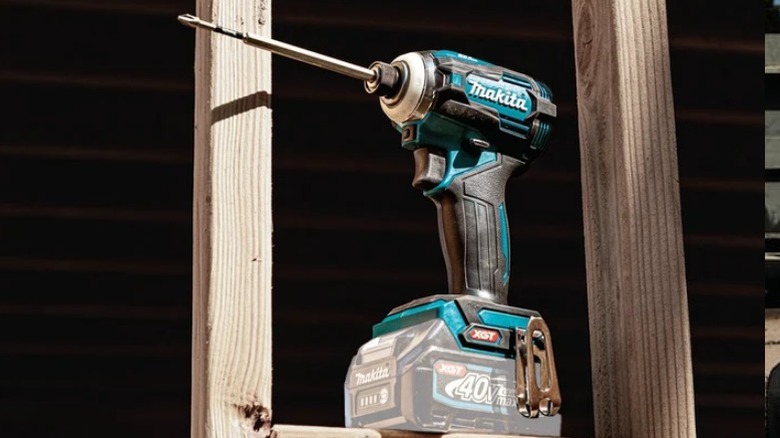
A good impact driver is a fantastic tool to have on hand. Not only does it make it so you aren't constantly swapping bits in your drill, but the hammering impact motion that the tool performs also makes it drive fasteners harder, faster, and with more torque than a standard drill. There are only a couple of impact drivers currently being sold in Makita's 12V CXT line.
There's the DT03Z 12V Max CXT Impact Driver, and then there's the newer DT04Z 12V Max Impact Driver. This newer model has seen an increase in torque from its predecessor, taking it from 970 in-lbs all the way up to 1,200 in-lbs. Add that to the variable speed that runs up to 3,000 RPM and 3,900 IPM, and it's plain to see that this little tool punches well above its weight class. Even so, this isn't nearly enough power to be considered pro-grade, and it still might struggle with heavier applications, like driving large lag bolts into framing timber, or driving self-tapping screws into metal. For these applications, you'll want something with a lot more force.
Now let's take a look at the 40V line. There is the GDT01Z 40V Max XGT 4-Speed Impact Driver, which is able to deliver up to 1,950 in-lbs of torque at up to 3,700 RPM and 4,400 IPM. Then there's the GDT04Z 40V Max XGT High Torque 4-Speed Impact Driver, which can hit 2,040 in-lbs of torque, 3,900 RPM, and 3,900 IPM. So not only do these drive with much more force, but they're also significantly faster, which you will appreciate the next time you're building a deck, shed, or fence and you need to drive hundreds of screws.
Breaking heavy-duty nuts with an impact wrench
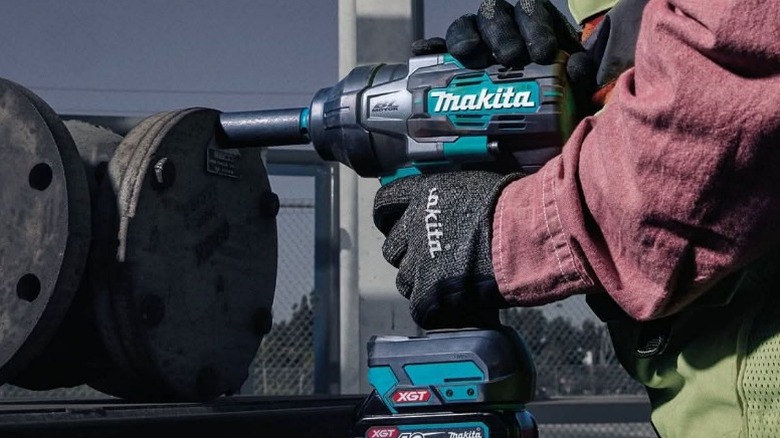
There are few tools more vital in auto repair than a good impact wrench. This is yet another situation where the tool you want will vary depending on what you need it for. There's only one of these listed in the CXT system so far: The WT06Z 12V Max CXT ½-inch Square Drive Impact Wrench. This little guy is able to deliver up to 122 ft-lbs of rotational torque and up to 210 ft-lbs of nut-busting torque. It has variable speed, with a maximum of 2,400 RPM and 3,600 IPM.
This is perfectly adequate for small DIY projects, but it's squarely in the category of light-duty work. It's great for smaller projects like bicycles and motorcycles, and you can even get away with some light work under the hood of your car. That said, you generally want something with at least 250-650 ft-lbs of nut-busting torque for general automotive work, and even more for heavy-duty suspension or engine repair.
The XGT system has a whole bevy of different impact wrenches for you to choose from. There is the smaller and lighter GWT05Z 40V Max XGT 4-Speed ½-inch Square Drive Impact Wrench, which is similar in design and scale to the 12V model, but which can deliver 465 ft-lbs of nut-busting torque, 3,200 RPM, and 4,000 IPM. Alternatively, you can get something like the GWT02Z 40V Max XGT 4-Speed High Torque ½-inch Square Drive Impact Wrench with Friction Ring Anvil. This is larger and heavier, but in exchange, you get a whopping 1,620 ft-lbs of nut-busting torque at up to 1,800 RPM and 2,400 IPM.
Cutting dense materials with a reciprocating saw
Makita is often counted as one of the best major reciprocating saw brands. Its tools are useful in a wide range of applications that have an equally wide range of different power requirements. Cutting drywall, pine 2x4s, and PVC isn't going to require all that much juice. So if that's all you need to do, the RJ03R1 12V Max CXT Reciprocating Saw is just fine. It's able to cut at a rate of 3,300 SPM with a ½-inch stroke. It's also compact, making it ideal for tight spaces, and can be used one-handed.
That said, it might struggle with larger pieces and denser materials. Makita states that it's good for "PVC and ABS pipe, EMT, drywall, wood, and more," but it doesn't explicitly mention denser materials like hardwood and heavier metal stock. There have been several reports from customers stating that the tool is underpowered, and specifically calling out that it struggles with medium-sized tree branches and metal, and that the battery included in the kit doesn't last long under load.
Compare that to the GRJ02Z 40V Max XGT AVT Orbital Reciprocating Saw or the GRJ03Z 40V Max XGT Reciprocating Pipe Saw with Chain Vise. These tools both promise 15-amp power, which is what you typically find in premium miter and table saws. Josh McGaffigan of Pro Tool Reviews gave the GRJ02Z a perfect 10 out of 10 score and stated that it offered top-tier cutting performance on all materials while also having great vibration control and a broad feature set. This makes it a much better option for cutting dense materials and heavy demolition work.
Heavy outdoor cleanup with blowers
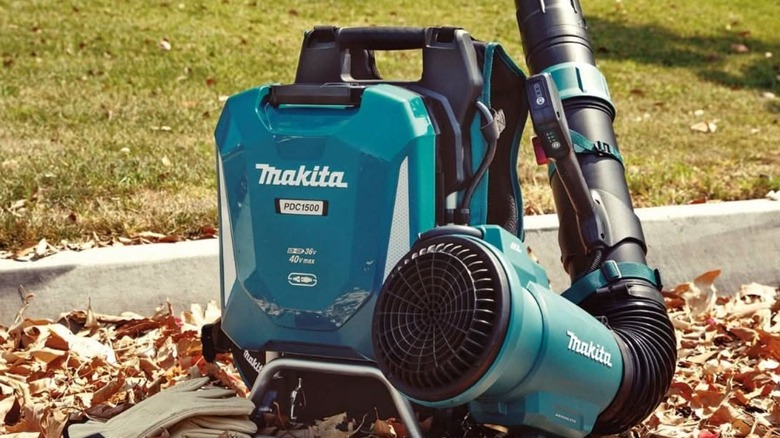
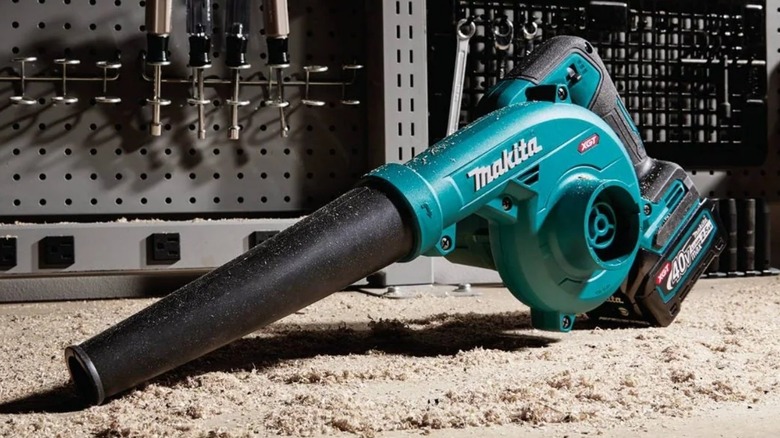
There are a few different applications for a blower, and some of them don't require a ton of power. Those who are simply looking to round up a few dry leaves or blow the dust out of a shop can easily get by with a lightweight tool like the Makita BU01Z 12V Max CXT Cordless Blower. It has a 3-speed motor that can produce air speeds up to 167 MPH.
Blowers like this are fine for most kinds of light everyday cleanup, but they will struggle with bigger jobs. If you have a yard full of wet leaves, sticks, and other heavy debris that you need cleaned, then you'll probably want to invest in something that can produce higher wind speeds, as this will give you a lot more pushing power.
Makita has three different handheld blowers and a backpack blower in its 40V line. Two of the handheld units have a greater emphasis on volume, with a higher CFM rating that allows them to push a greater amount of leaves at once, but not necessarily with more raw pushing force. Then there's the GBU02Z 40V Max XGT Compact Blower. This has a similar design to the 12V version, but manages to produce air speeds up to 221 MPH with 127 CFM. This is a much better option for heavy debris. But the true heavy-duty option is the GBU04Z 40V Max XGT Brushless Backpack Blower. This tool provides up to 675 CFM of air volume at speeds up to 215 MPH, granting the user both volume and power.
Cutting thick and dense materials with a circular saw
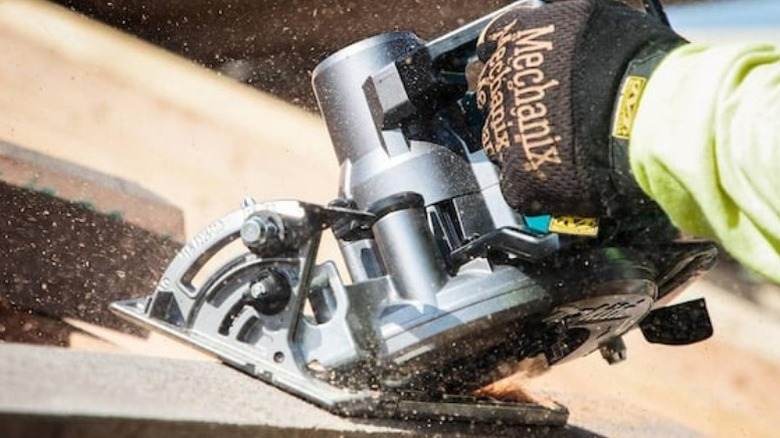
There's only one circular saw in Makita's 12V system: The SH02R1 12V Max CXT 3 ⅜-inch Circular Saw. This is a little one-handed saw that the company states is great for cutting "plywood, MDF, pegboard, particleboard, melamine, drywall and more," but you might notice that there are a few common materials missing from that list — like thicker dimensional lumber. You should also consider that these applications are somewhat limited by the size of the blade and power behind the tool.
The first issue is the 3 ⅜-inch blade, which delivers a maximum cutting depth of 1 inch. This is fine for most sheet goods, trim, wall paneling, flooring, and even some softer common boards, but it won't be able to cut through anything thicker in a single pass, such as 2x4s. Several users have also noted that the tool is underpowered for some applications that involve denser materials, such as pressure-treated boards and hardwoods. Makita reports that it can only achieve speeds up to 1,500 RPM. This is fine for a small tool designed for working with soft, thin material, but not much else.
Now compare that to Makita's selection of 40V saws. The company has just shy of a dozen models in various designs with blade sizes ranging from 6 ½ inches to a colossal 16 5/16 inches. The smaller GSH05Z 40V Max XGT 6 ½-inch Circular Saw is able to generate up to 5,200 RPM, making it a high-speed saw capable of cutting dense materials and maintaining momentum through long rip cuts. Other models are even more powerful. The GSR01Z 40V Max XGT Brushless Rear Handle 7 ¼-inch Circular Saw hits up to 6,400 RPM and has an automatic torque drive for adjusting speed under load for optimal performance.