

What The Numbers On Your Chainsaw Chain Actually Mean

The numbers stamped on your chainsaw chain are the shorthand that tells you exactly which replacement chain will fit your saw safely. But there's no single universal code across all brands. Stihl, Husqvarna, Oregon, and all the other major chainsaw brands each use their own marking systems, and the placement of those numbers can vary from the chain's drive links to the bar's heel or even the packaging.
What almost every system conveys are three core specs: pitch, gauge, and drive-link count. Pitch is the chain's "size," defined as half the distance between any three consecutive rivets; common values are ¼", .325", ⅜", and .404". Gauge is the thickness of the drive links, typically .043", .050", .058", or .063". Drive-link count is simply how many drive links form the full loop; it determines overall chain length and must match the bar's specified length.
On many of the best chainsaws, pitch and gauge are stamped directly on the side of each drive link on the chain. Guide bars often carry stamps near the powerhead end, listing bar length, pitch, and gauge; some also include the required drive-link count. For example, Husqvarna's X-CUT chains show pitch and gauge as single digits on the drive link (e.g., "8" and "5" for ⅜" pitch and .050" gauge), while Stihl encodes gauge as a final digit (1 = .043", 3 = .050", 5 = .058", 6 = .063"). Oregon, by contrast, uses a two-digit "series" code on the drive link that maps to a specific pitch-and-gauge pair.
Reading the stamps without guesswork
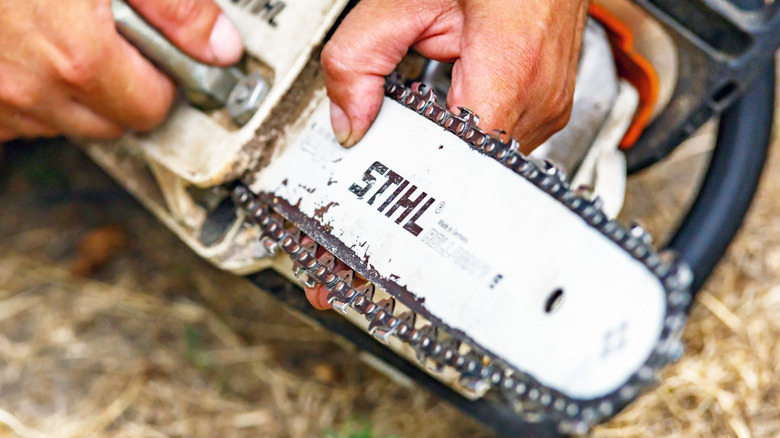
Start by locating the markings. On the chain, look at the flat side of the drive links for small stamped numbers or codes. On the guide bar, check near the base where it meets the powerhead; you'll often see a string like "16 3/8 .050 57DL" or a brand-specific code. The first number is usually bar length in inches, followed by pitch and gauge, and sometimes the drive-link count.
Decode pitch first: if you see "⅜" or ".375," that's ⅜" pitch; ".325" and ".404" are also common. Gauge will appear as a decimal like .050 or .063, or as a single digit in certain brand codes. Drive-link count may be shown as "57DL," "57," or embedded in a longer part number; it must match exactly, or the chain won't fit the bar and sprocket properly. You can also measure manually. For pitch, measure across any three consecutive rivets and divide by two. For gauge, use calipers on the thickness of a drive link where it engages the bar groove. Then count the drive links around the full loop.
Finally, remember that matching all three specs — pitch, gauge, and drive-link count — is non-negotiable, and it critical for chainsaw maintenance. A chain with the right pitch but the wrong gauge can wobble or bind; the wrong drive-link count won't wrap the bar correctly. When in doubt, use your saw's model number and the bar's stamps to look up the exact chain in the manufacturer's chart rather than guessing from generic numbers.