

Why Do Some Astronaut Helmets Have Gold-Coated Visors?
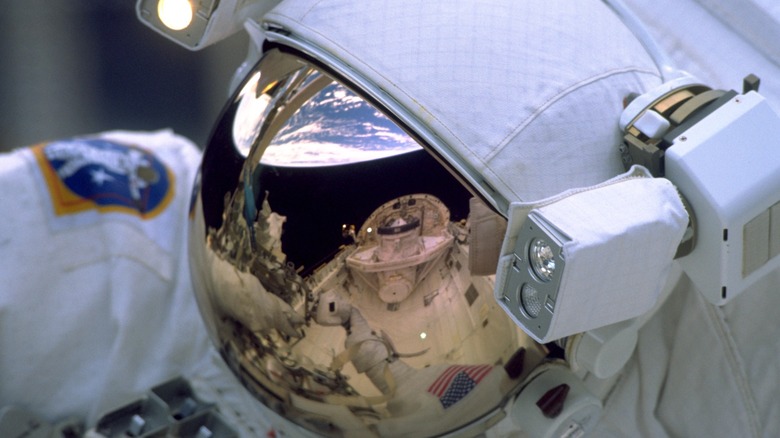
The Space Race saw a lot of impressive developments by both sides of the Cold War, but the first nation to produce a space suit was the Soviet Union. Famed astronaut and the first man in space, Yuri Gagarin, wore a Soviet SK-1 suit on his April 12, 1961, mission to space. That was the first time a space suit was worn by an astronaut outside of the planet's atmosphere, and space suits have evolved ever since. If you look at the helmets worn by astronauts, they often have an interesting feature that blocks your ability to see the occupant: gold.
The reason why NASA puts gold on helmet visors is largely to protect the astronaut's eyes from unfiltered sunlight, which could quickly cause permanent retinal damage. Gold is the most malleable metal, so you can take one ounce of the shiny stuff and pound it down to a thickness that's so thin that you can cover a surface of 100 square feet. When it does this, gold doesn't lose its desired properties of high reflectivity of infrared light.
It allows visible light to pass through, making it an ideal element to protect an astronaut on a spacewalk in zero gravity. Because of this, adding gold-coated visors to space suit helmets is a no-brainer, as the weight added to a spacecraft is almost negligible. While the practice of using gold-coated visors began in the 1960s, it's never gone away. Modern space suits like NASA's Axiom Extravehicular Mobility Unit (AxEMU) feature a gold-coated visor designed by Oakley.
NASA's use of gold-coated visors dates back to the 1960s

When President John F. Kennedy declared that the United States would make it to the Moon before the end of the 1960s, NASA answered the call. On July 20, 1969, NASA astronauts Neil Armstrong and Buzz Aldrin stepped onto the lunar surface, and they did so wearing a helmet with a gold-coated visor. The gold was very thin, measuring only 0.000002 inches thick. This wasn't the first use of gold-coated visors; it started with the Gemini missions in 1965.
While we cannot see inside, the astronaut wearing the helmet has no problem peering through the gold on their end. It protects them from solar radiation, and reduces the sun's glare, which would blind them were they to look at Earth's star unfiltered by atmosphere.
You can see gold on more than an astronaut's helmet, as it's found on satellites outfitted with gold-coated components. This is largely due to its high conductivity and corrosion resistance.