

Common Mistakes Almost Everyone Makes When Shopping For A Drill

Any proper toolkit, whether for home, work, or hobby, needs a good power drill as one of its baseline tools. If you don't already have a power drill, it's certainly not difficult to find one, as their ubiquity in toolkits makes drills from all the major brands readily available at most hardware stores. Considering how broad the selection is, though, it can, ironically, become more difficult to find the optimal power drill for your needs.
There are a good number of factors that go into determining the perfect drill for your needs, including the drill's power, the battery pack that comes with it, whether it's a regular drill or a hammer drill, and its relevant accessories and brand platform. That's not even mentioning how much you'll potentially spend on this little endeavor. It can make for a bit of a headache, but it's a headache worth enduring. Avoiding common mistakes and properly considering all the factors and options can, hopefully, result in a reliable drill that will serve you well for years to come, rather than a half-baked, barely functioning drill that'll fall apart in a week.
Only buying the cheapest drill
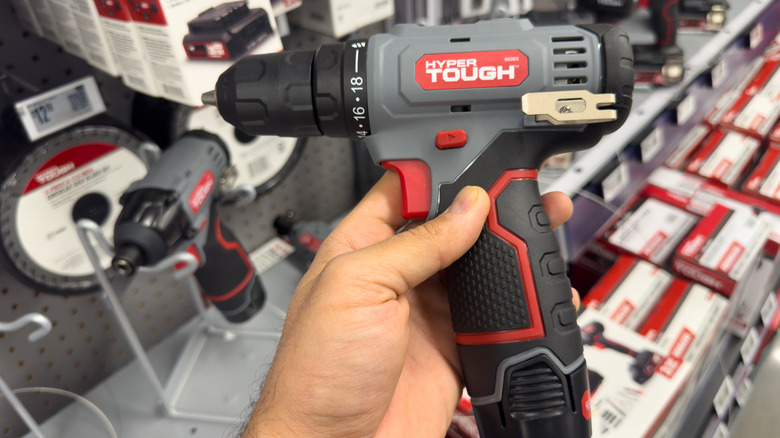
We get it: power tools are expensive. They're heavy-duty, precision-made equipment, and even something as standard as a power drill is probably going to run you at least $50 at the absolute bare minimum, to say nothing of the over $100 a fancier model will likely cost you. It's frustrating, but you should remember that a power drill is an investment, not just a purchase, and that price tag will help to ensure quality and usability.
You could technically opt for cheaper power drills from a no-name brand in a dusty corner of Home Depot, sacrificing perks like swappable, rechargeable batteries to get the price tag down to around $30. However, with no-name drills comes a distinct lack of user support. Compared to major brands, which have more robust frameworks for user support, repairs, and returns, it's basically a toss-up whether a bargain-bin drill will offer those same features. That means if something breaks, you're almost certainly up a creek. Buying a cheap drill may save you some cash in the short term, but those savings will swiftly dry up when that drill needs to be replaced after just a few uses.
Buying a drill with too much or too little power
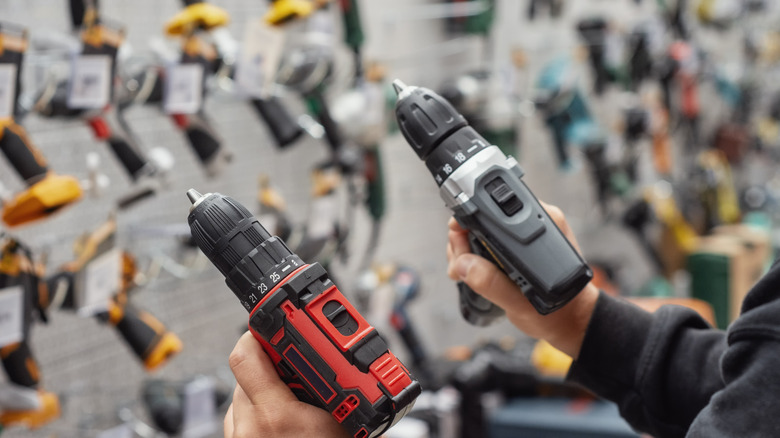
It's easy and fair to assume that a power drill is a power drill; you pull the trigger, it spins, and it doesn't get any more complicated than that. As a matter of fact, though, it does get more complicated than that. Different power drills have different power ratings, meaning they may be better or worse suited for different kinds of jobs and work intensities. If you just grab the first power drill that catches your eye off the shelf, you might end up with one that can't handle whatever you're planning to do with it, or one that's entirely too intense for a simple job.
For example, if you're planning to do some high-intensity plumbing, either in your own home or as part of your work, you wouldn't be able to handle it with a low-end 12V drill. It'd be able to poke through a wall, sure, but not the wall studs. Conversely, if you're just looking to do a couple of odd jobs around the house, such as drilling pilot holes for a DIY project or drilling a hole in your desk to feed a wire through, a heavy-duty 20V drill would be serious overkill. It'd do the job fine, but so would that 12V drill.
Using an insufficiently powerful battery
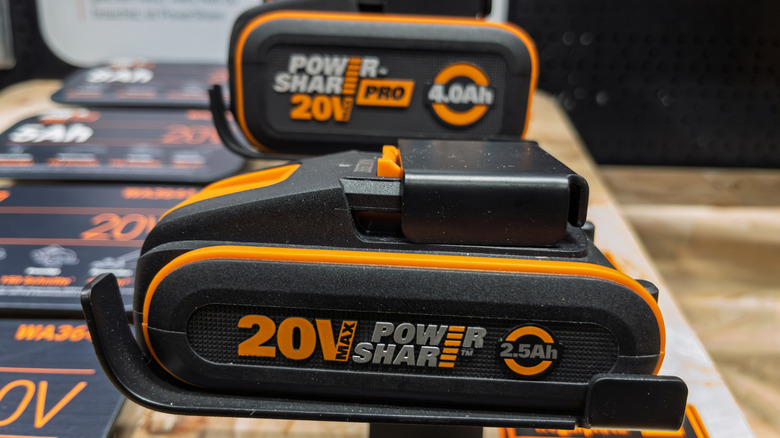
The drill's strength isn't the only factor you need to keep in mind. If you're specifically using a cordless power drill, you also need to take the power of its attached battery pack into account. To clarify, when we say "power," we're not talking about the voltage. Different brands and tool systems are often differentiated into 12V, 18V, 20V, and so on, but you literally can't put a battery from one voltage class in a tool designed for another. Rather, we're talking about amp-hours, usually abbreviated to Ah.
A battery pack's Ah rating determines how much power it can output and for how long on a single charge. Ryobi's 18V system, for example, features 2, 4, and 6 Ah battery packs. All three of these batteries can power an 18V power drill, but a 2 Ah pack won't deliver as much sustained output as a 4 or 6 Ah pack. If you're planning to get down to some serious work with your new power drill for long stretches before swapping packs, you'll definitely want a more powerful battery pack, while a lower-Ah pack would be better for occasional, low-impact jobs.
Mixing up regular drills and hammer drills
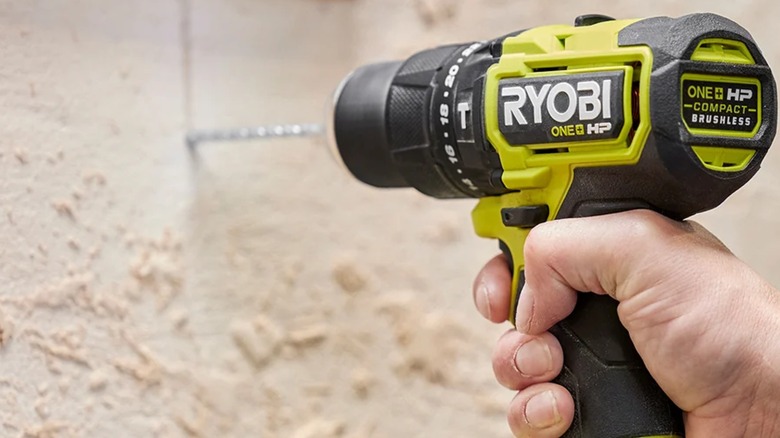
As we mentioned before, finding an ideal power drill isn't as simple as grabbing the first cordless model off the shelf. In addition to the aforementioned reasons, there's also the possibility that the power drill you've grabbed isn't actually a power drill at all. It could be a hammer drill, a similar tool with some important distinctions.
Where a regular power drill consists of a motor-powered spinning bit, a hammer drill also incorporates a hammering mechanism, usually behind the chuck. When this mechanism is engaged, the drill bit rapidly pumps back and forth in a chipping motion, making hammer drills similar to rotary hammers. Hammer drills are intended for drilling into thicker types of materials, such as concrete or stone, with the pumping motion chipping into the material as the drill makes its hole. Mistaking a hammer drill for a regular drill wouldn't be the end of the world, as a hammer drill can function as a regular drill just fine with the hammer mechanism turned off, albeit a heavier, less comfortable one. Mistaking a regular drill for a hammer drill, on the other hand, would be suboptimal, as it could have trouble penetrating solid materials. Don't forget that a drill may not have the necessary voltage for concrete work, either.
Ignoring platform compatibility and accessories
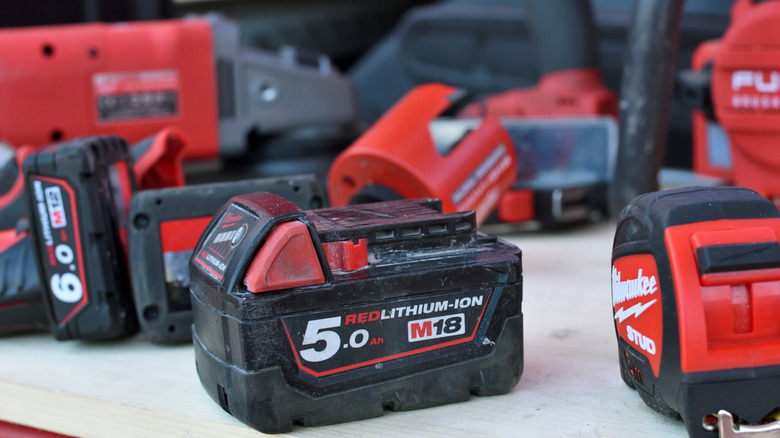
Investing in a good power drill isn't just about the drill itself; it's also about everything that comes with it. If you've already got some tools at home that belong to a particular brand and tool system, like Milwaukee's M12 or M18 frameworks, it would definitely be in your best interest to buy a drill that's also part of that system, if possible. Buying a drill from a random brand, even a good one, could leave you with an annoying situation where none of the accessories or batteries you have at home will work with it, forcing you to buy a bunch of extras for a completely different system.
If you're buying a drill on its own and don't already have accessories from its ecosystem at home, you'd do well to get those critical add-ons so you don't have to buy them later. Chief among these add-ons is a battery charger, which is required if you're buying a cordless drill. You may also want to invest in one or two backup batteries, as well as additional drill-specific accessories like a drill bit set.