

How Do Your Car's Automatic Headlights Know When It's Night Time?

GM first introduced automatic headlights on the 1964 model year Cadillac and dubbed the feature Twilight Sentinel. In addition to turning the headlights on and off, it kept the car's lights on for 90 seconds after the ignition was switched off, which GM billed as a safety feature. Other manufacturers started offering automatic headlights, but they were often an optional add-on or only available on higher-end trims. These days, they're fairly commonplace.
Automatic headlights rely on ambient light sensors mounted on a car's dashboard, at the top of the windshield, or on the rearview mirror. When ambient light dips below a predetermined threshold, like in a tunnel or at twilight, the sensor prompts the vehicle's lighting system to turn on. Similarly, when ambient light reaches a certain minimum level, the headlights and tail lights are turned off. Most systems include a delay of a few seconds, so that a vehicle's lights don't come on when, say, passing through the shade of a tree.
Aside from giving the driver one less thing to do, automatic headlights can improve safety (no more forgetting to turn on your headlights when it's overcast and raining) while also extending the life of your car's bulbs. Some vehicles also have headlights that automatically turn on the high beams on dark roads but dip them when there's oncoming traffic.
Not all automatic headlights are created equal
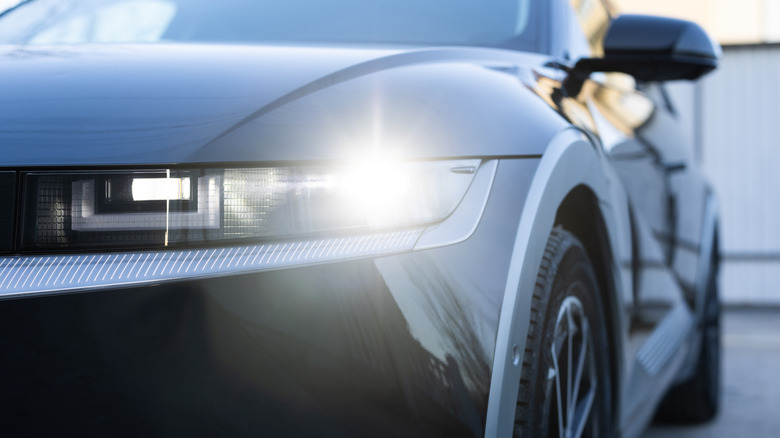
The simplest automatic headlights merely toggle a vehicle's headlights and tail lights on or off depending on ambient conditions, but many newer and higher-end vehicles take things a step further. Adaptive headlights (which were illegal in the U.S. until recently) not only move between high beams and dipped beams automatically, but also pivot as you steer, adjusting to better illuminate corners.
Matrix headlights offer even more situationally aware lighting. Where conventional headlights use bulbs, matrix headlights use banks of LEDs which can be individually controlled, offering far finer control over how much illumination is delivered. For example, in darker conditions with oncoming traffic, matrix headlights can still provide higher visibility without blinding other drivers by making the dipped segments brighter than they are when there's more ambient light available.
In order to ensure your automatic headlights are working properly, it's important to keep the sensors that power them clean and make sure nothing blocks them. It's also important to keep your headlights clean, especially after driving off-road or in other conditions where dirt can build up. Otherwise, you might find yourself on a dark highway wondering why your automatic headlights haven't turned on and needing to turn them on manually instead.