

Apple Brought Back MagSafe On MacBooks, But Is It Better Than It Was Before?
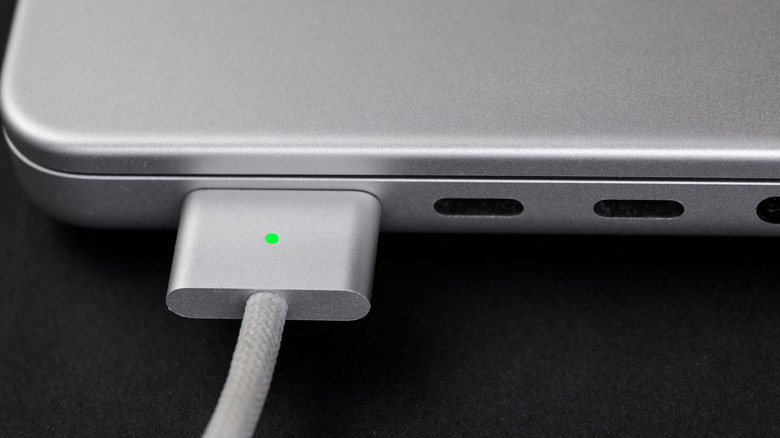
Apple's MagSafe technology currently spans both MacBooks and iPhones, and has existed across three generations. Apple's MagSafe is a portmanteau of "magnet" and "safe," and was initially inspired by magnetic safety cords on deep fryers and Japanese cooking appliances, like rice cookers, that featured a magnetic breakaway power cable. The cable was designed to prevent the appliance from turning over and spilling scalding contents if someone, like a child, pulled on the cable. This core idea underpinned Apple's version, as well, preventing the laptop from being pulled off of a surface if the cable was tugged on or tripped over.
MagSafe replaces the traditional mechanical power connection with a magnetic one. The connector and port both use magnets arranged with opposite polarities, allowing them to couple together. MagSafe for MacBooks has used a few different connector types, such as the T-shape and L-shape bodies, but have always been able to connect in any orientation, just like USB-C. MagSafe charging became a feature that was part of the MacBook identity, and it was originally used between 2006 and 2016, until Apple's 2016 MacBook Pro eschewed the MagSafe port in favor of Thunderbolt 3/USB-C ports instead.
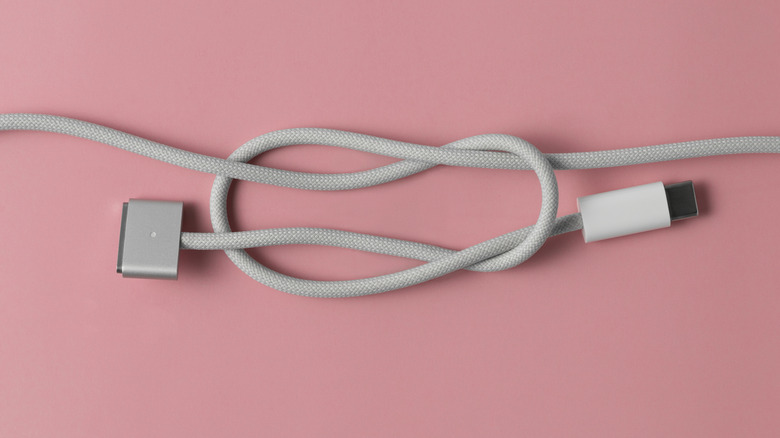
Apple would revive MagSafe for MacBooks in 2021, and it now fits into a larger MagSafe charging ecosystem. MagSafe 3 carries notable improvements over previous iterations, such as faster charging, braided cables, and a detachable USB-C to MagSafe 3 cable, which replaces the older models where the cable was integrated into the power adapter. This makes MagSafe 3 better than it was before, and here's hoping Apple doesn't kill it again.
MagSafe 1, MagSafe 2, and discontinuation
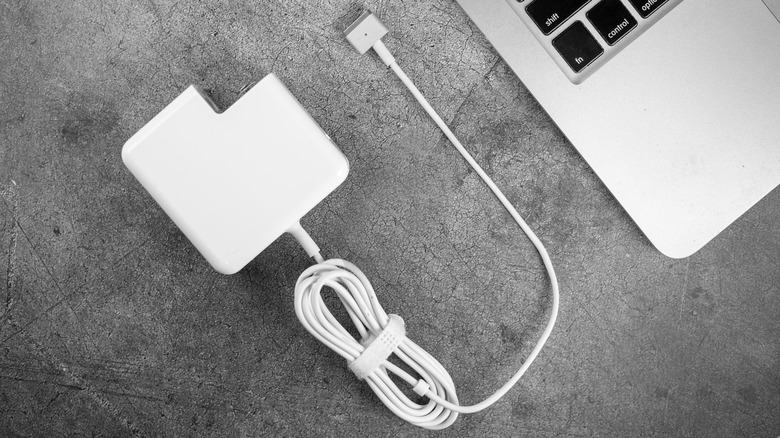
While the concept of magnetic connectors and breakaway cables wasn't new, Apple refined the idea and brought it to the mainstream consumer laptop market with its first Intel-based MacBook Pro in 2006. Apple was granted a patent (US Patent No. 7311526B2) for MagSafe in 2007, as its design was deemed different enough from previous concepts. The original MagSafe (MagSafe 1) would go on to include the original MacBook and the first MacBook Air, and featured power profiles of 45W, 60W, and 85W.
MagSafe 2 came alongside the 2012 MacBook Air and MacBook Pro with Retina Display. The connector was reshaped a bit to fit thinner laptops, and was not compatible with MagSafe 1, but Apple did sell a MagSafe 1 to MagSafe 2 adapter. MagSafe 2 was featured on MacBook Air models between 2012 and 2017, while MacBook Pro models used it between 2012 and 2015 before being phased out. MacBook Pro models between 2016 and 2020 would use Thunderbolt 3 (USB-C), and the last Mac to feature MagSafe 2 was the 2017 MacBook Air, which was discontinued in 2019, seemingly marking the end for MagSafe.
This was a silent and unceremonious end to MagSafe, with Apple saying very little at the time about its exit from the Mac lineup. USB-C is a more versatile port that was also catching on with other consumer electronics at the time, and would eventually be included on almost every device we use now. USB-C also gave Apple leeway to unify and streamline the ports on Macs, helping with thinner and lighter designs. Still, that didn't stop people from mourning the loss of MagSafe, with plenty of online eulogies and calls to bring it back.
The Return of MagSafe: MagSafe Wireless, MagSafe 3, and what's different
In 2020, the MagSafe brand was brought back in the form of wireless charging, starting with the iPhone 12 series. In 2021, during Apple's Unleashed event, Apple announced MagSafe charging for AirPods and AirPods Pro charging cases (and no, MagSafe won't kill your battery). Also during the Apple Unleashed event, Apple revived MagSafe for Macs with MagSafe 3, coinciding with the launch of its first M-series Macs: the 14-inch and 16-inch MacBook Pro models that featured Apple's M1 Pro and M1 Max SoCs.
MagSafe 3 has been further refined over its predecessors, in that it now features a slimmer T-shaped connector, and a maximum wattage of 140W for the 16-inch MacBook Pro, which Apple notes is capable of fast charging the device to 50 percent in about 30 minutes. The 140W GaN power adapter also makes use of a USB-C to MagSafe 3 cable and replaces the older proprietary connector. It supports USB 3.1 Power Delivery, too. MagSafe 3 additionally comes with braided cables, which address some of the early problems with past MagSafe cables fraying around the connector –- which landed Apple in a class action lawsuit in 2009, which it later settled in 2011. As a bonus, the MagSafe 3 braided cables also come in matching MacBook colorways.
Between MagSafe Wireless for iPhone and MagSafe 3 for MacBooks, Apple has built an entire MagSafe ecosystem with numerous accessories, like iPhone MagSafe cases. MagSafe 3 also exists alongside USB-C charging functionality on MacBooks, and still retains the core safety feature that users seemed to love the most. Apple bringing MagSafe back to MacBooks feels like something of a course correction, and MagSafe 3 is a clear win for MagSafe fans.