

These 3D-Printed Cubes Can Cool An Entire Room With Zero Electricity
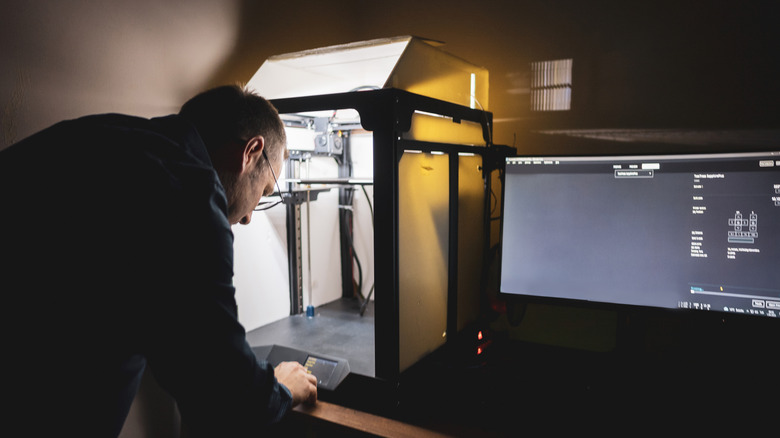
A 3D printer isn't just a fun tool for hobbyists. Even everyday consumers can use these devices to generate practical items they may use around their homes. In the hands of researchers and scientists, 3D printers can also help tackle various real-world problems. For example, a team from the Institute of Architecture and Media at Graz University of Technology (TU Graz) has developed a method that leverages centuries-old knowledge with innovative 3D printing technology to cool hot spaces without relying on electricity.
Granted, this project involves working with materials not commonly used in typical consumer-grade 3D printers. The team used additive manufacturing tech to create ceramic cubes that have been shown to measurably cool spaces like attics thanks to a principle known as "evaporative cooling."
Basically, during evaporation, water absorbs heat from the air in its immediate surroundings. This yields a cooling effect. Milena Stavric, one of the members of the TU Graz team behind this research, explains that clay jugs and related artifacts indicate that civilizations have been using this principle to cool their spaces for hundreds of years. Now, thanks to 3D printing technology, Stavric and her fellow team members have been able to create uniquely porous clay cubes that offer "an enormous evaporation surface." The result is an efficient, low-volume cooling mechanism that doesn't require significant resource usage.
Test shows effectiveness of 3D-printed cooling cubes

The porous ceramic cubes the TU Graz researchers have developed don't need to be particularly large to be effective. Each side of one of the cubes measures about 23 centimeters, or just over nine inches. The team printed the cubes via a method meant to ensure a relatively large surface area while using minimal material. Thanks to the porous nature of the cubes, they can absorb and hold water through capillary action.
The large surface area means the evaporation surface is large. Once water is distributed throughout one of the cubes, it continues to evaporate, drawing heat away from the surrounding air as it does so. An early indoor test has provided evidence of the cubes' usefulness. The team placed one of the cubes filled with water in a hot attic. The air immediately surrounding the cube showed a temperature drop of close to seven degrees Celsius. One team member stated that the cubes' cooling effect was "clearly noticeable throughout the room".
The potential future of 3D-printed cooling materials
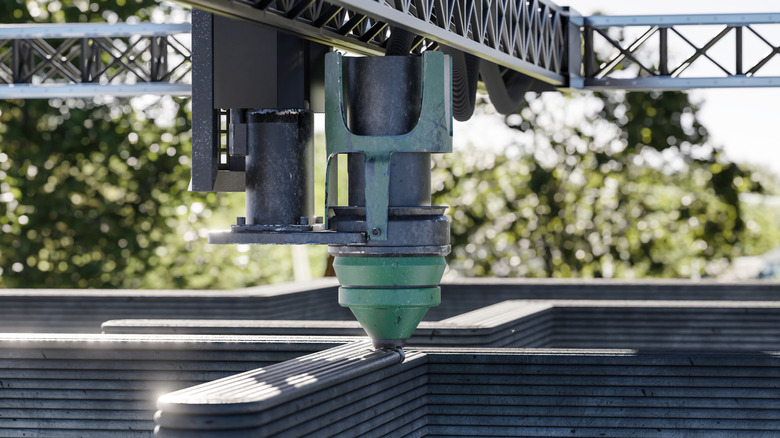
The TU Graz researchers weren't working with consumer 3D printing technology when they created these cooling cubes. They specifically used ceramic materials ideal for these purposes. The team has also expressed interest in experimenting with other materials, with the potential goal of developing a way to incorporate 3D-printed cooling materials in construction projects. Theoretically, this innovative method could allow for energy-efficient cooling systems embedded within buildings' own construction materials.
You might not have access to the tools necessary to replicate the researchers' experiments in your own home. In the meantime, however, you can still use a basic 3D printer for other advantageous purposes, such as saving money. While researchers continue to experiment with ways to use additive manufacturing for the benefit of all of us, individual users can explore the tech on a smaller scale, potentially using 3D printing to solve basic household problems.