

When Did Ford Release The Mustang SVO (And What Makes It Special)?
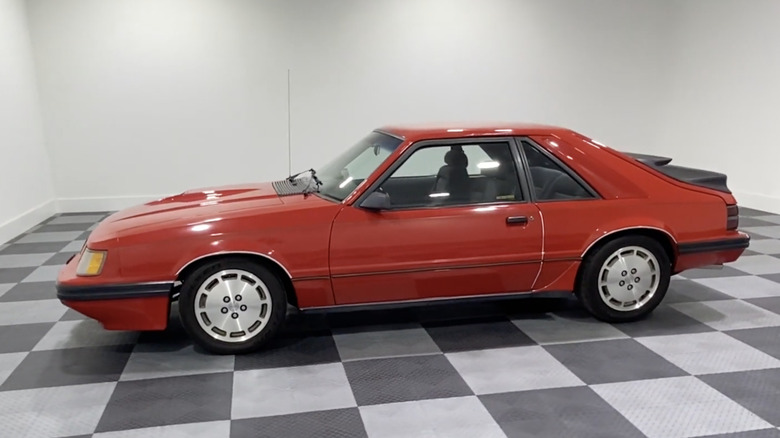
By the early 1980s, the Mustang had basically grown synonymous with big V8 engines. So, when Ford decided to build that car without the V8, but somehow still keep it quick, it almost counted as an act of heresy. The heretic in question was the Mustang SVO, which hit showrooms in the fall of 1983 as a 1984 model. Production then ran for three years before the car was quietly killed in 1986.
The 1980s were an era of tighter laws around fuel economy and emissions from the government, so it's no surprise engines grew smaller through that period. While the Mustang was still offered with a V8, the SVO was supposed to offer an alternate Mustang – a world-class, high-handling sports car that rivaled the refined machines coming in from Europe. And that's exactly what made the car so special. The Mustang had always been a symbol of American performance, so borrowing bits from a European recipe made it stand out.
A new internal division was set up in late 1981 called Special Vehicle Operations, or SVO, and was tasked with the creation of the car. This department was originally created to run all of Ford's motorsports programs , while also growing a performance parts business. The third task was to develop limited-run street cars whose profits would help pay for the racing. The Mustang SVO was the first of those cars. What makes it even more interesting is that it almost didn't happen.
Why the Mustang SVO was ahead of its time
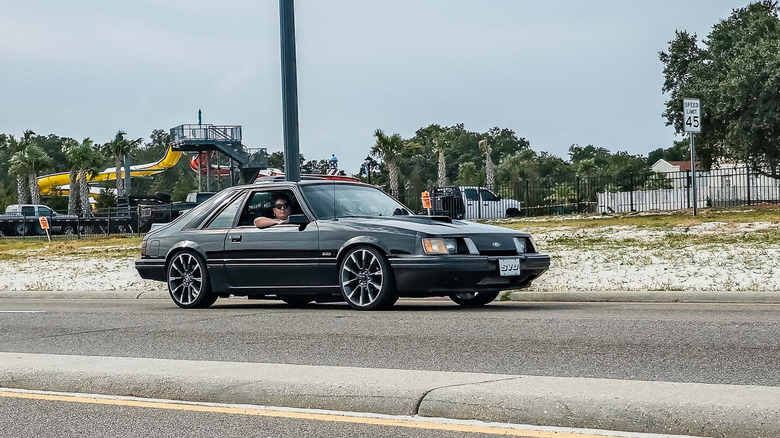
Originally, the car was supposed to come out in mid-1982, but then Ford decided to replace the Mustang with a front-wheel drive coupe built on a Mazda platform. Thankfully, Ford reversed that call within months, though it still ended up delaying the SVO's arrival by more than a year. But the team made good use of that time to test and refine turbocharged prototype versions of the car, even sneaking two of those into a 24-hour endurance race at Ohio's Nelson Ledges circuit in 1982.
Ultimately, they managed to build an American answer to the BMW 3 Series. The sport sedan had spent years setting the benchmark for how a car could still feel upscale without being meters and meters long — and handle well while at it.
The American answer was powered by a humble 2.3-liter four-cylinder boosted by a turbocharger. The engine was also Ford's first with multi-port fuel injection. In its first year, it had 175 horsepower, which may not sound like much, but the figure still matched the Mustang GT's 5.0-liter V8 for output — while weighing roughly 150 pounds less. This let the team sit the engine behind the front axle for better front-to-rear balance.
Great car, but a tough sell
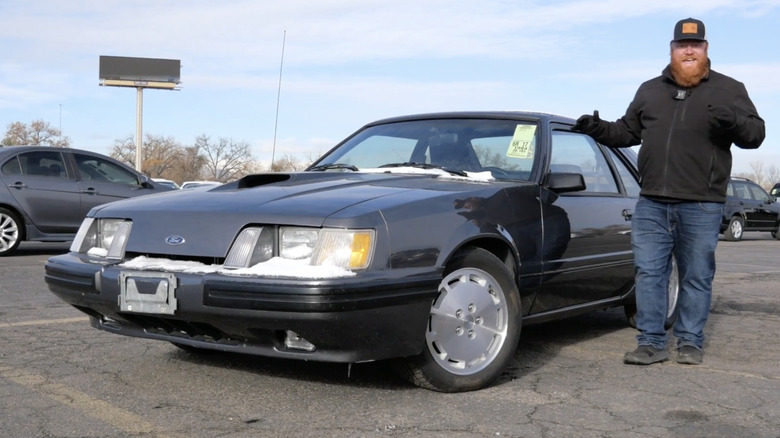
The car also collected a couple of genuine firsts along the way. This was the first American produced carwith an intercooler, the device that chills compressed intake air for extra power. Engine aside, the other half of the car's appeal was carried by the chassis and unique design features. SVO fitted the car with Koni dampers, quicker steering, and four-wheel disc brakes borrowed from the Lincoln Continental. Next year's update (referred to as the 1985½ model) then lifted the output to 205 horsepower and added flush headlights to the nose.
Unfortunately, all of these quirks and features led to a higher price, and it was one of the reasons why the car didn't sell that well. The SVO launched for $16,713, which was about $6,018 more than a V8 Mustang GT. Most shoppers understandably went for the GT branding while saving several thousand dollars.
Ultimately, the SVO ended up being one of the rarest limited-edition Mustangs Ford ever built, with fewer than 10,000 made. Should you want one today, Classic.com pegs the average sale price at $15,691, which is almost funny considering that's roughly the same as its initial launch price.