

Sleeping In Your Car? It Could Be A Crime In These US States & Cities
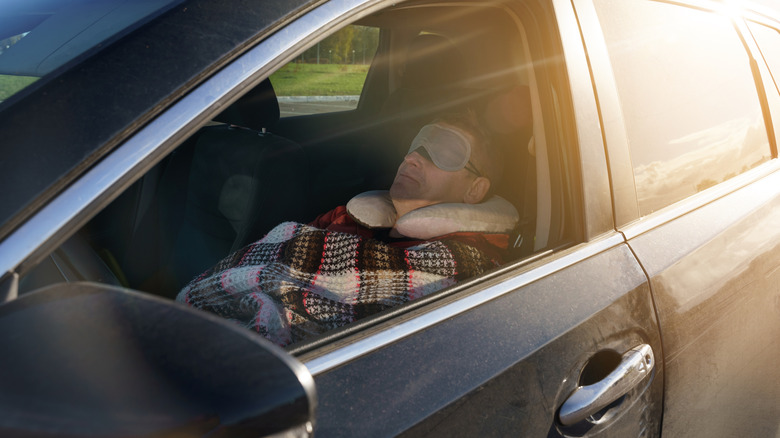
Government agencies have tightened up the laws governing sleeping in your car overnight, as mobile living continues to grow at an exponential rate. That said, there's no federal mandate making it illegal to sleep in a vehicle; that decision is left to the myriad of state statutes, Department of Transportation policies (mainly focused on sleeping at highway rest stops, which tend to have rules of their own), as well as city and county ordinances, many of which are currently in a state of flux.
There was once a time in the good ole U.S. of A. when part of any great road trip involved sleeping in your car, usually at a rest stop, but sometimes anywhere you wanted simply because your peepers demanded some downtime. Those days may well be behind us, for several reasons. There's not only the proliferation of what the kids like to call "the van life," but the cost of housing has reached a level that's leaving many people unhoused. Those unfortunate folks need somewhere to sleep, and more often than not, end up in whatever vehicle they can access.
Because this is such a fluid issue, there is no simple yes-or-no answer. Technically, sleeping in your car is legal in most states, but only if the car is legally parked. Where things tend to get sticky is when you add in local ordinances, rules regarding private property, and posted signs that straight-out prohibit it. Knowing all these rules is one of many car and truck camping tips you should be aware of.
Sleeping in your car can be a tricky proposition in many states
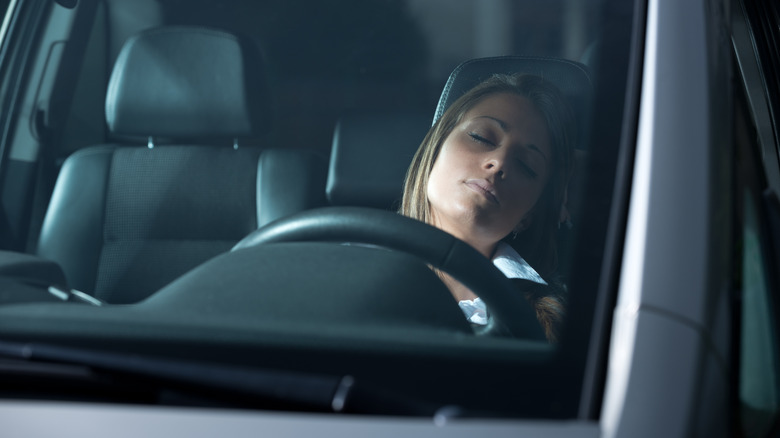
Only five states have laws on the books (both for and against), with several others looking to make changes. Hawaii is perhaps the most stringent, as Revised Statutes (HRS) § 291C-112 prohibits using a parked vehicle for human habitation on any public street, road, highway, or unauthorized private property between the hours of 6 p.m. and 6 a.m. It doesn't apply to vehicles in parks, camps, and other recreational areas complying with the law.
In 2024, Kentucky added a caveat to its existing law on unlawful camping that temporarily allows sleeping (for no more than 12 hours) in a legally parked car on any public road, street, or parking lot. Utah has no state law against living in your car, but most cities prohibit sleeping in them on public streets. Plus, there are regulations against "unsanctioned camping" on state property. Florida HB 1365 also went into effect, creating rules around camping or sleeping on public property, and even caps how long you can sleep at a Florida rest stop. Still, cities can enforce their own time limits, no-parking zones, and trespassing rules.
California doesn't have a statewide law, but allows sleeping up to 24 hours in most cities. However, cities like San Francisco and San Jose aren't so kind, and both Los Angeles and San Diego don't allow it on residential streets between 9 p.m. and 6 a.m. In LA, you can do so in non-residential areas, but San Diego doesn't allow it on any public streets, and never near a school or residential property. Ultimately, it's best to think of sleeping in your car as a very grey area and always check local ordinances wherever you might find yourself — before you need to catch a few winks.