

Which Car Has The Smallest V6 Engine?
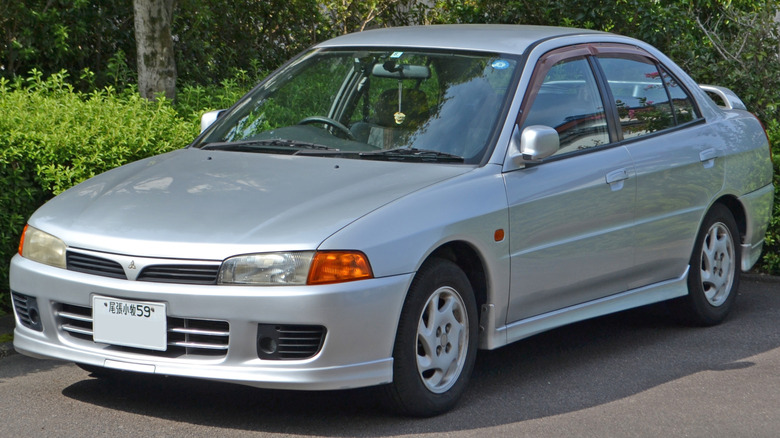
It's true that smaller cars routinely come with smaller, low-displacement engines, but they're usually relegated to four-cylinders, not six. There's a notable exception to this, though. The car with the smallest displacement V6 engine is the Mitsubishi 6A10, with a measly 1.6 liters of swept volume. The 6A10 engine is the tiniest member of the Mitsubishi 6A1 engine family, which encompassed displacements as large as 2.5 liters, with others going down to 2.0 and 1.8 liters in size. The 6A10 used a 10:1 compression ratio to produce 138 horsepower at 7,000 rpm, which indicates that you needed to rev it way up there to generate max power. In reality, it most definitely falls short of the four small engines with more power than muscle car V8s.
The naturally-aspirated 6A10 represents a power output of 86 horsepower per liter, which is adequate for its purpose. It features a cast iron block topped by an aluminum alloy DOHC head with 24 valves. As to why the 6A10 existed at all, this was Mitsubishi's way of offering a V6 engine that would reduce the amount of registration taxes that Japanese buyers had to pay. Because Japanese taxes are based on displacement and not the number of cylinders, Mitsubishi could offer buyers of the 1992-1998 Lancer sedan a smoother, more powerful, and just as tax-friendly alternative compared to the standard 1.6-liter, 111-horse four-cylinder under the hood.
The 6A10 was never imported to the U.S. by Mitsubishi, so if you really want one, your best bet is to import a Japanese Domestic Market Lancer in MX, MX Limited, or Royal trims from those model years. The good news is that the 25-year import rule has passed for these cars, so you're free to import a JDM Lancer from those years.
What else should you know about the Mitsubishi 6A10 engine in the 1992-98 Lancer?
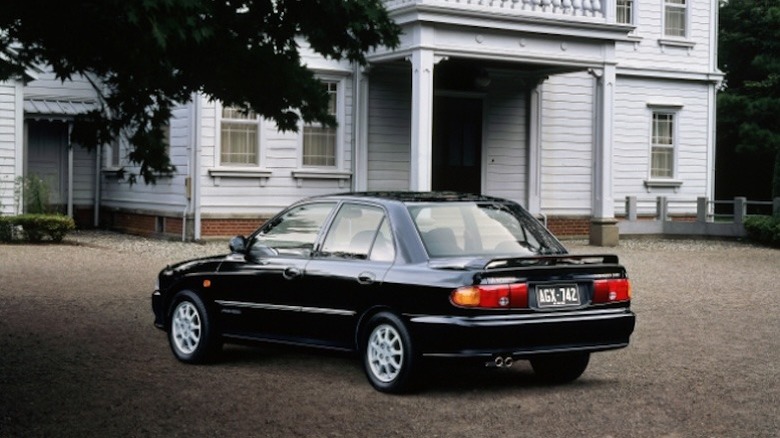
The Mitsubishi Lancer with the 6A10 V6 engine was aimed at lower-level young executive types who would select the vehicle for its practical and low-tax aspects, but who also wanted something more than a four-cylinder engine to provide its motive power. So Mitsubishi gave these buyers of Lancers with upscale trims a small V6 engine that weighed only about 357 pounds without its fluids. This miniscule powerplant would retain the same tax structure as an inline four but would be noticeably smoother on the road, creating a real difference in how the car felt to drive.
The front-wheel drive Mitsubishi Lancer could make the run from 0-60 mph in around 10 seconds, with transmission choices being either the standard five-speed manual or an optional four-speed automatic. Not too surprisingly, the automatic transmission ended up as the more popular choice among the intended clientele. After its run, the 6A10 V6 was dropped from the Mitsubishi Lancer lineup, to be replaced by the larger 1.8-liter version of the same V6 engine. By the time we had reached the 21st Century, this V6 was phased out and wouldn't be available in any Lancer, ending its time of being equipped with a six-cylinder engine.
The Mitsubishi Lancer would continue in the U.S. lineup until it was dropped in 2017, while its high-performance, all-wheel drive, rally-bred sibling, the legendary Lancer Evolution was discontinued two years earlier. Both were axed to make way for the wave of SUVs that has engulfed us, and which continues to be the best-selling category here, currently reaching 41 percent of all vehicles owned by Americans.