

What Distinguishes Fleetlines From Other Classic Chevy Sedans?
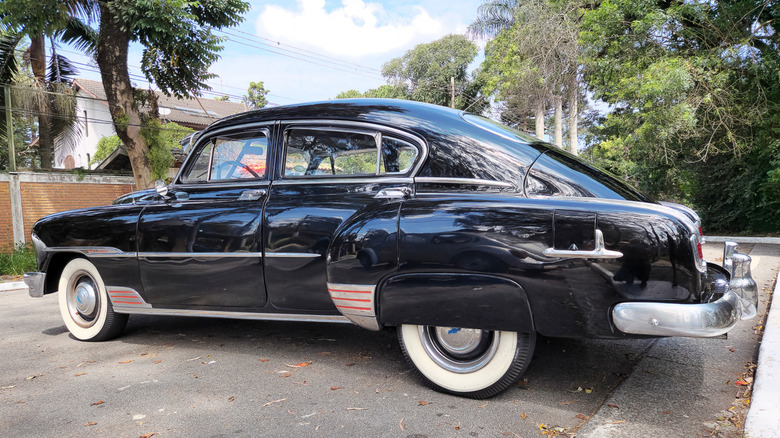
The distinguishing characteristic of the Chevrolet Fleetside is its fastback roofline. The Chevy Fleetside's origin story goes back to the 1942 Chevrolet Aero-sedan, released right before Pearl Harbor. Then the U.S. auto manufacturers converted their production facilities to support the Allied war machine, with several automotive brands used in the U.S. military. The car resumed post-war production in 1948 as the Fleetline Aerosedan, which was shortened to Fleetline for the remainder of its life. The focus of this article will be on Chevrolet's first modern post-war vehicle, the 1949-1952 Chevrolet, which was an all-new design that offered the Fleetline body style throughout its four-year run.
Chevrolet's Engineering Department completely redesigned the 1949-1952 Chevy, while styling was done under the supervision of GM Design Chief Harley Earl. The Fleetline was an extremely successful body design, although this was not equally distributed between the four-door and two-door Fleetline models. While 171,595 of the four-door examples were sold during the car's four years on the market, an incredible 851,137 of the two-door versions were sold. This trend led to the deletion of the four-door from the Chevy lineup after 1951, when only the two-door sedan would remain.
Many of these Fleetline models would live on in different areas of the car culture, with some being customized and others being made into lowriders. The 1949-1952 Chevrolet Fleetline marked the end of the line for a fastback-styled Chevy — at least until the body style returned in a slightly different form during the 1960s, as exemplified by America's best-selling car of 1965.
How did the 1949-52 Chevrolet Fleetline perform?
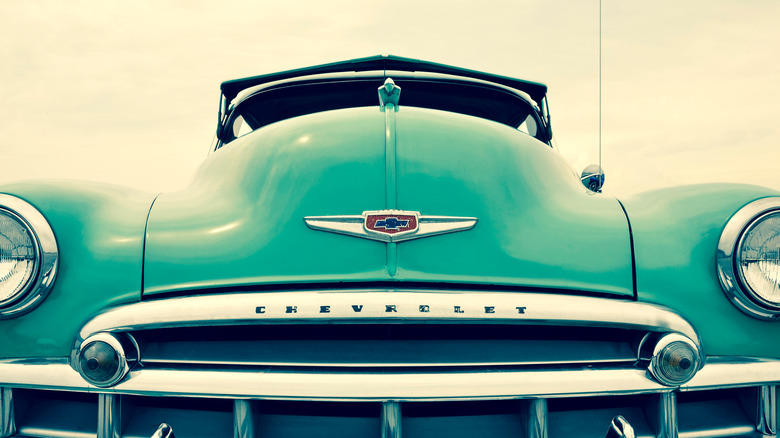
While the sheetmetal and the chassis of the 1949-1952 Chevrolet Fleetline may have been new, that doesn't mean that its engines were. Initially, there was a 216.5 cubic-inch "Thriftmaster" inline six-cylinder engine mated to a three-speed manual transmission that produced 90 horsepower in 1949 and was boosted to 92 horsepower for the remaining years of the run. The big news came in 1950, with the addition of a two-speed Powerglide automatic transmission. Adding Powerglide required an engine upgrade to a larger, 235 cubic-inch "Blue Flame" inline six that made 105 horsepower. Both engines breathed through a single-barrel carburetor. Braking was by hydraulic drum brakes at all four corners, while suspension was independent in the front with a live axle and leaf springs at the rear.
Performance stats for the 1949-1952 Chevrolet Fleetline were not great by today's standards, but they were likely comparable to the Fleetline's competitive set, with the Powerglide cars about a second slower than the manuals. Zero to 60 mph took between 20 and 22 seconds for the manual, with the quarter-mile taking a similar amount of time, with a trap speed of 60 mph or slightly more. Top speeds were somewhere between 80 and 85 mph.
The Chevrolet Fleetline was far from being one of the worst-looking Chevrolets ever made. It represented the final expression of fastback design language for a decade or so. It would take until the go-go 1960s were fully underway before GM would resurrect this mode of styling and adapt it to the muscle car era.