

Which Classic Mopar Was Nicknamed 'The Banker's Hot Rod' & What Made It So Special?
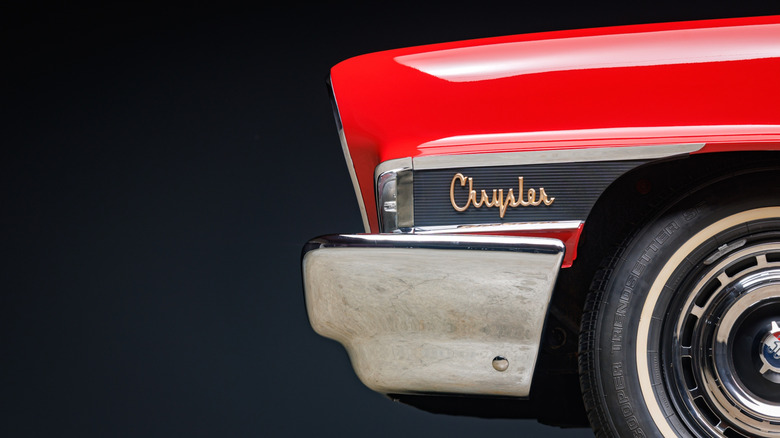
When one pictures the Chrysler Corporation's great performance cars of the mid-20th century, the most obvious examples are the iconic Dodge and Plymouth-badged muscle cars of the mid '60s and early 1970s. With their bright body colors, cartoon mascots, loud spoilers, and legendary 426 Street HEMI engines, those Mopars perfectly represent the wild spirit of the muscle era.
However, well before the time of the Road Runner, Super Bee, and 'Cuda, Chrysler's brands were offering V8 performance cars of a more upscale flavor, and one of these is an iconic Chrysler model known by some as the "banker's hot rod." The model we're talking about is the original Chrysler 300 series, often referred to as the Chrysler 300 Letter Cars.
This line of cars started in 1955 with the Chrysler C-300, and they stayed in production until 1965. During this period, the Letter Cars established themselves both on the street with their sleek styling and on the racetrack, with big V8 horsepower and handling that belied their size and mass. While the 300 was a full-sizer rather than the mid-sized car that defined the muscle car era, the Letter Cars laid the groundwork for the later Mopar-built performance machines. Decades on, the Chrysler 300C name would return on a modern interpretation of the American luxury performance car, with great success.
Win on Sunday, sell on Monday
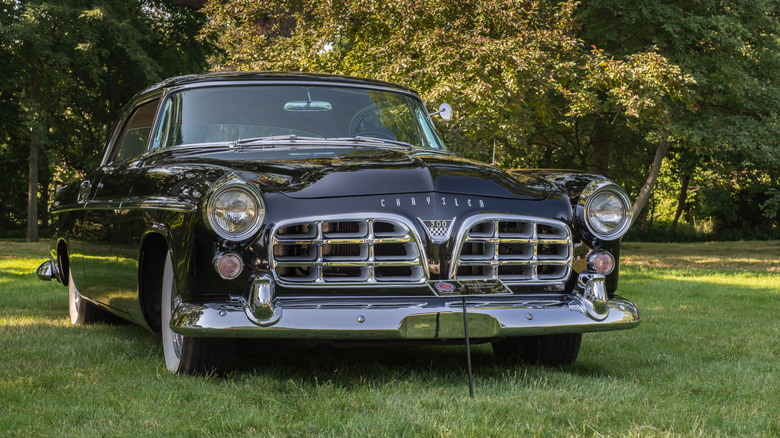
The original 1955 Chrysler C-300 was a groundbreaking car. Styled by Virgil Exner, who took elements from both the Chrysler New Yorker and Chrysler Imperial to create a sleek new two-door model, the car was the first mass-produced American automobile to produce 300 horsepower, a figure that also gave the car its name. This was thanks to the engine under the hood, which was a hopped-up, race-bred version of Chrysler's early 331 HEMI V8.
The Chrysler 300's power wasn't just for bragging rights either. The car absolutely dominated NASCAR competition in 1955, in an era when NASCAR race cars were actually stock cars rather than purpose-built race cars with manufacturer bodies. Importantly, despite its performance, the 300 on sale at America's Chrysler dealers was still a well-appointed, comfortable, and classy car, which helped the car earn the "banker's hot rod" nickname.
There's some debate over whether the luxurious, full-sized 1955 Chrysler 300 could be considered the first true American muscle car. Even if the legendary 1964 Pontiac GTO is more widely considered the first of its kind, though, the 300's historical accomplishments are hard to understate. Beginning in 1956, the re-named Chrysler 300B began the tradition of sequentially lettered Chrysler 300 models that lasted until 1965.
The Chrysler 300 name continued well past the '60s
The '50s and '60s were an era when cars rarely carried over unchanged from one model year to the next, and each of the original Chrysler 300 letter cars improved on its predecessor in some way. By 1961, the Chrysler 300G had nearly 400 hp and 500 lb-ft of torque from a 413-CI Wedge V8. Chrysler would continue iterating until 1965's 300L, the last of the original Chrysler 300 letter cars.
In 1970, the series made a brief comeback on the Chrysler 300 Hurst, also called the 300H. The 300H was a rare version of the 300, powered by a 440 V8 and styled in the same gold-and-white livery as other Hurst-branded muscle cars of the era. The letter series went dormant again until 1999 with the front-wheel-drive Chrysler 300M, which won Motor Trend Car of the Year.
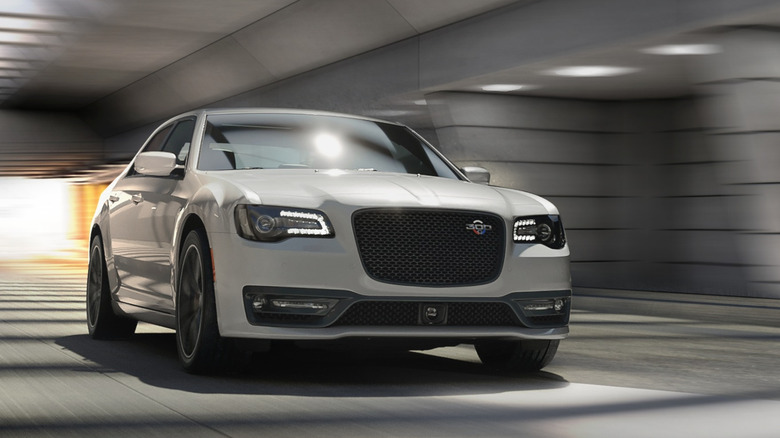
In 2005, the Chrysler 300 returned to its '50s and '60s roots with the rear-drive, HEMI V8-powered 300C built on Chrysler's then-new LX platform. The LX-based Chrysler 300 would stick around for nearly 20 years, spawning high-performance variants like the 300C SRT8 and the special-edition, 485-hp Chrysler 300C that sent the model off in 2023. Chrysler parent company Stellantis hasn't announced any plans to bring the 300 back, but we wouldn't rule out a comeback for the banker's hot rod in the future.