

How Does Your Car Know When The Speed Limit Changes?
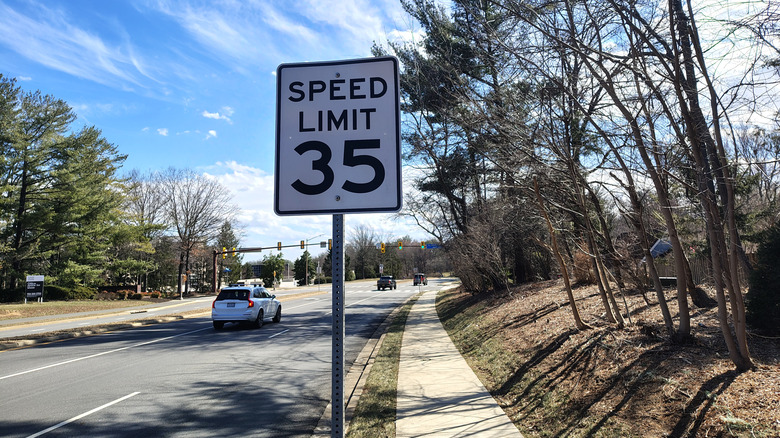
Have you been behind the wheel of a new car lately? The sheer amount of smart features they throw at the driver is unbelievable. Beyond infotainment systems replacing CD players or fancy adaptive cruise control and lane keep abilities, newer models can also tell you when posted speed limits change. Pass a speed limit sign, and some cars will display the new limit on your instrument cluster, infotainment screen, or head-up display almost instantaneously. But how?
It's an advanced driver assistance system (ADAS) known as traffic-sign recognition (TSR), and it uses a mix of cameras, data, and sophisticated image-processing software to update you on roadside signs as you drive. Rather than relying on navigation data alone, traffic-sign recognition incorporates an additional layer of awareness by continuously scanning the road ahead of you for important traffic markers. It's not a replacement for paying attention to the road, of course, but brands like Honda include it as a safety feature if you happen to miss a sign or two.
Traffic-sign recognition isn't always perfect
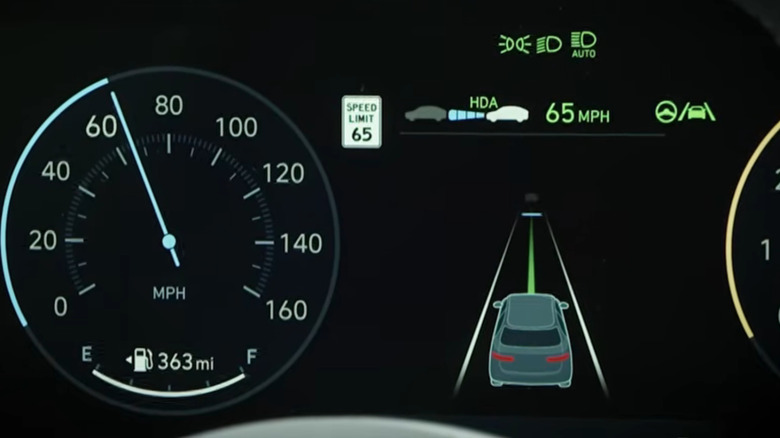
Traffic-sign recognition starts with a forward-facing camera mounted high on the windshield, typically around the rearview mirror housing. It's there to monitor the road ahead, continuously capturing images of roadside signs as the vehicle drives. (The same camera also helps you with lane-keep assist and adaptive cruise control, among other innovative safety features.) Once a speed limit sign enters the camera's field of view, the software analyzes the image in real time, classifies it, and displays a matching symbol for the driver.
Just because TSR systems rely on cameras and real-time data, it doesn't mean they're completely accurate all the time. Their accuracy depends entirely on how clear of a view they can get of the roadway signs. Heavy rain, snow, fog, and other poor conditions are going to hurt visibility... and, in turn, accuracy. Super bright or super dark lighting conditions can also have an impact. Even a dirty windshield can interfere with camera performance and hurt your TSR system's performance. Roadside conditions can be just as much of a challenge. Signs partially hidden by trees, blocked by other roadside objects, or signs bent, warped, or mounted at weird angles might not get recognized properly, either.