

5 Wild West Tools And Tech That Made Cowboy Life Possible
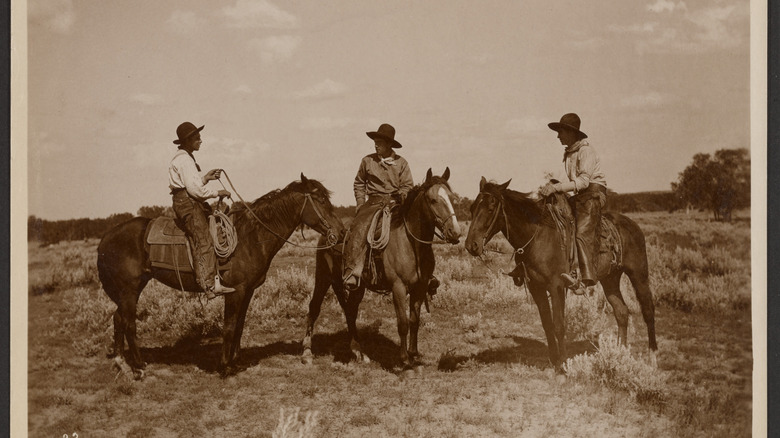
If we asked you what tools a cowboy in the Wild West needed most, you'd probably say their spurs, their saddle, their Stetson hat, and perhaps the lasso. You'd be right, too, but just as our modern misconceptions about cowboys give us a historically warped view of how they really were, spurs and saddles aren't the whole story. Cowboys during the Wild West — roughly the latter half of the 19th century — relied on a lot more than just the stereotypical accouterments of their mythologized career. Some of the tools they relied on weren't always for the reasons you're thinking — and of course, there's a lot of interesting history behind each and every one that's worth digging into.
We want to take a very brief look at Wild West-era tech that would have played an important role in a cowboy's life, even if only indirectly. Some of the most groundbreaking innovations in human history came about during the westward-moving American frontier. Thus, America's beloved cattle drivers came to rely on them in some fashion. Let's take a look at these five items in particular.
The Telegraph
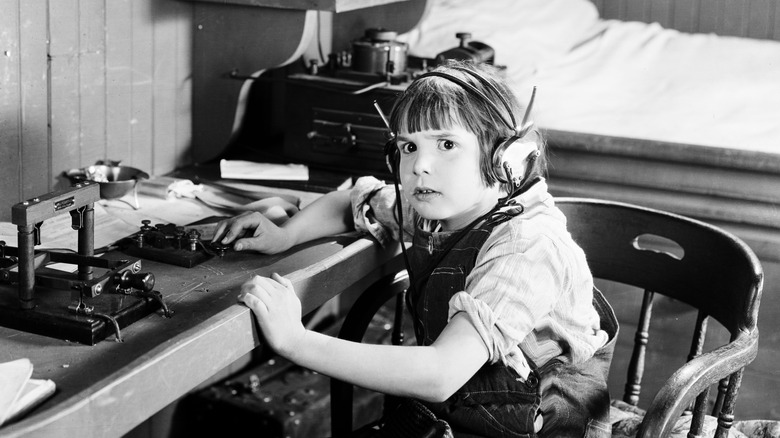
Throughout history, humans did think up some quick, long-distance communication methods, like semaphores. The telegraph took that to the next level. The electric telegraph, as we know it, sent its first official message in 1844. For the first time in history, a message could travel the miles at virtually the speed of light. You can still send a telegram today if you really want to.
Since the American West was so vast, so far from the eastern seat of government, and still expanding, the telegraph closed the distance, in a sense. Updated prices, standardized time zones, train schedules, it could all be sent much faster than even the Pony Express. Since cowboys worked primarily as cattle drivers directing cattle to railway depots, from whence they'd go east to the slaughterhouses, the telegrams were the superior means of communication over these vast distances; the telegraph affected supply chains of all kinds, like cotton and textiles, in some cases completely upheaving how they'd functioned previously. The telegraph might transmit the price of beef and coordinate the rail, and thus would have been a pivotal — even if unspoken — technological advancement underpinning a cowboy's career.
Aside from that, the telegraph would have helped a cowboy in other ways. News, for example. News could arrive as it happened, so cowboys no longer had to wait on riders or word of mouth. They also had the ability to wire money orders via Western Union as early as 1870.
Canning
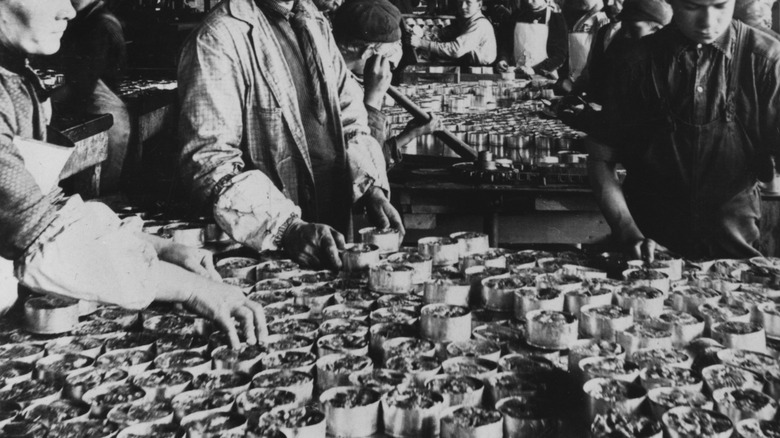
Nowadays we don't think twice about canned food. It's so commonplace and dull that it doesn't even merit a conversation, but it's hard to overstate just how big of a technological advance this was in the 19th century. Food spoils quickly, so before canning — heating food and sealing it in an airtight container — there were massive constraints on how and where food could be stored, how it was transported, and how long you could safely eat it. After canning, long journeys halfway around the globe without frequent stops for provisions became possible. It changed how people fed their families, how wars were fought, and unsurprisingly, how cowboys lived.
Canned food quickly became available in the American West, for obvious reasons. Cowboys might have enjoyed meat, fish, vegetables, and fruit thanks to it while out on cattle drives far from anywhere that would sell it fresh. They often ate from chuck wagons, white-topped wagons carrying enough to feed everyone on the trail (via NCSU). Some of the brands you're most familiar with (Campbell's Soup, for one) started out in the late 19th century. It's entirely possible a cowboy over 100 years ago was enjoying the tomato soup that you now take for granted as part of your emergency supply in the pantry.
Granted, not all their food was canned, and it wasn't sacrosanct; during that period, there were times when poorly done canning led to rotten food and consequently, a public mistrust of the process.
Metallic cartridges for firearms
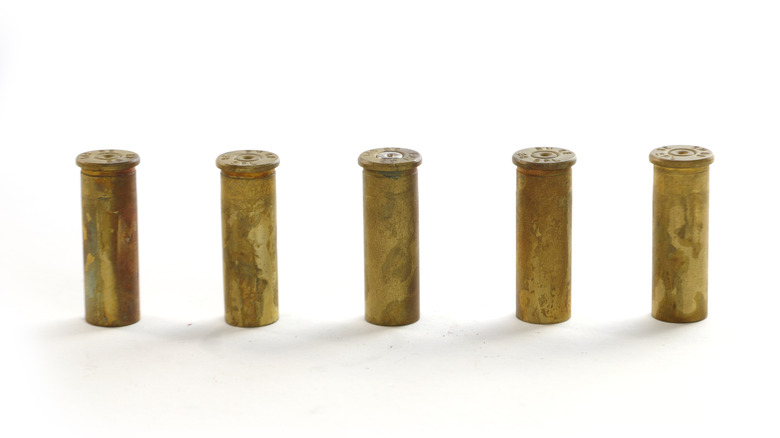
Guns loaded with bullets in brass cartridges have been the norm for over a century. Prior to that, a trained soldier needed a full minute to breech-load a musket with a paper cartridge and a single shot. Battles up to and including the American Civil War (a war already deploying submarines) were fought in lines of men standing in open fields while they shot, reloaded, and shot. All of that changed in the mid-19th century with the proliferation of metallic cartridges. Aside from being faster to reload, metallic cartridges made guns safer to shoot and kept powder dry for longer (via American Rifleman).
For one, if cowboys were attacked on the trail, it usually was an ambush, likely necessitating a gun that can load and fire quickly. The term "vigilante" originates from that time since law enforcement was scarce in the regions where cowboys might have worked. Dangers on the trail included predators, cattle thieves (better known as rustlers), and in some cases Native American tribes, so a cowboy armed himself for self-defense and to protect his boss' herds (via NCSU). Further, cowboys were on long cattle trails that pitted them against wet weather, so paper cartridges wouldn't be ideal.
The irony is that cowboys did need guns, but not for the reasons you'd suspect. The reality was cowboys shooting an attacking bear, or rustlers knowing there wasn't a lawman for miles who'd punish the crime.
Repeating rifles (and revolvers)
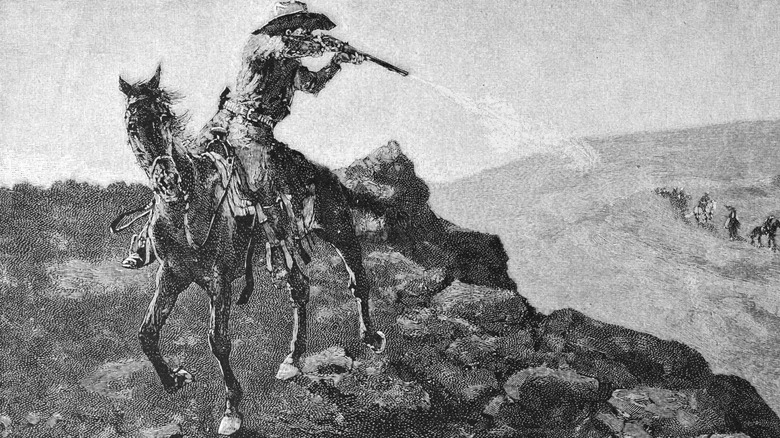
Alongside metallic cartridges, guns made significant strides around the same time. Guns went from single-shot affairs to weapons that a person could shoot and reload in quick succession, particularly repeater rifles and revolvers. Gun manufacturers like Smith & Wesson and Winchester became household names at this time. As such, a cowboy might have access to a Winchester 1873 or a Colt 1873 (known as the Colt Single Action Army), a repeating rifle and revolver, respectively (via Lamar University Press).
Coupled with metallic cartridges, the benefits are clear: cowboys had guns they could shoot and reload quickly. As previously stated, a cowboy faced several threats where a firearm would be essential. However, there's a lot more nuance to cowboys and guns than most may realize. For one, these early repeating weapons were finicky. Misfires could happen, and generally speaking, gunshot injuries were more often accidental than not.
Then there's the less spoken-of side to the Wild West: gun control. Gun violence wasn't as rampant as many believe, but people at the time were still fed up with it. In some cases, cowboy gangs were the main aggressors. Cities like Tombstone enacted strict laws on ownership and open carrying, in response (via Smithsonian). If you're imagining a Hollywood movie where a cowboy struts into town with a six-shooter bouncing on his hip, the reality is more likely that he'd make a beeline to the local officer and surrender it for the duration of his stay. If he didn't, he might spend his last moments looking down that officer's barrel.
Railroads
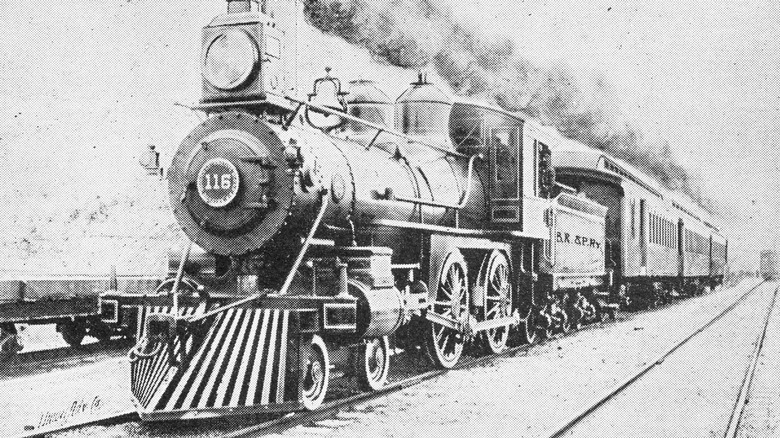
Locomotive engines rose to prominence in the 19th century, changing everything as the telegraph did. Now, heavy cargo could be taken long distances relatively quickly, safely, and reliably, and the average person had access to cheaper goods from faraway places. Beef was one of these things. The demand for beef from growing cities in the east could be sated with the immense herds of longhorns in the sprawling west. All that was needed was cowboys to drive herds (numbering in the thousands) between mountains, across plains and rivers, to their cattle cars. Cowboys took long routes such as the famous Chisholm Trail to guide cattle safely from pastures to the rail, with all the environmental, animal, and human dangers that entailed.
Cow towns (or cattle towns) arose as a direct result of this, to service tired cowboys at the end of their route (via Kansas Historical Society). These cow towns epitomized the Wild West idea of a town we all have in our heads: hoof-churned streets, roisterous saloons, and violent clashes between the law and armed men. Even once the cows stopped coming, many of these towns found new sources of prosperity.
The train made a lucrative business out of bringing beef to places that didn't have much. That business needed burly men who could be trusted to get a horde of stubborn animals from point A to B safely. So even though many cowboys probably rarely — if ever — set foot on a train, many of them would have had no employment without it.