

Why Some Ford Mustangs Have Independent Rear Suspension (And Others Don't)
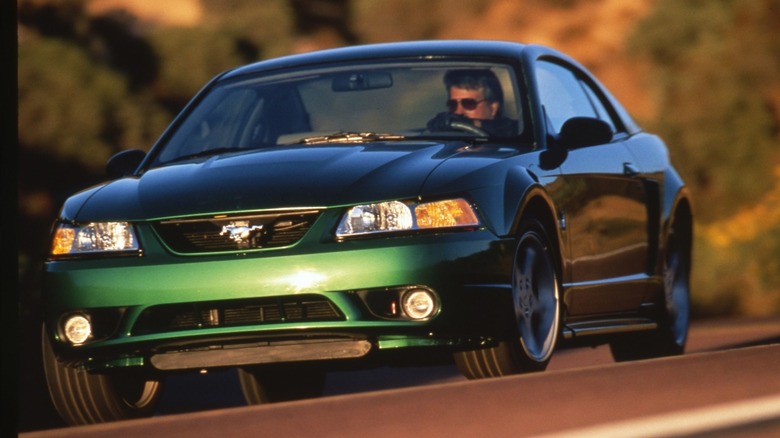
It is true that some Ford Mustangs have independent rear suspensions (IRS), while others do not. From the debut of the very first Mustang in April of 1964 until model year 2015, all Mustangs had solid, or "live" rear axles, with the exception of the 1999-2004 Mustang Cobra SVT models, one of which is shown above. Yet whether the rear suspension is independent or not is not necessarily why Ford Mustangs seem to spin out so frequently, though solid rear axles do tend to have a slightly harder time cornering than independent ones.
One of the major reasons why Mustangs have not had independent rear suspensions until recently has lots to do with the cost of a solid axle compared to an IRS setup. Keep in mind that the original 1965 Ford Mustang was a car that promised great performance and an impressive top speed, but at an affordable price. When that original Mustang was in development, one of its engineers had received patents for an independent rear suspension, but while it provided greatly improved handling and ride quality during testing, it was ultimately eliminated due to both its cost and its weight. The solid rear axle was chosen, and the rest was history — at least until 2015 rolled around.
But while a cheaper solid rear axle does keep the cost down, it introduces some other problems, particularly if good handling is something you'd like your Mustang to have. IRS will give engineers, and ultimately customers, a significant improvement in both ride and handling, due to each rear wheel's ability to react independently of the other one, which is not possible with a solid rear axle.
What's better, a sold rear axle or an independent suspension?
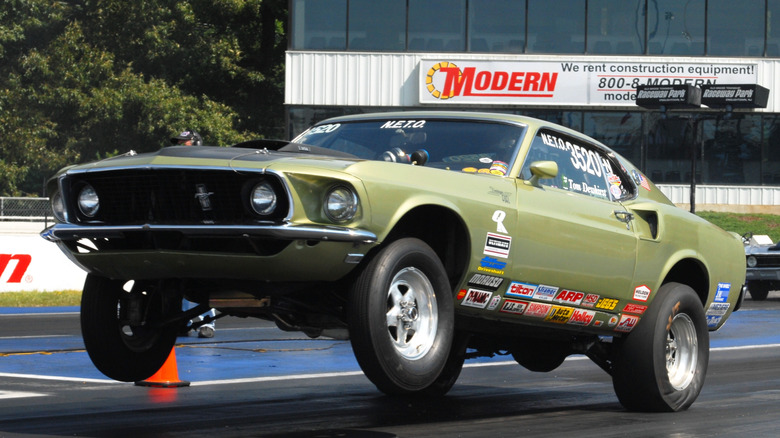
For the vast majority of driving in the real world where you have to go around corners, drive on winding roads, and put up with uneven, potholed, and generally deteriorated road surfaces, an independent rear suspension is a much better choice for your driving enjoyment. This is because an IRS setup gives a car much lower unsprung weight, due to the fact that the heavy differential part of the axle is normally attached to the car's chassis, leaving the lighter-weight wheels to conform to the road surface "independently."
All Mustangs have enjoyed the benefits of IRS since the sixth generation was revealed in model year 2015. IRS continues throughout the sixth and into the seventh generation, which was unveiled for the 2024 model year and continues with today's Mustangs, which are included in our review of every Ford Mustang generation, ranked worst to best.
However, there is a "solid" use case for equipping your Ford Mustang with a solid rear axle. This would apply in the event that your primary automotive focus is drag racing in a straight line, in which case you may be better off with a solid rear axle. That's because its simpler construction is both stronger and keeps both rear wheels upright and flat against the road surface when applying max power, as you would in a dragstrip setting. In fact, a solid rear axle is the preferred setup for Mustangs that are intended for the dragstrip — some 'Stangs that originally had IRS have had them swapped out for solid rear axles.