

How To Know When It's Time To Replace Your Chainsaw Bar
We may receive a commission on purchases made from links.
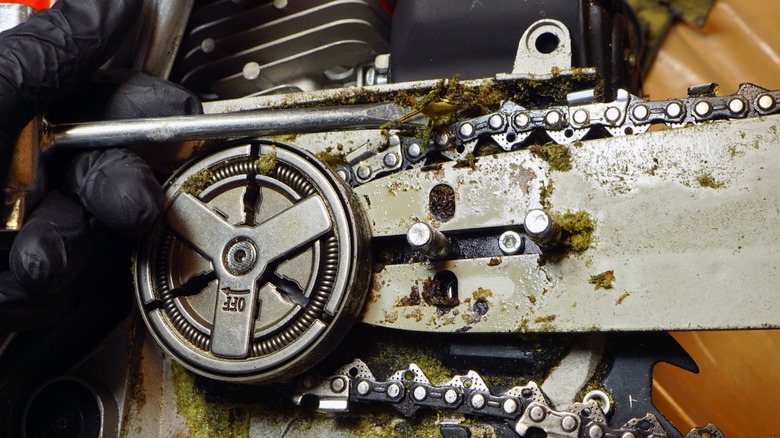
Proper maintenance and keeping your cuts out of the dirt can extend the time before your chainsaw chain needs to be replaced. This rule also applies to the chainsaw bar. The good news is that a high-quality guide bar's life expectancy is four times greater than that of a saw chain.
One trick sawyers use to extend the lifespan of their guide bars is to periodically turn them over when swapping out saw chains. This puts what was the bottom of the bar, where most of the heavy-duty cutting occurs, on top. In addition, keeping your saw clean and lubricated not only prevents chainsaw chain rust before it starts but also extends the life of your saw.
Some signs that your guide bar is due for replacement, or at least repair, include cuts that drift left or right despite your best efforts to cut straight. You could also feel new or excessive vibration as the saw chain rubs against the guide bar.
A definitive test to determine whether your guide bar has reached the end of its serviceable life is to measure the groove depth between the rails. While you could use any thin metal scale to do this, Stihl provides one in its saw chain filing kit, available at Amazon; just make sure it works for your chain size before ordering.
Specific minimum groove depths vary by saw chain pitch but typically fall in the 4mm to 7mm range. If the groove is too shallow or the bar is damaged, it's time to replace it. But if one rail is worn lower than the other while still above the minimum, the bar can be redressed with a file to restore its functionality.
What you need to know to replace a chainsaw bar
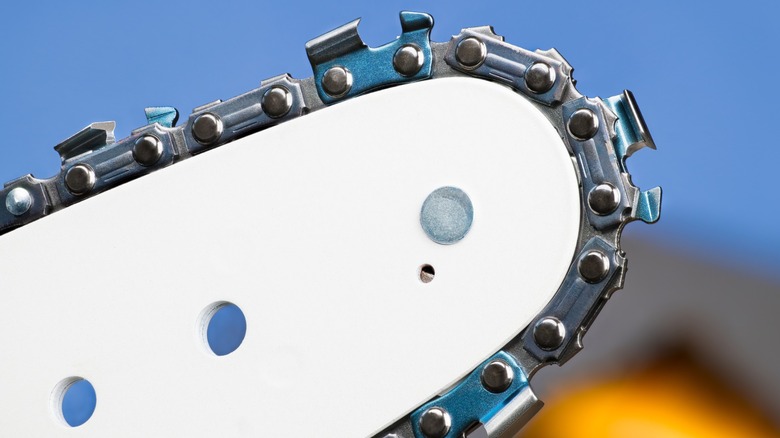
Once you've decided to replace your chainsaw's guide bar, you'll need to know some specifics regarding the bar size and type of saw chain it uses. An easy way to get the correct information is to consult your chainsaw's manual. It's important to get this right, since there are many different chainsaw sizes and not all bars fit all chainsaws.
Alternatively, you could take the bar and chain to a reputable dealer for assistance, or take the measurements yourself. You'll need an accurate measuring tape or scale and a dial or digital caliper (or a 0"-1" micrometer), or you can use a chainsaw bar and chain measuring tool from a supplier such as Oregon, available on Amazon and other retailers.
Often, chainsaws can support a range of bar lengths, so you'll need to measure yours if the size isn't stamped on the bar. With the bar mounted on the saw, measure from the end of the rounded tip to the front of the chainsaw casing where the bar enters, and round up to the next even inch. Generally, we're looking for an even number, such as 12, 14, or 16. However, some mini chainsaws, like the Bauer 5-inch pruning saw from Harbor Freight, use odd-number-length bars.
Next, you'll need to measure the saw chain's pitch and gauge. If you don't have a measuring tool designed for this task, calculate the pitch by measuring the distance between three rivets on the chain and dividing by two. You should end up with a pitch of 0.25", 0.325", 0.375", or something close to another standard saw chain pitch. The chain's gauge is simply the thickness of the drive links, typically 0.050" or 0.058".