

Audi Finally Builds A Bigger SUV, But Is It Better?
Audi throws around its "vorsprung durch technik" tagline with drinking-game-worthy frequency, and even though the English translation—"truth in engineering"—is just as snappy, it's always in the language of the automaker's home country. Because in the auto industry, German engineering is advertising gold.
By bringing technologies like all-wheel drive and LED lighting into widespread use, the automaker from Ingolstadt has certainly earned its reputation for engineering innovation. But Audi also has a conservative side, one it specifically shows in the most important market segment. Audi was well behind its German rivals in launching its first SUV (the Q7, in 2007) and it's been happy to ceded full-size SUV sales to the BMW X7 and Mercedes-Benz GLS-Class until now.
The 2027 Audi Q9 arrives at dealerships later this year to finally fill that gap in the lineup, but it's not exactly a poster child for "vorsprung durch technik." It's feature-packed and luxurious, but doesn't so much innovate as put what Audi is already doing on a photocopier and hit "enlarge." And like every other full-size SUV, it reflects American tastes more than those of its country of origin.
The Q9 will be enough to entice new customers—and keep those who previously had to go elsewhere for a bigger SUV—even if it exploits the legacy of German engineering rather than adding to it.
Styling flaunts the biggest Audi's generous proportions
Throughout the presentation ahead of this super-sized Audi's debut in New York City, executives emphasized that the Q9 was developed primarily with the U.S. market in mind. It definitely shows, although that doesn't exactly make for a handsome-looking vehicle.
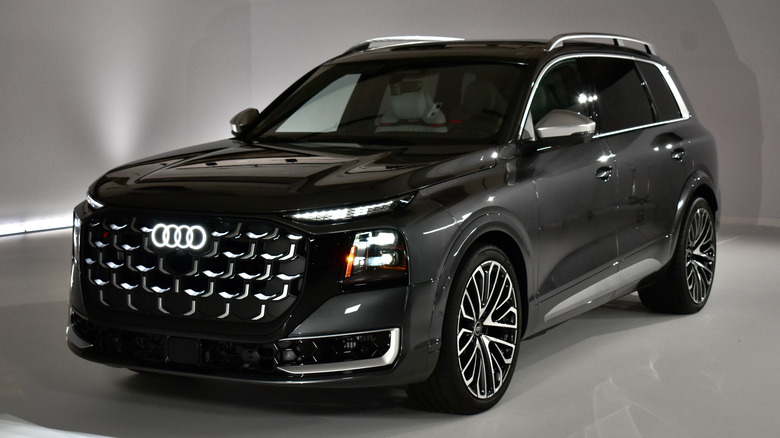
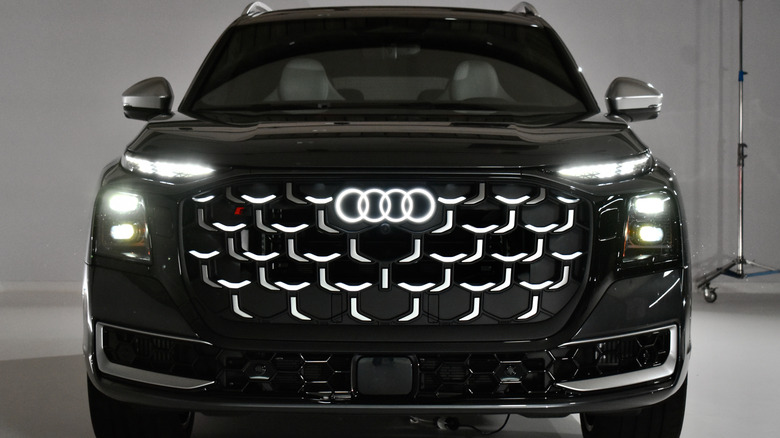
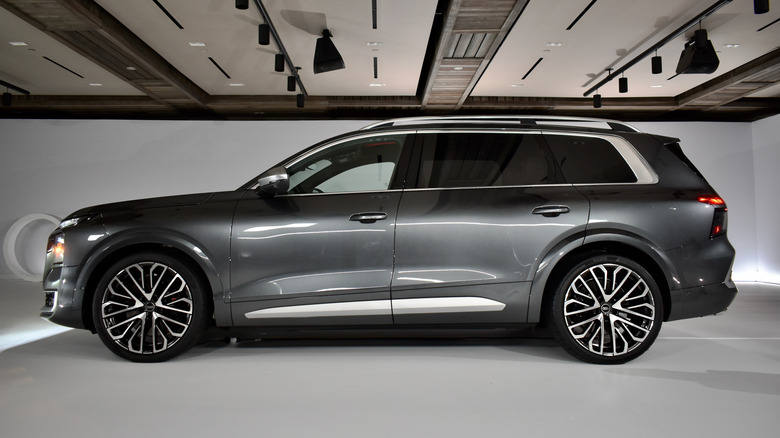
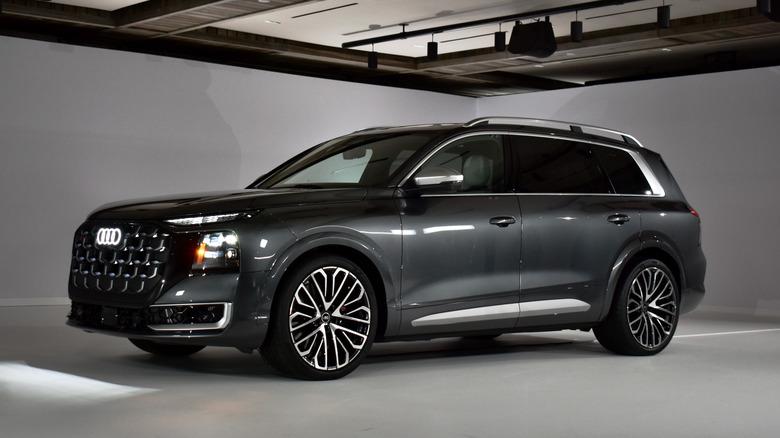
Audi's signature grilles have gotten bigger and taller in the most recent redesigns of its SUVs, and the Q9 doubles down on that with one that tries to go inch for inch with the likes of the Cadillac Escalade and Lincoln Navigator. It's flanked by stacked lighting elements, with swollen headlight bulges mounted lower and eyelash-like daytime running lights above. The sides are mostly flat, except for the subtle creases Audi puts on all of its vehicles as a nod to the box fender flares of the old Quattro rally cars.
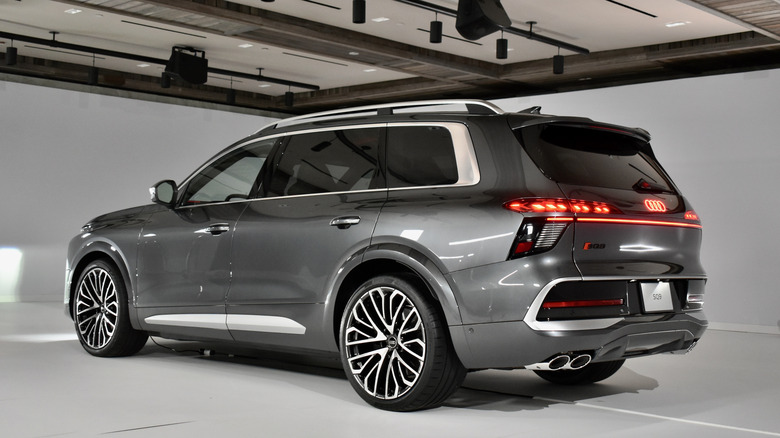
The overall look is pretty similar to that of the just-unveiled third-generation Q7, except at the back. Audi designers made the roofline more upright, and lowered the license-plate mount to make the rear end look even bigger. Again, the aim seems not to be style, but to ensure drivers don't feel inadequate in the private school drop-off line.
A real light show
The Q9's claim to technical innovation rests entirely on fancy lighting. After roughly a decade, Audi is finally bringing its game-changing Digital Matrix LED headlights to the U.S. on this SUV. The 25,600 elements—each thinner than a human hair—can be individually programmed to precisely aim the lights so drivers can see at night without blinding everyone else. At the back, third-generation OLED taillights curve with the sheetmetal for nearly the entire width of the tailgate. The two different technologies were each chosen for different attributes.
"In the front you would like to have light on the road, in the rear you would like to have light on the car," Michael Kruppa, Audi head of front light development, explained. Conventional LEDs can project a lot of light, while ultra-thin OLED elements can be shaped to cover the largest possible area.
The OLEDs can also form different shapes, like warning triangles, albeit ones too small to distinguish easily from a safe following distance. Potentially more useful is the Advanced Turn Signal, which projects arrows onto the ground when the turn signals are activated to make them more visible.
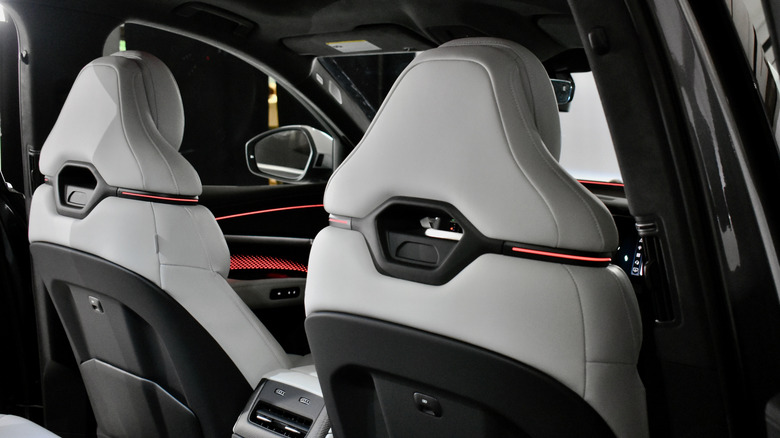
There's some gimmicky stuff as well, including light-up grilles and logos that keep pace with BMW and Mercedes in the peacocking arms race. And inside, the ambient lighting extends onto the seats (and at a later date) the sunroof glass.
A luxurious interior with a different vibe
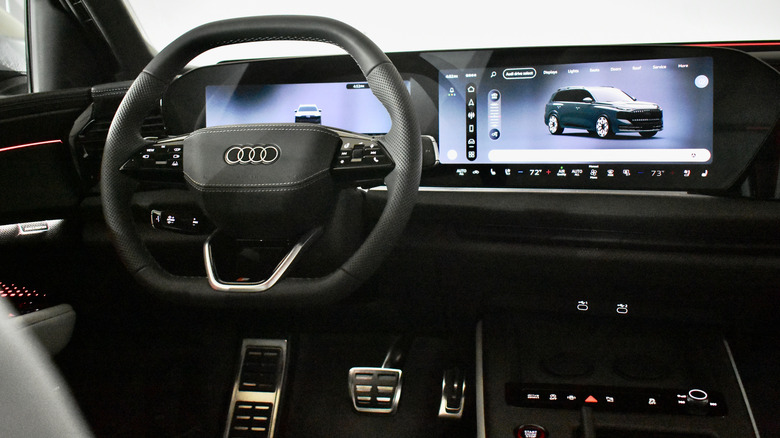
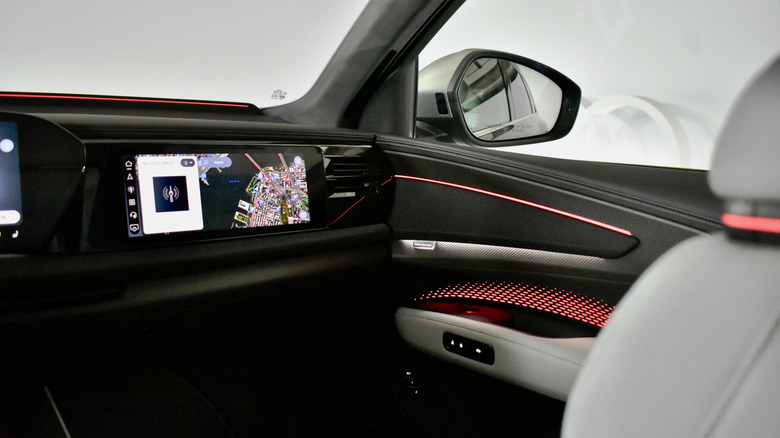
Like the exterior styling, the interior layout largely follows other recent Audi models, but with a few more luxurious touches to mark the Q9 as the fleet's flagship. The dashboard array of 11.9-inch digital instrument cluster, 14.5-inch central touchscreen, and 12.3-inch front passenger touchscreen is familiar at this point, and you'll need all of those screens because there are no manual air-vent adjustments. Dual magnetic wireless chargers keep phones powered up while you're using wireless Apple CarPlay and Android Auto.
Power-closing doors and that spacious second row dial up the fanciness quotient, although Audi doesn't offer chauffeur-worthy options like the reclining seats you get in some other luxury SUVs. The vibe is also more nightclub than country club, thanks to copious ambient lighting and a muted color palette. Audi's choice of mostly matte finishes gives the cabin a high-quality feel too. There's no shiny plastic to produce glare and attract fingerprint smudges.
An available 22-speaker Bang & Olufsen audio system including actuators in the front seats furthers the clubbing experience. It sounded crisp in the studio where Audi had the Q9 demos set up, but there was no opportunity to test the new hands-free highway driving system, which helps Audi catch up in a technology race it's largely ignored up to this point.
How much space are you really getting?
The Q9 is the biggest Audi SUV ever, but it's not that much bigger than the newly redesigned Q7. It's essentially a stretched version of the third-gen Q7, measuring just as wide and only a fraction of an inch taller, but 9.9 inches longer and with a 5.6-inch-longer wheelbase.
That translates to more space toward the back. Headroom in the first two rows is identical to that of the Q7, but third-row passengers get an extra 1.5 inches. When it comes to legroom, it's second-row passengers that benefit, with an additional 2.3 inches over the Q7's second row. This helps affirm the Q9's position as Audi's new flagship since the second row of a big SUV is the closest analog to the back seat of a big sedan like the Audi A8. And expanding third-row legroom would have been too much of a stretch—literally.
"You would end up with the car being 200 millimeters [7.8 inches] longer," Audi CEO Gernot Doellner explained in a media roundtable. "We thought that would be a bit too much."
The 19.3 cubic feet of cargo space behind the third row, 43.8 cubic feet behind the second row, and 87.7 cubic feet behind the first row are also 4.2, 6.1, and 9.6 cubic feet more, respectively, than you get in the Q7. And they should be comparable to the biggest BMW and Mercedes SUVs, albeit not the American full-sizers.
Conservative powertrain choice still gets the job done
Audi played it safe when it came to powertrain choices. The Q9 is only available with the same twin-turbocharged 2.9-liter V6 as the midsize Q7, making the same 429 horsepower and 442 pound-feet of torque as in the smaller SUV, and also hooked to an eight-speed automatic transmission and standard all-wheel drive. Despite the extra weight, Audi claims the Q9 is only 0.1 second slower to 60 mph, at 4.9 seconds. The top speed is an electronically-limited 130 mph, as in most non-S or RS Audi models.
It may not be an upgrade from the Q7, but this engine still produces more horsepower and torque than the turbocharged inline-sixes that are standard equipment in the BMW X7 and the Mercedes-Benz GLS, making the Q9 quicker than both rival SUVs as well. The 7,700-pound maximum towing capacity also doesn't disappoint.
Expected chassis features are standard. Adaptive air suspension includes multiple ride-height settings that can jack the Q9 up by 3.5 inches, or lower it by 2.4 inches to ease entry and exit, city-bus style. Four-wheel steering can turn the rear wheels up to five degrees, either in the opposite direction of the fronts at low speeds to aid maneuverability, or in the same direction at higher speeds for greater stability. But Audi has nothing to rival Mercedes' E-Active Body Control system, available in the GLS.
SQ9 brings V8 power and impressive acceleration
The Q9 also follows the Q7 template with a sportier S-badged variant. And like the base Q9, the SQ9 borrows its engine from the equivalent Q7 model: a twin-turbo 4.0-liter V8. Once again, you don't get any more power, but 591 hp and 590 lb-ft of torque is not bad. Neither is a zero to 60 mph time of 3.8 seconds (0.1 second slower than the SQ7) and a 155 mph top speed with optional summer tires.
A simple engine transplant was apparently all that was needed here as well. On paper, the SQ9 will easily dispatch V8 versions of the X7 and GLS. It's even 0.1 second quicker to 60 mph than the 631-hp Alpina XB7 and 603-hp Mercedes-AMG GLS 63. Those two have higher top speeds, but that only matters if you have a second house in Germany.
The SQ9 has an eight-speed automatic transmission, standard all-wheel drive, air suspension, and four-wheel steering like the Q9. But everything gets sportier tuning, including a rearward bias for the all-wheel drive system and a fully-lockable rear diff that might make this the only driftable three-row SUV. The SQ9 also rides on staggered wheels and tires—10 inches wide in front, 11.5 inches in back—and can be fitted with 23-inch wheels.
No need to overachieve
This big SUV comes with a big price, starting at $89,095 in standard Q9 guise and $113,395 for the V8 SQ9. That's within normal range for this segment, and the Q9 has plenty to recommend it on paper. It's quicker than its most direct rivals, has a usable third row and plenty of cargo space, not to mention those clever lights.
The styling, powertrains, and platform all take a conservative approach, but the numbers show that such an approach still gets the job done. And Audi probably didn't have to try too hard; there's probably a lot of existing Audi SUV owners who want something bigger, or soon-to-be-orphaned A8 owners who have likely been coveting the tall seating position and easy ingress and egress of an SUV.
By Audi's reckoning, SUVs are now 80% of the luxury market. Building another one was a no-brainer, especially as Audi doubles down on the U.S. market, where 65% of Q9s are expected to go. But it's not exactly the daring approach that Audi built its reputation on, and there's little room for German character in a car so stereotypically American. Thankfully for Audi, the average car buyer doesn't consider these things. This is a new car the market will love.