

Odd-Fire Vs. Even-Fire V6 Engines: What's The Difference?
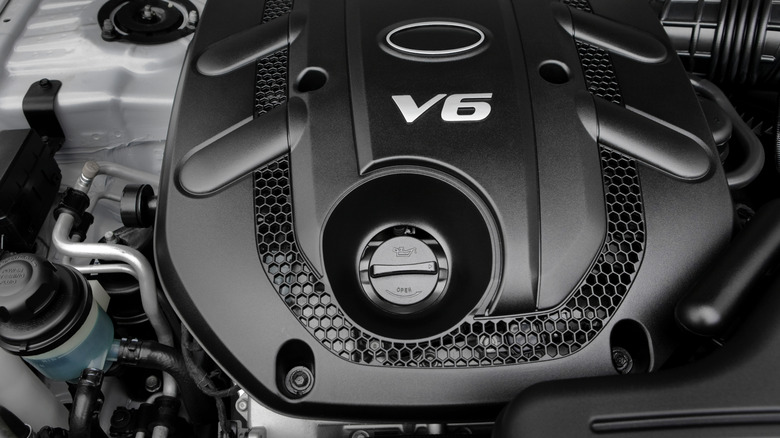
The V-configuration engine has been powering our cars and exciting car enthusiasts almost since the very first car. And while most motoring enthusiasts will associate the engine architecture with the throaty growl of a big-block V8, there are still plenty of great-sounding V6 engines, and some V6 engines can even out-muscle HEMI V8s. In terms of heritage, the V6 engine arrived late to the party and didn't appear in a production car until 1950, when it was used to power the Lancia Aurelia. This engine produced a rather underwhelming 56 horsepower, but the seed was sown.
This engine was an even-firing 60-degree V6 with a displacement of 1.8 liters. However, just what do we mean by describing a V6 as even-firing or odd-firing? To understand this, it helps to know how a V6 completes its four-stroke cycle. In a V6, each cylinder fires once every 720 degrees of crankshaft rotation, meaning the engine as a whole requires a combustion event every 120 degrees. Many V-6s achieve this with a 60-degree layout: This design naturally supports evenly spaced 120‑degree firing intervals; any V6 that achieves equal 120‑degree combustion events across the 720‑degree four‑stroke cycle is considered an even‑firing V6. While this helps the engine run more smoothly, there are still inherent balance issues and other common problems with V6 engines.
Odd-firing V6 engines follow the same basic four-stroke cycle, but their firing intervals aren't evenly spaced. This might seem like a strange design decision; after all, uneven firing sequences can lead to rough-running engines that don't sound like your classic V-configuration engine. This raises the question — Why do odd-firing engines exist at all? To understand this, we need to take a quick history lesson.
Why there are odd-firing V6 engines
Every four-stroke engine works on the same principle — air and fuel are drawn in, compressed, ignited, and exhausted. During each four-stroke cycle, each cylinder completes a "combustion event" every 720 degrees of crankshaft rotation. As outlined above, a typical even-firing V6 does this by spacing these events at 120-degree intervals. Typical V8 engine crankshaft configurations include cross-plane cranks, where four crank journals are arranged at 90-degree intervals, and flat-plane cranks, which use two pairs of crankshaft journals 180 degrees apart. In other words, an engine is even-firing when the required firing interval divides evenly into 720 degrees.
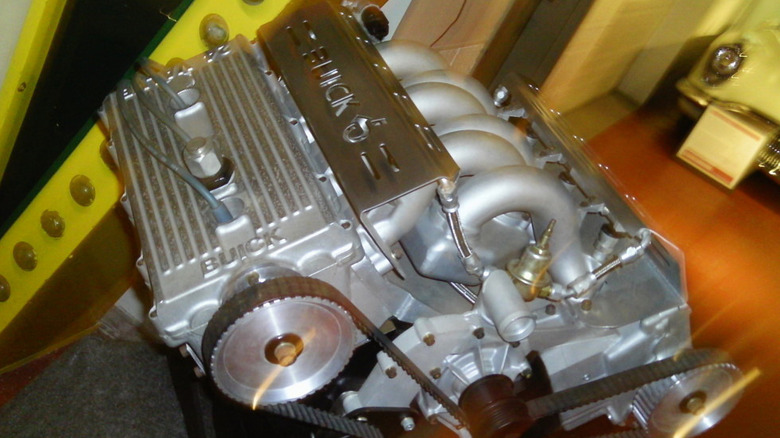
This makes sense, and you'd think every V6 would be designed this way — after all, the very first production V6 was, so you'd think it was a reasonable path for other designs to follow. To understand why this isn't the case, we need to look at the first American V6 developed for the commercial market — the Buick Fireball V6.
Unlike the Aurelia's V6, which was based on a custom-designed 60-degree block, Buick's engine used the same architecture as its small-block aluminum V8. Essentially, the V6 was a sawn-off version of this block and still retained the 90-degree bank angle despite being two cylinders light, though it used a cast-iron block. While this design decision made the new V6 inexpensive to manufacture, it had two cylinders missing from the cycle. Thus, the crankshaft couldn't deliver the evenly spaced 120-degree firing intervals. Instead, the firing intervals alternate between 90 and 150 degrees, giving the engine its distinctive odd-firing character and noticeably uneven rhythm. It's worth noting that this engine was the forerunner of the iconic Buick 3800 V6 engine.