

Honda HRX-BE Vs. HRX-BV: What's The Difference Between These Lawn Mowers?
We may receive a commission on purchases made from links.
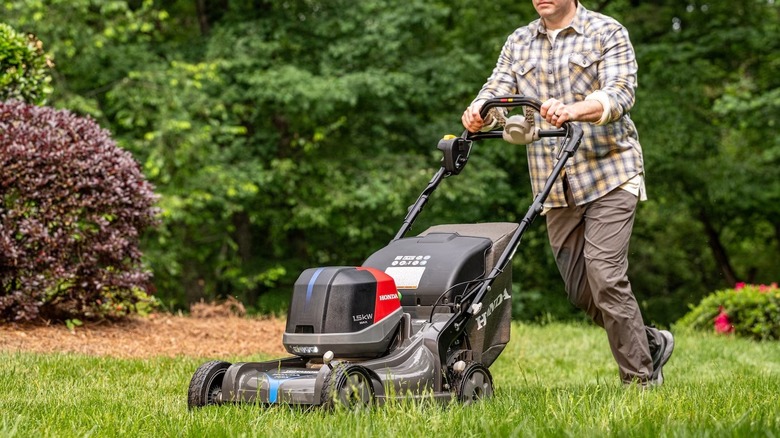
You can find Honda among the most reliable push lawn mower brands ever built, with the manufacturer noted for offering machines with lengthy service lives. However, Honda announced in late 2022 that it would cease producing gas mower models the following year and instead has released new electric options in their place. In terms of the residential tier, both the HRX-BV and HRX-BE are strong contenders, carrying over the HRX name from previous gas model lineups. Both mowers feature a 4-in-1 Versamow system, Roto-Stop safety capabilities, and a 5-year warranty. But what sets them apart?
The HRX-BV is the more entry-level model of the two. It runs off of a single 8 Ah battery that allows for up to a half hour of runtime and can accommodate a yard size of around ¼ acre in ideal conditions. You'll also notice that the HRX-BV has a prominent speed selecting dial near the handles that allows you to precisely adjust the self-propel pace.
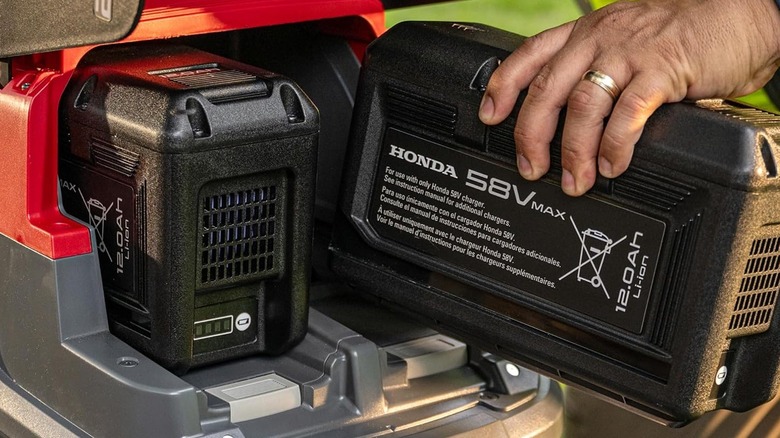
Conversely, the HRX-BE offers more power and runtime, with up to 45 minutes on a 12 Ah battery, making it possible to cut up to .37 acres. In addition, the battery bay (located on the top of the unit) has a second slot for another battery if you want to add even more capability to the machine. Lastly, instead of a dial to adjust the mower's self-propel pace, you get toggle levers on each side of the handles that can be triggered with your thumbs. One incrementally speeds up the unit, and the other slows it down.
High prices and poor design choices hinder these Honda mowers
While reviews praise these Honda machines for offering an excellent cut, many also note the exorbitant price tag. The HRX-BV is available from retailers like Amazon for $1,049, which is expensive for a walk-behind mower. The more robust HRX-BE sits even higher at around $1,299, and that's with just one 12 Ah battery. An additional battery runs just under $600; that combined has you forking over $1,900, nearing the price bracket of entry-level riding mowers.
Another aspect of these tools that may give you pause is the material that comprises the deck. Instead of steel or even aluminum, Honda opted to use a proprietary NeXite polymer, which is similar to the composition of something like an automobile bumper. While it can resist impacts and rust, there are reasons you might want to avoid a lawn mower that has a plastic deck, with some experts citing general durability over time being one possible issue.
Lastly, some reviews have pointed out inconvenient design aspects of these electric Honda mowers. For example, the battery bay access door doesn't feature a mechanism to keep it positioned open. So, one hand must keep the door open while the other slides the heavy, nearly 9-pound battery into place — a battery that doesn't include a carry handle. These nitpicks might not be a deal breaker, but considering the best cheap lawn mowers according to Consumer Reports (both gas and electric) are all under $450, the decision to go with Honda might be more difficult.