

What's The Difference Between A Nuclear Reactor And Nuclear Weapon?
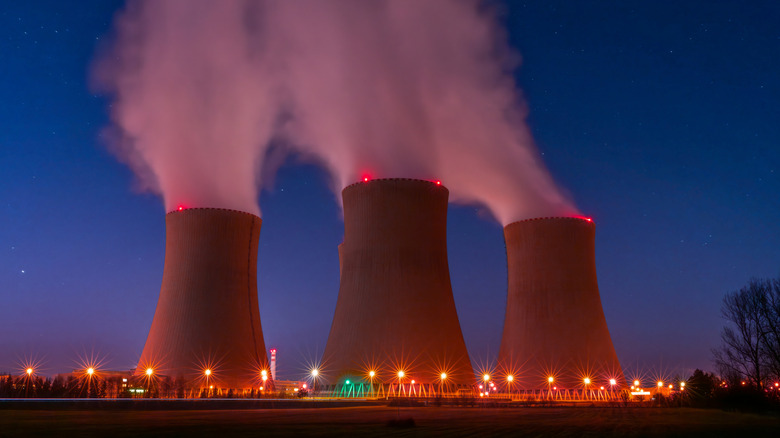
Let's get the obvious difference out of the way first: A nuclear reactor generates electricity that can power the world around us. A nuclear weapon, well, we know plenty enough about the damage one of these devices can cause.
However, this leads to an interesting question: What prevents a power station from becoming a nuclear weapon (and vice versa)? To understand this, we need to look at the physics that underpin both processes and where they vary. Fundamentally, both of these scenarios rely on a chain reaction known as fission. Fission unleashes the energy locked within all mass, as Albert Einstein's famous equation, "E=MC²," states. In both weapons and reactors, this involves splitting uranium atoms by hitting them with subatomic particles called neutrons. A successful hit splits the uranium and produces more neutrons. These neutrons hit further atoms and hey presto: a fission chain reaction.
In a nuclear reactor, this reaction is highly controlled. The most common type of nuclear reactor uses two water loops; one to cool the reactor and another to generate power. The former ensures that just enough fission occurs to heat the latter, which produces the steam that drives the turbines and, ultimately, generates electricity. Nuclear weapons, on the other hand, aim to make this chain reaction as aggressive as possible. In other words, the defining difference is: Nuclear reactors rely on controlled fission, whereas nuclear weapons require an uncontrolled reaction.
Controlled versus uncontrolled chain reactions
As noted, both reactors and weapons largely rely on uranium — more specifically on the fissile isotope uranium‑235 (U‑235), although both can also use plutonium. Most uranium is not U-235, however; instead, 99.3% of mined uranium is uranium-238 (U-238), and this raw form is unsuitable in either situation. Thus, uranium must be enriched. This takes place in advanced centrifuges, which spin unrefined uranium so fast that the heavier U-238 atoms move to the outside of the mass. Very simply, the longer you spin, the higher the density of U-235 becomes.
For uranium to be useful in nuclear power stations, it needs to be enriched from about 0.7% U-235 to around 3 to 5%. This is considered low-enriched uranium (LEU) and is below the critical mass required to create a nuclear explosion. In other words, the amount of LEU required to allow an uncontrolled chain reaction is too large to make a viable proposition.
The solution for weapons, then, is to cram more fissile material into a smaller volume. This is where highly-enriched uranium is needed. Although this applies to any uranium-235 level of 20% or higher, weapons-grade uranium is usually enriched to over 90%. Calling it "weapons-grade" is something of a misnomer, though, as it has a few niche applications beyond munitions. These include naval reactors, which is partly why it takes years to refuel a nuclear-powered aircraft carrier.
How fallout from weapons and nuclear reactors differ
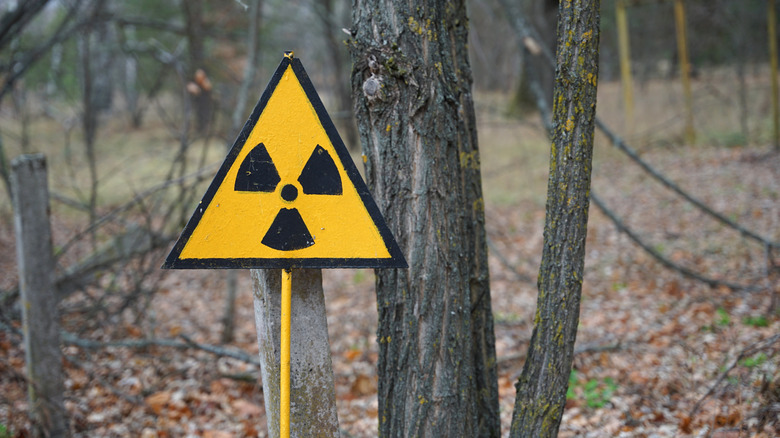
While nuclear energy is generally considered clean, major accidents can be catastrophic. However, the radioactive fallout caused by such accidents differs from that of nuclear explosions. The very nature of a nuclear weapons explosion means the vast majority of radioactive fission products are produced at the moment of the explosion. Most of these are short-lived and tend to decay quickly. As a general rule, after 48 hours, the amount of residual radioactivity will have dropped to around 1% of the level present an hour after the explosion. This can vary depending on how the device is detonated, however.
For instance, above-ground explosions can send radionuclides to 50 miles into the atmosphere. In these cases, heavier particles tend to settle near the explosion site, while lighter particles are lifted into the upper atmosphere and can remain there for years before settling. The amount of these in the atmosphere since the end of nuclear testing in the 1980s has dropped below measurable levels. However, nuclear test sites like Bikini Atoll still have high levels of radiation in groundwater and vegetation. It's worth noting that most nuclear testing was carried out underground, and in these cases fallout was usually contained, unless the explosion vented radioactive debris into the atmosphere.
In reactors, these short-lived fission products are continually decaying. However, because a reactor can run for up to two years without refueling, there is time for older, long-lived fission products to accumulate within the reactor. This means that in the rare cases of catastrophic accidents, longer-lived isotopes like strontium-90 could contaminate the environment for thousands of years, as is the case around Chornobyl.