

This Is The Most Common Type Of Nuclear Reactor In The World
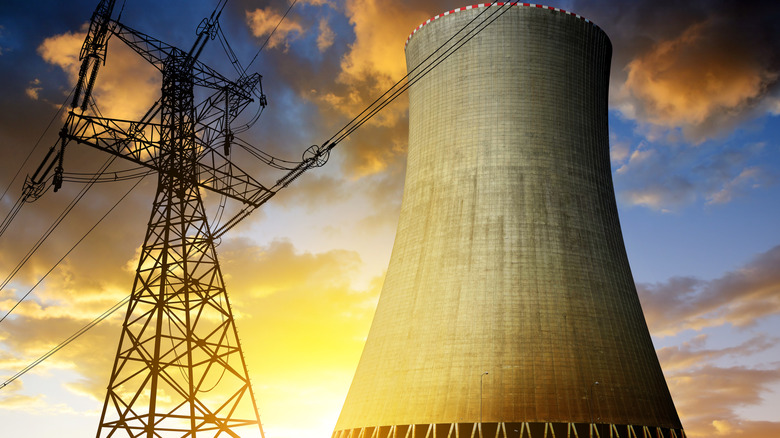
The principles of nuclear energy are fairly simple to understand and are governed by well-understood laws of physics. In simple terms, matter and energy are interchangeable, meaning there is a vast amount of energy locked away in matter. This is the energy that nuclear power stations unlock — all nuclear power plants do this, including pressurized water reactors (PWRs), which are the most common type of reactor.
Nuclear reactors set off chain reactions, using neutrons as tiny bullets to split uranium atoms, releasing the energy stored in the atoms as heat. Take this energy, heat some water, and use the generated steam to spin a turbine and generate electricity — simple, really. Importantly, as we look to reduce carbon emissions, nuclear energy is considered clean.
However, while the principles of generating electricity from any type of nuclear reactor are set in stone, there are still different engineering approaches dictating the architecture, and therefore also the type of nuclear reactor.
The most common types of reactors use water both as the means of generating energy and as the coolant for the core. This type of reactor accounts for about 95% of the planet's civilian reactors. However, it's the subdivisions within this that also define what type of nuclear reactor it is. As noted, the most common of these are PWRs, which account for about 70% of all operational commercial reactors.
How do pressurized water reactors work?
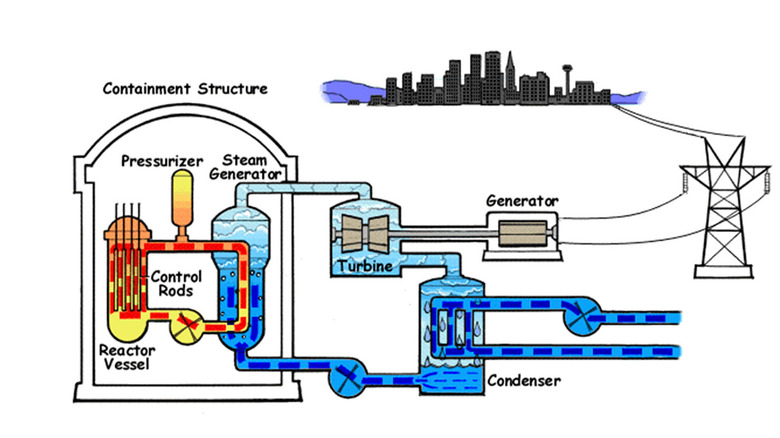
A defining characteristic of a PWR is its dual-water-loop architecture. As the name suggests, this type of reactor uses two isolated water loops. One of these is the coolant loop, which is where the "pressurized" part of the name becomes relevant. This loop is pressurized up to about 150 bar or about 2,176 psi. The reason this loop is pressurized is for much the same reason a car's coolant system is pressurized — the pressure raises the boiling point of the water. In the case of nuclear reactors, this allows the water to reach temperatures of about 617°F without boiling.
The second water loop is what spins the turbines, and so steam is needed. This is why the "steam loop" is less pressurized. However, unlike the coolant loop, in which water is heated as it passes through the reactor core, the secondary loop is heated by the coolant loop via a heat exchanger. Because the steam loop operates at lower pressure, it produces steam at lower temperatures. This is the steam that drives the turbines and produces the electricity. Of course, the process of transferring heat across the loops also removes heat from the coolant water, which is then cycled back through the core and so on.
The water in the coolant loop also acts as a moderator to manage the chain reaction inside the reactor. To achieve this, boric acid is added to the coolant water; the acid concentration is closely monitored and adjusted via an injection system.
From submarines to the global grid: the rise of the PWR
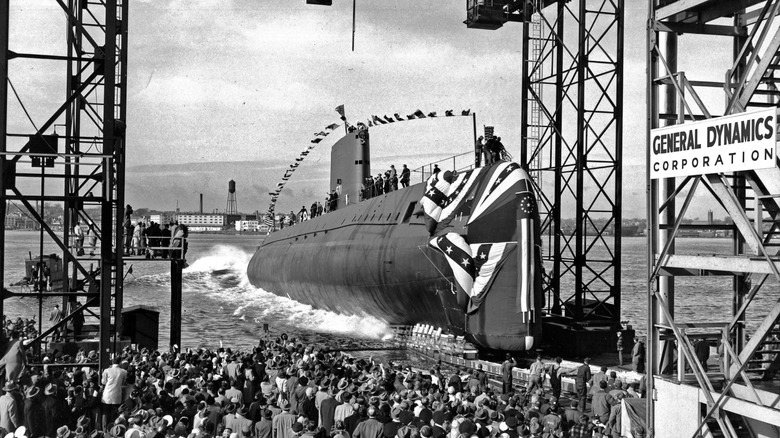
Despite their dominance of the commercial nuclear power sector, PWRs can actually trace their heritage back to the 1950s, when they were designed for the first generation of US Navy nuclear-powered ships. The first ship to sail (or submerge) under nuclear power was the USS Nautilus, commissioned on September 30, 1954, a submarine that had a major impact on the evolution of naval warfare.
Nuclear power gives Navy ships a major advantage by essentially freeing them from the need to continually refuel. Although when refueling is needed, it does take an inordinate amount of time to refuel a nuclear-powered aircraft carrier, for instance. For submarines, the fact that nuclear power doesn't require oxygen is also a big advantage.
Modern-day commercial PWRs still use the same design principles. There are a couple of main reasons why PWRs are the most common type of nuclear reactor. First, there are the separate "water loops" to consider. Because they never come into direct contact, the chances of radioactive water leaks are greatly reduced. The second is simplicity; at least in nuclear power terms, these are considered easier to operate with more control over the nuclear reaction — which can only be considered a good thing.
There are some disadvantages to this type of reactor, though. They are expensive to build because of the need to maintain the pressure in the system. The use of boric acid can also cause some operating difficulties. Boric acid is both aggressively corrosive and can cause metals to dissolve into the coolant, where they become radioactive.