

How Far Apart Should Ethernet Cables Be From Power Cables?
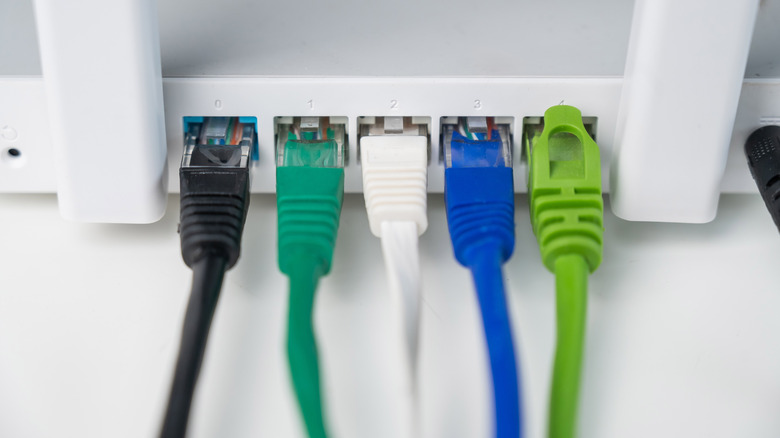
Ethernet cables are specifically designed to block out electrical noise (shielded ones especially so), but they're not completely immune to it. Because of this, it's not a good idea to run your network cables close to your home's power wires. The main reason is electromagnetic interference, which can cause the data signal to be disrupted, especially over long distances or in rooms with lots of appliances. This translates to slower network speeds or random loss of connection altogether. To counter this, Ethernet cables should be sufficiently far apart from power cables. But how far apart exactly?
There isn't a universal minimum distance, but generally, you should aim for at least 8 inches (20.3 cm) if both the Ethernet cables and power cables run in parallel. That said, 6 inches (15.24 cm) might be fine as well in some cases. If the Ethernet cables are of the shielded variety (those that are made to resist electromagnetic interference), they can be put closer to power cables, but don't keep them closer than 2 inches (5 cm).
Additionally, whenever the two cables need to cross, do so at 90 degrees, as that keeps the stretch where they run alongside each other as short as possible, and that parallel stretch is what drives the coupling between them. This is handy to know, since some of the Ethernet cables can be long. Lastly, make sure you never bundle the Ethernet cables and power cables together, as that's just asking for trouble.
Can electricity travel through Ethernet?
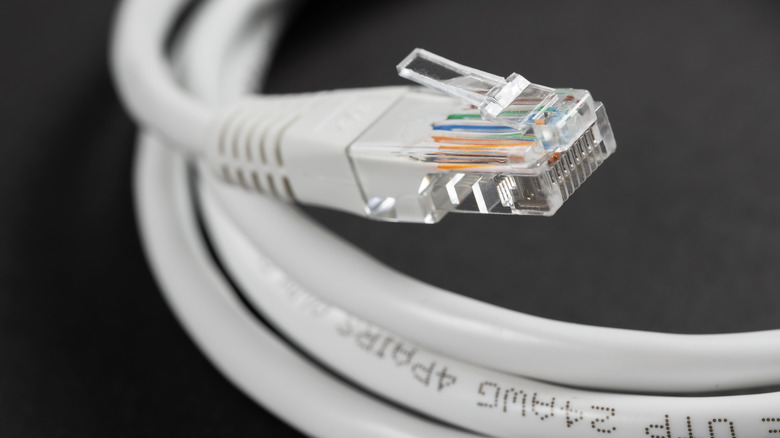
Possibly a lesser-known fact about Ethernet cables is that they can carry electricity. In fact, there are probably several things you didn't know Ethernet cables and ports can do. For instance, standard Ethernet cables have tiny, low-voltage electrical signals that help transmit data. Interestingly, there's a technology called Power over Ethernet (PoE), which lets standard Ethernet cables deliver both internet signals and electrical power at the same time. This means that a single Ethernet cable can be used to safely send both data and power to devices like Wi-Fi access points, security cameras, VoIP phones, and some smart home gadgets.
It's worth noting that Ethernet cables and PoE don't and can't carry the same kind of power and voltage that the household electrical outlets supply. Just like how Ethernet cables have different properties and speeds (with some Ethernet cables being faster), PoE also has different standards. There are four types, and the headline wattage refers to what the port supplies rather than what the device actually receives. Type 1 delivers up to 15.4W of power at the port and around 13W at the device, while Type 4 tops out at 90W at the port and roughly 71W at the device.