

What Does It Mean When You See A 'Runaway Vehicles Only' Sign On The Road?
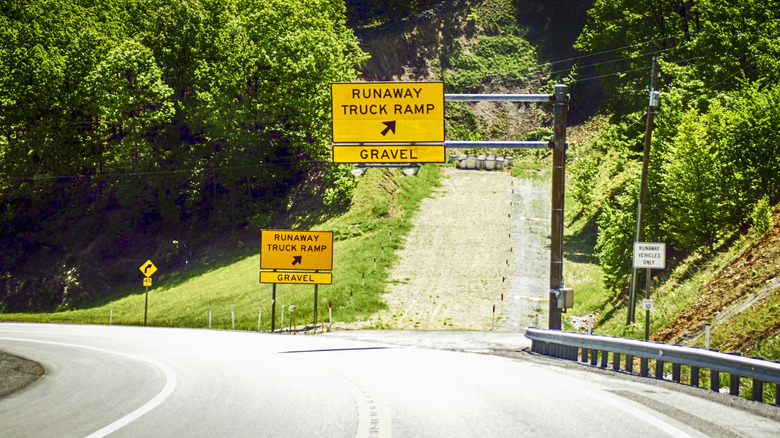
Mountains might be havens for skiers during the winter and off-road cyclists in the summer, but the steep inclines and declines of the roads getting up to them are no friend to the average truck driver. If you happen to live in the flat expanse of land somewhere in the Midwest that's devoid of said mountains, it's possible you've never encountered a road sign regarding runaway vehicles. They're used to warn drivers who somehow lost the ability to slow down (i.e., failed brakes) as they're coming down the backside of a high-elevation mountain pass.
These signs are primarily intended for big rigs, but they also apply to passenger cars. Despite the rigorous federal and state laws governing the upkeep and maintenance of semitrailers, Murphy's Law — if anything can go wrong, it will — keeps everyone on their toes. The last place you want that particular law to pop up is when you're headed downhill, applying the brakes to maintain a proper speed limit, and suddenly they stop working. If you find yourself in such a precarious predicament, though, know that you probably have a safe way out.
A runaway truck ramp is a feature built just off the side of the road that forces a truck or car to stop safely in an emergency. While these ramps come with different design elements, most are filled with huge quantities of sand or gravel and built with an uphill slope that's angled away from the main highway to avoid causing even more problems. Think of it as a large quicksand pit that uses a combination of friction and gravity to force a vehicle into a controlled stop.
It's better to be safe than sorry
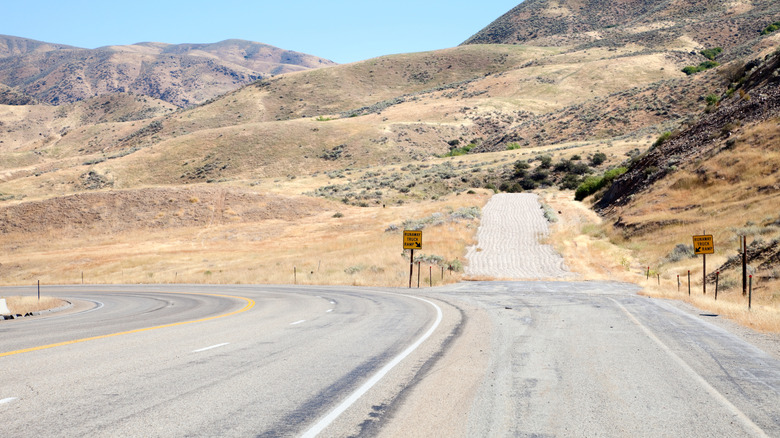
You'll find these (mostly) yellow warning signs in mountainous areas. Interstate 80 meanders through the Sierra Nevadas on the way to Lake Tahoe and Reno, and I-5 crosses over the Tejon Pass (aka the Grapevine) on the way to Los Angeles. In Colorado, Interstate 70 snakes over the Eisenhower Pass at over 11,000 feet. You'll also find these signs on Monteagle Mountain (Tennessee), Mount Rose Highway (Nevada), Teton Pass (Wyoming), and Interstate 40 in North Carolina.
The first runaway truck ramp in California opened in August 1956. In July of 2026, a new type of ramp was built along westbound Loop 375, near the I-10 interchange in El Paso, Texas. It uses a series of eight energy-absorbing nets bolted to reinforced concrete walls and will safely stop a 90,000-pound truck going 90 mph. Even with Jake Brakes, which are different from regular air brakes, trucks can have a hard time slowing down on steep declines. And while most ramps use gravel or sand, some (like the one in El Paso) are built using wire nets with breakaways. Where uphill gravity ramps aren't possible, they'll probably be level, but will have a much longer runway, giving the vehicle ample time and space to slow down.
On I-15 through Cajon Pass in Southern California, any vehicle can use the runaway truck ramp in an emergency scenario. Such is the case in most states, but because laws vary considerably from state to state, it's always best to check local laws to make sure. Whatever the method used, they'll be impossible to ignore thanks to prominent warning signage.