

5 Unexpected Ways Recycled Wind Turbines Are Being Used
Like any piece of technology, wind turbines (not to be confused with windmills) aren't functional forever. With time and use, they break down, often requiring deconstruction after just seven to 10 years of service. Wind turbines can be up to 750 feet tall, and given their immense size, figuring out what to do with the massive turbine blades becomes an important issue, lest they end up taking over landfills. Many have taken on the challenge, ensuring that these blades receive a new lease on life and don't end up tossed in an ever-expanding landfill somewhere.
With that said, it's worth mentioning that full-on recycling of wind turbine blades isn't impossible. For instance, companies like Carbon Rivers have figured out ways to break down the fiberglass and steel of these blades, keeping the glass fibers intact so they can be used in new creations (via Department of Energy). However, this is a highly specialized and therefore expensive process, which is why it's not adopted on a wider scale. For this reason, many companies have opted for simpler, more creative, and, in several cases, less pricey ways of using retired turbine blades, such as in constructing playgrounds, bridges, and art installations. As these companies and artists have shown, wind turbine blades don't need to be tossed aside when their perceived usefulness is over. The following are just some of the great and unexpected ways these large constructs have been reused over the years.
Wind turbine blades are turned into lightweight concrete blocks
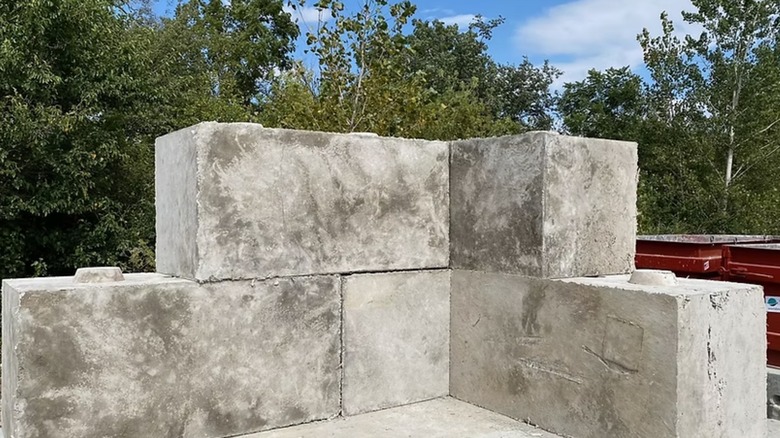
Though it may seem like wind turbine blades only serve a single purpose, evidently, there are lots of uses for them once their job of converting the kinetic energy of wind into electric power is over. One of the most functional of all is in construction, which can look different from case to case. In some instances, these blades are recycled and turned into concrete to create blocks and barriers. The company Renewablade is one of the foremost names exploring this technology and putting it into scalable, real-world use. Their blocks are lighter and easier to transport than regular concrete blocks. Des Moines, Iowa's Mercy College of Health Sciences used 28 of Renewablade's wind turbine blade-concrete composite barriers while construction crews worked on the campus.
Aside from using wind turbine blades to create new forms of concrete, they've also seen use as structural elements in buildings. A highly-publicized example comes out of Lund, Sweden, where a 365-car parking garage used dozens of decommissioned blades as curtain walls: Those that aren't vital to holding the full weight of the building, but cover the outer sides. The decision to use recycled turbine blades came as part of the building's overall intent to create what they call "visible sustainability" (via Vattenfall). This involved installing solar panels on the roof for clean EV charging — another consideration for cities looking to remedy their EV charging woes — and pollinator-friendly plants to encourage the natural habits of local wildlife.
Wind turbine playgrounds
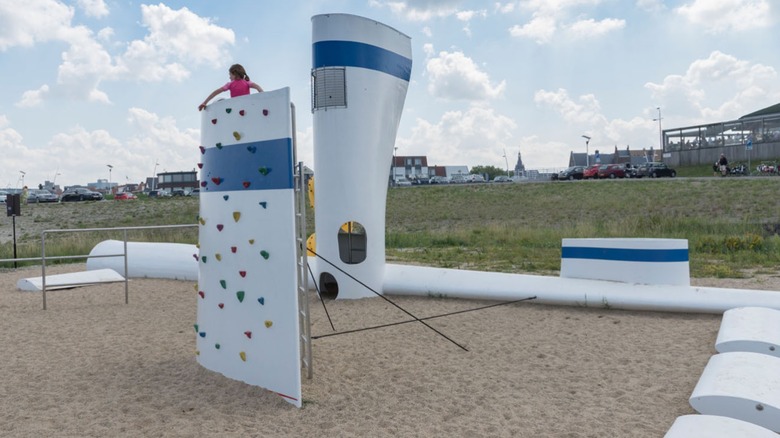
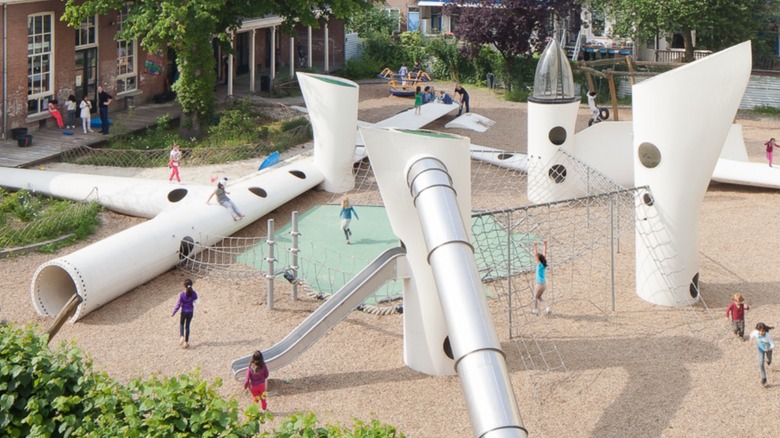
There's nothing saying that reusing or recycling materials has to be a drab, corporate affair. If possible, it should be fun, and that's exactly what wind turbine blade playgrounds seek to achieve. As evidenced by the efforts of Superuse Studios – an architectural collective dedicated to construction using reused and waste materials — these massive pieces are excellent for creating fun and enriching playgrounds for kids. Simultaneously, they instill in the younger generation a sense of duty to make the most of what already exists and creativity regarding what the world around them can look like.
Surprisingly, it seems that wind turbine blades are quite versatile when it comes to playground construction. They can act as tunnels, especially if enhanced with several entry and exit points throughout. Cut and installed upright, they make fine forts for imaginative play and seem more than sturdy enough to support the weight of kids and playground essentials such as slides and climbing ropes. As of 2022, Superuse has managed to recycle 27 turbine blades, creating playgrounds and other installations across the Netherlands. The company claims that these playground projects reduced carbon emissions by roughly 90% compared to the average new construction playground.
Turbine blade-supported footbridges
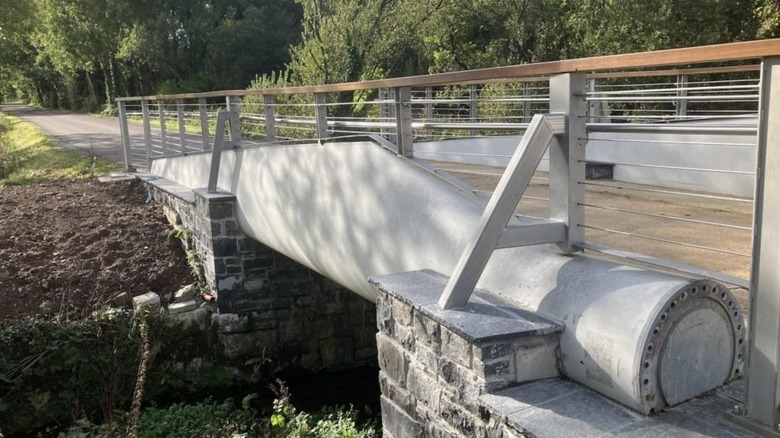
Given their length, size, and sturdiness, there's something to be said for the structural uses of wind turbines. Aware of the possibilities, some have even used wind turbines as supporting pieces for footbridges. One example is the Midleton to Youghal Greenway Bridge in Cork, Ireland, which features two LM13 blades that act as supports in lieu of traditional steel girders. The just-over-18-foot steel deck bridge was completed in January 2022 at a cost of around $31,069.83. Far from one of the largest bridges ever built, but still impressive for an experimental piece, it remains in use by the public, albeit with consistent monitoring of its condition.
BladeBridge — the same company responsible for this construction — later got the opportunity to create a second wind turbine blade bridge. This one had the backing of the Science Foundation Ireland, the Northern Ireland Department of the Economy, and the US National Science Foundation, and was assembled in Draperstown, Northern Ireland, in April of the same year. It's a bigger creation at around 19 feet in length, featuring a timber deck and two turbine blades as girder replacements with steel angles bolted on. This bridge came to £10,808 (roughly $13,450 in 2023) – and while it wasn't a permanent installation, its low cost and durability indicate there could be a future for more bridges like it.
Public wind turbine planters and benches
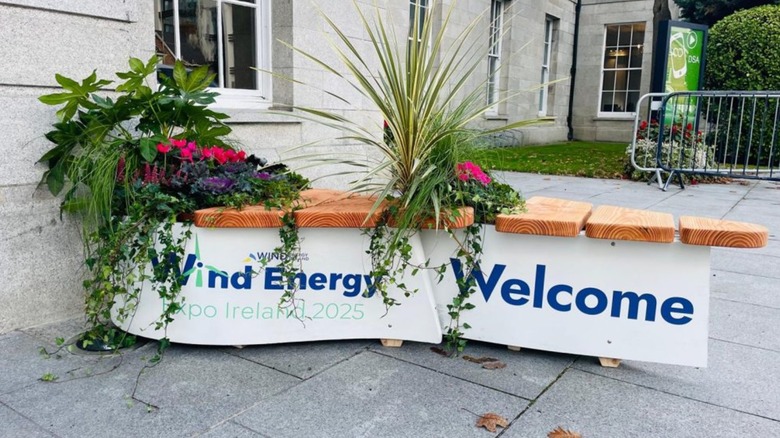
As noted in the wind turbine blade playground example, many wind turbine parts are hollow. Thus, with some tweaking, they can theoretically live new lives as forms of item storage or display. This has already shown promise, as chopped-up turbine blades have been turned into large planters in public spaces. DTE's Warren Service Center in Detroit, Michigan, gave this innovative idea a try with great success. All it takes is cutting up a small piece of the blade, installing a false bottom, cutting out drainage holes, and adding foam to the edges to aid in durability.
The aforementioned BladeBridge project has created some intriguing turbine blade planters of its own in Ireland. At the 2025 Wind Energy Ireland Expo, BladeBridge showed off combination bench-planters created out of recycled turbine blades. Pictured above, one of them features small seating sections broken up by various plants, while another utilizes leftover cuts from an LM13 turbine blade in a three-spoke configuration — a design that, as the company explained, intentionally invites people to sit close to one another to spur conversations and create connections.
If you want a turbine blade bench of your own, the company Noblewins sells them in different shapes and seating arrangements. While they're environmentally-conscious and visually interesting, know that they are surprisingly expensive, with even smaller examples totaling multiple thousands of dollars.
Wind turbine blade art installations
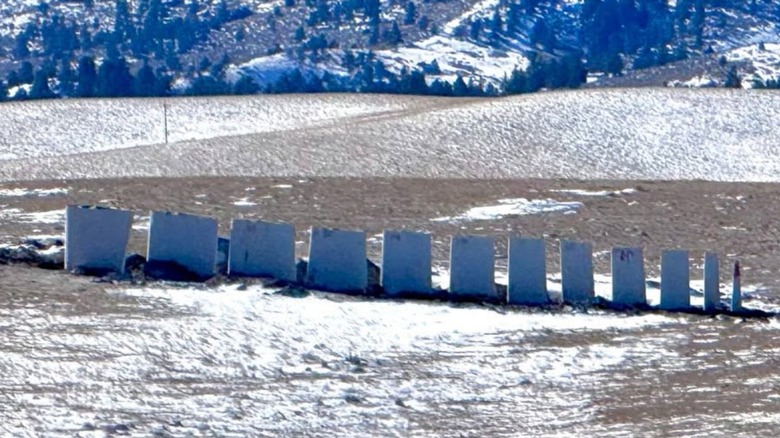
In addition to planters, turbine blades have also been used as unique snow walls, as demonstrated by a Wyoming-based artist, Chris Navarro. He took several cut-up blade portions and turned them into a combination art piece snow wall, which he told Cowboy State Daily is intended to provide onlookers with feelings of hope and renewal. After all, in the most literal sense, this is a way for these huge, difficult-to-recycle wind turbine parts to take on a new identity. Murals on both sides of the wall were planned to coincide with the art piece's optimistic message.
Meanwhile, others have used complete turbine blades to make dramatic artistic expressions. For example, as part of the Hull UK City of Culture 2017 celebration, multimedia artist Nayan Kulkarni installed a 246-foot-long blade turbine in the middle of Hull in East Yorkshire, England. The appeal of the aptly-titled art project "Blade" was that it appeared overnight, dazzling onlookers with its sheer size and presence within an urban center. In reality, moving the blade and putting it into place was no easy task. Per Informed Infrastructure, the blade required special tripods to hold it up, loads of heavy machinery to get it correctly positioned, and it called for the temporary removal of street lamps, traffic lights, and more to accommodate its size.