

Updated US Decoy System Puts Non-Existent Fighter Jets On Enemy Radars
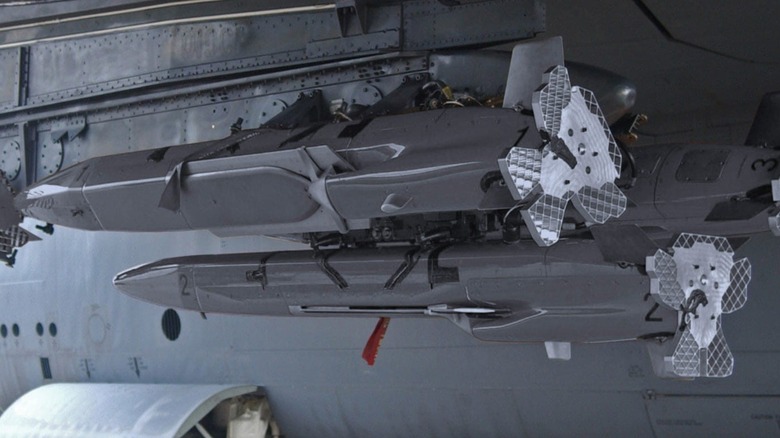
Pilots have several ways to protect themselves during aerial warfare. One tried-and-true method is the use of decoys, and one of the most advanced systems is proving its worth by replicating fighter jets to confuse enemy radar. One of the most advanced systems is Raytheon's MALD decoy system. First developed in the '90s, MALD has made a comeback thanks to updates to its software and hardware; the decoys can trick enemy military air defense systems to ensure pilots remain out of harm's way.
The decoys work much like you might suspect: An operator sends one or more in a formation into hostile airspace where they fool air defense radars into thinking they're the hostile threat. Meanwhile, a piloted aircraft carries out its mission without alerting the system, ensuring the pilot's safety. MALD is a robust system that involves airborne vehicles that look and operate much like missiles, each with a range of around 575 miles. That allows them to fly deep into hostile territory, well beyond line of sight.
Raytheon also builds the MALD-J, a jammer variant of the basic MALD decoy. It's the first jammer decoy of its kind to enter production. The MALD-J can operate solo or in pairs, getting in close to an enemy radar system then jamming the electronics. This allows them to remain in the area and continue loiter operations to aid piloted aircraft as they carry out their mission. These systems have been battle-tested in the Russo-Ukrainian War, and their use is likely to increase going forward as Raytheon has restarted production in mid-July 2026 to place more systems in the battlespace.
The MALD and MALD-J are small but incredibly useful
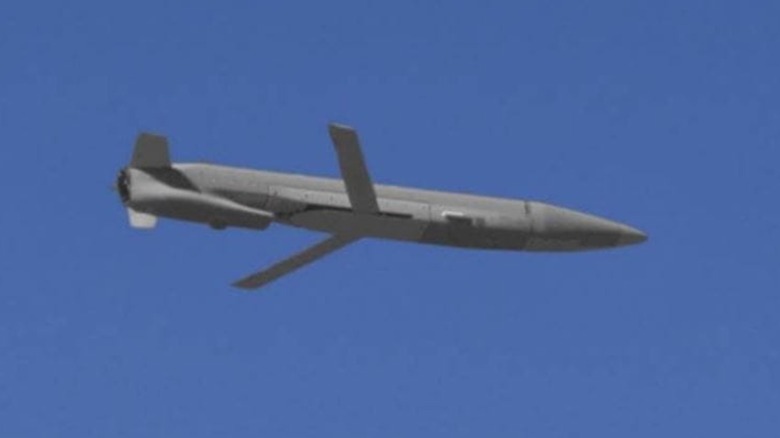
The MALD and MALD-J vehicles are relatively small devices that mount on an aircraft's hardpoints in the same manner as conventional munitions like long-range air-to-air missiles. The system's military designation is ADM-160 MALD, which stands for Miniature Air-Launched Decoy, and its primary function is to deceive the early-warning and target-acquisition radars used by air defense systems. The MALD program goes back decades, so the concept of decoys like the ADM-160 isn't new.
That said, the current version is updated and more robust with greater capabilities, as the technology has evolved since the 1990s, when it was introduced following a DARPA-initiated program that awarded the first contract to Teledyne Ryan (Northrop Grumman). Raytheon took over the program in 2003 with the ADM-160B. This led to the ADM-160C, which is the newer, updated MALD-J variant that operates as both a jammer and decoy.
Costs skyrocketed, so production was reduced, but it's been renewed to support Ukraine in its ongoing fight. Both the ADM-160B and 160C are in use, and the vehicles measure 9 feet, 4 inches long with a wingspan of 5 feet, 7 inches. Each vehicle weighs 99.2 pounds, and they can reach speeds of up to Mach 0.91 (698 mph). They have a 90-minute endurance and are powered by a Hamilton Sundstrand TJ-150 turbojet engine. The Ukrainian Air Force successfully used them against Russian radar systems in its war against the occupying nation in 2023, and they've become integral to most missions.
How the MALD system works
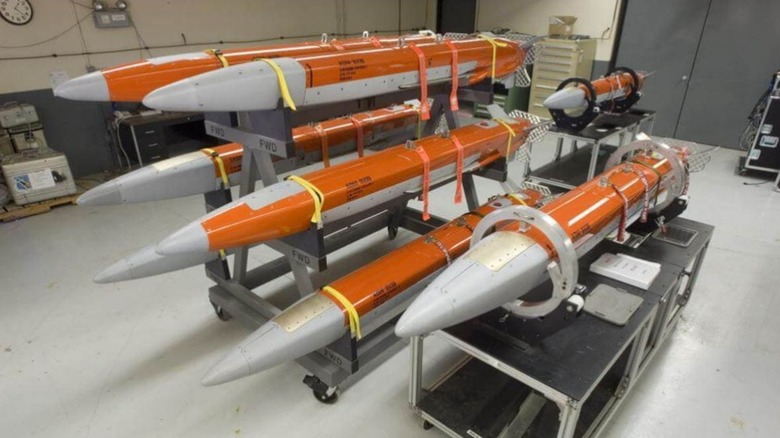
Tricking an enemy radar system isn't as simple as flying a decoy into the area and hoping for the best. Radar systems are designed to pinpoint unidentified signatures, while their operators are trained to parse what the system picks up. To trick both the computer system and its human operator, the MALD vehicles are programmed to fly routes that resemble those of U.S. or allied aircraft.
While the MALD decoys look like missiles, they don't pack a warhead of any kind. Instead, MALDs carry a payload that works by manipulating radar frequencies. These electromagnetic components can simulate any aircraft, so when they're active, they can trick radars into mistakenly identifying them as an F-15, F-35, or whatever its operators desire. The radar operator then sees whatever the programmed MALD wants them to see, and they act accordingly.
The system can be used to sow confusion, making it seem as if attacks are coming from a certain direction (or all around), thereby helping to ensure mission success. MALDs can, of course, be shot down, and while they're not cheap at around $380,000 apiece, losing a MALD is preferable to losing something like an F-22 Raptor, which not only costs $369.5 million but also carries a pilot inside.