

Here's Where You Can Find The Fastest Speed Limit Sign In Canada
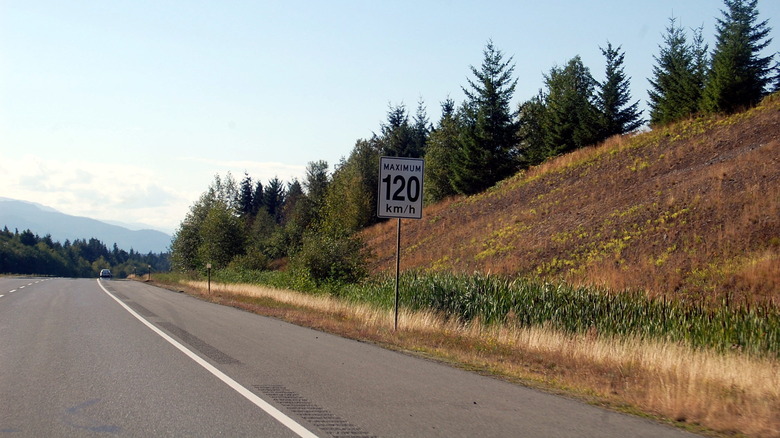
In addition to being home to both square and diamond-shaped traffic lights, Canadian roads are posted in kilometers. Sixty km/h equates to about 37 miles per hour, and the maximum speed limit in most areas is 110 km/h (62 mph). In a few specific areas, however, it reaches 120 km/h (about 75 mph).
British Columbia, Canada's westernmost province, sits between the Pacific Ocean and the Rocky Mountains. With the third highest population, it serves as the main gateway to the Pacific. The four-lane Coquihalla Highway (aka Highway 5) is the largest of four routes connecting the Vancouver area (or the Lower Mainland) to the interior. Along the portion that runs from Hope (in the Lower Mainland) to Kamloops — and only on that specific segment — are you officially allowed to go 120 km/h, or about 75 mph.
A new pilot project launched in April 2026 also boosted the maximum speed limit to 120 km/h in Alberta, the province bordering eastern British Columbia. In this case, a nearly 14-mile section of the Queen Elizabeth II Highway (aka QEII or Highway 2) between Calgary and Edmonton will test the limit. There's already an unwritten rule that this speed is allowed on most highways, depending on the traffic flow, conditions, and provincial highway on which you're driving. Still, this might become the new norm on other divided multi-lane highways if this goes well, including Highway 16 through Edmonton, Highway 1 near Calgary, and Highway 63 to Fort McMurray.
The limitations behind Canada's fastest
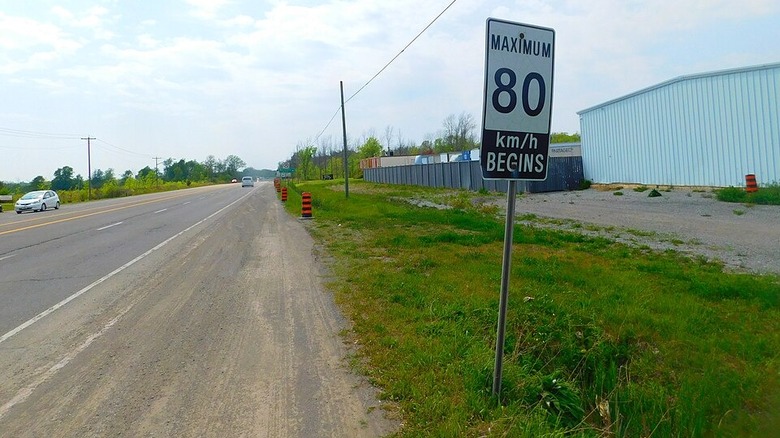
The Alberta government surveyed over 50,000 people in 2025, and 70% agreed that rural divided highways should have a speed limit of 120 km/h because they're designed for such increased speeds. But not everyone likes the idea. The Alberta Roadbuilders and Heavy Construction Association (ARHCA) was concerned enough to write to Alberta Transportation and Economic Corridors (TEC), stating that changes also needed to include "safety improvements to the infrastructure, consistent enforcement, and effective public awareness campaigns."
Not only does data collected by ARHCA show drivers are already going substantially faster than the posted limits through construction zones, but Royal Canadian Mounted Police (RCMP) data also shows that speeds between 120 km/h and 130 km/h have dropped by as much as 71%. In comparison, speeds above 140 km/h have jumped by 65%. Alberta's Transportation Minister, Devin Dreeshen, says they've already made significant safety improvements to Highway 2's infrastructure by increasing the length of on- and off-ramps and adding speed-sloped paving. Ultimately, these decisions are all made in an effort to keep traffic within the province flowing smoothly, barring the odd occurrence when a moose, often seen as the nation's symbol, tries to lick the outside of your car.