

MIT Scientists Found A New Way To Rapidly 3D Print Concrete
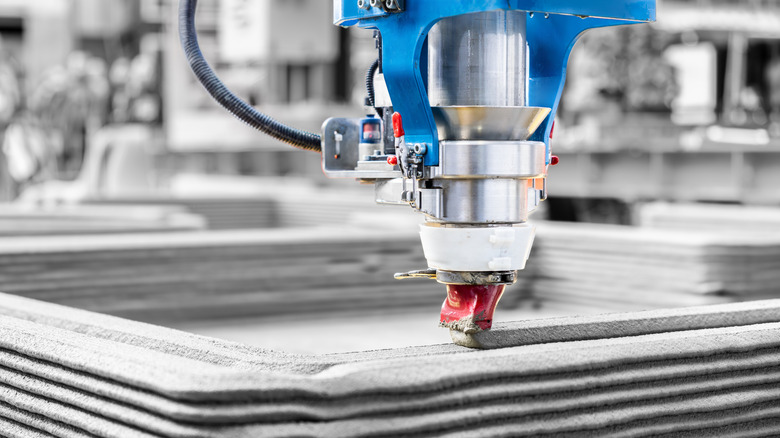
3D printing concrete can potentially be faster and more environmentally friendly than using molds, but optimizing designs to accommodate how 3D printers actually work has previously been a difficult task. Scientists at MIT just announced a breakthrough that could help make that process quicker and easier, eliminating the need for humans to painstakingly rework designs. They published their findings in the Additive Manufacturing journal.
The team worked with large-scale 3D printers at the Autodesk Technology Center in Boston, and used the expertise of the Center's technicians to find the limitations of the previous modeling framework. They already knew that many of the supposedly optimized designs created by these frameworks couldn't actually be built by 3D printers, but they found three things in particular were making them unworkable. Printers need to print in a continuous line, which the previous framework was not properly accounting for, and their nozzles are also limited in how sharply they can turn. The thickness of the printing bead was also found to be a consistent limitation.
By accounting for these limitations in their framework, the team managed to cut the time needed for a printer-ready design down from several days to several minutes. There was no specialist hardware needed either, with the team creating the designs on a laptop.
Some thought MIT's printing speeds would be impossible
At the heart of the team's latest framework is a lot of extremely complicated math. So complicated, in fact, that the study's co-author Zane Schemmer said if "you go back five, 10 years ago, the solver we used, even three years ago, could not solve these problems." Now, the team has proved that faster speeds are not only possible, but actually realistic. To prove the effectiveness of their work, they built a 2.3-meter concrete bridge using Autodesk's printers.
After arriving at the Center on the day they were supposed to print the bridge, the team found an issue. They needed to slightly reduce the size of the bridge design, a job that would previously have meant they'd need to significantly delay the print. Instead, with their new framework, it only took them around 10 minutes to update their design.
The bridge was not only readily printable, but it was also just as strong as the team predicted. Co-author Hajin Kim-Tackowiak said the bridge turned out to be "super over-engineered," comfortably holding more than 2,000 pounds of weight. Kim-Tackowiak said that the framework could design far stronger bridges, adding that it was only "after 200,000 pounds [that] you can start to think about the physics."
The findings can help improve future 3D printers
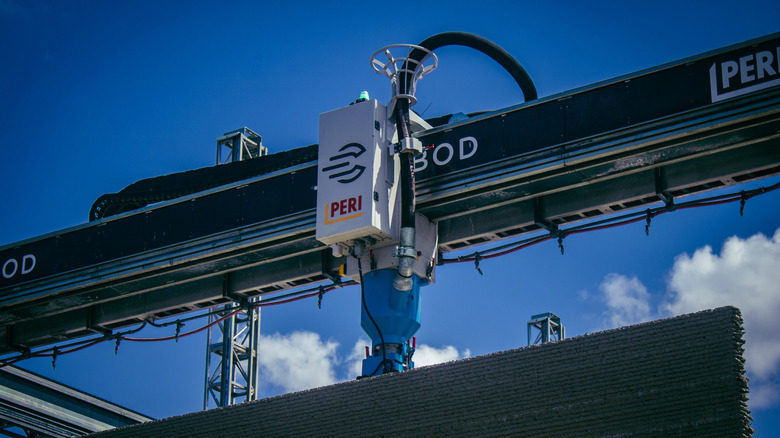
As well as speeding up the time it takes for engineers to create printer-ready designs today, the team says that their work can help spotlight areas where 3D printer brands could improve their products in the future. In particular, they said that the width of the bead that the printer could lay made a surprisingly big difference to the amount of material that was needed to build a design.
The bridge they created was built using a 4cm bead, but they found that they could have reduced the amount of concrete needed by as much as 76% if they had a printer that could lay a 1cm bead. According to their calculations, this narrower bead would not have compromised the bridge's safety either. The biggest material savings came when the printer was used to create one-off designs, which the team said could be particularly beneficial if it was used to rebuild infrastructure after natural disasters.
Despite being a promising breakthrough, some major drawbacks to 3D printing concrete still remain. One of the biggest is that there's currently no way to print reinforced concrete, although the team say they're now turning their attention to solving that problem too. In the meantime, 3D printed houses are already becoming a reality, even if 3D printed large scale infrastructure isn't going to become commonplace for now.