

What Is The 2-2-2 Rule For Motorcycle Helmets?

There are several different types of motorcycle helmets, including modular and dual-sport options. Those who are familiar with them know there are important things to look for when buying a new motorcycle helmet, and that there can be considerable difference between the types of helmet. Nonetheless, all of them follow the 2-2-2 rule, which is a quick and convenient way to determine whether the helmet is the right size in the first place.
You can perform the 2-2-2 rule using just two fingers, making sure to check three things, as explained by Colorado's Memorial Region Health in an Instagram post. Firstly, you want to make sure that the front lip of the helmet sits about two fingers above your eyebrow line. Second, place two fingers along the side of your face, just under your ear, in a "V" shape. This should align with the straps, which may not be positioned correctly if it doesn't. Lastly, you should be able to fit two fingers between your chin and the chinstrap to make sure it is fastened properly.
In this way, a biker can ensure that they have their helmet fastened safely and securely before each journey. After all, a helmet that's too big will be too loose and might come off your head in the unfortunate event of a collision or crash. Meanwhile, a helmet that's too small can be restrictive, potentially causing pain or disrupting your vision.
Checking the fit of a motorcycle helmet

The World Health Organization reported in 2023 that "Safe, quality helmets reduce the risk of death in a road crash by over six times, and reduce the risk of brain injury by up to 74%." Needless to say, though, they have to be the correct size and fitted properly in order to protect the rider.
It's important to measure your head circumference to get the best fit before selecting a helmet. Doing so is a matter of checking the circumference from a point about 2.5 centimeters above your eyebrows, and then comparing the results against the different sizes of helmet on offer at your chosen retailer. For instance, if you're considering an AGV K6 S Helmet, RevZilla provides an AVG Helmet Sizing chart, allowing the consumer to choose from XS to 2XL depending on that measurement.
The next crucial thing is to check that the helmet doesn't move too much on the head. The aim is for a secure fit, but not a restrictive one. MotoCentral notes that "with the chin strap fastened, your skin should move with the helmet — not the other way." You also need to consider things like the shape of your head, which can alter the fit. Manufacturers offer helmets for different shaped heads, including intermediate oval and round oval, demonstrating that the head circumference figure alone isn't enough to ensure that a given helmet will provide a trusty and reliable fit.
The dangers of a poorly fitting motorcycle helmet
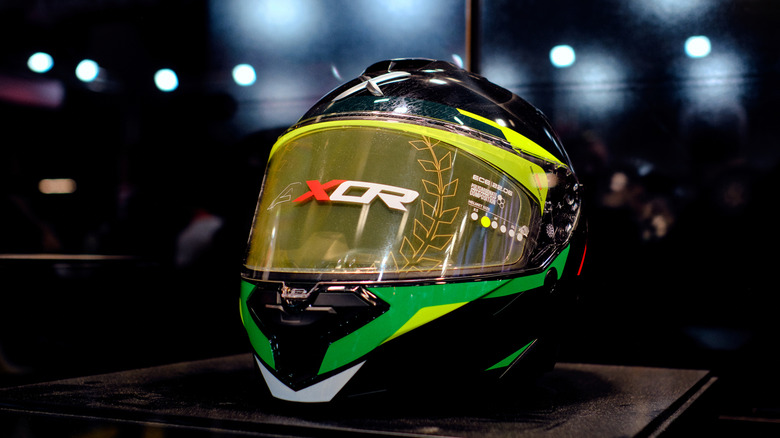
For motorcyclists, as for cyclists, helmets are among the most critical life-saving tools available. This is why bikers must take such good care of them. The 5-year rule for motorcycle helmets is one that a lot of veteran bikers may be familiar with, and it's indicative of the fact that it is just as important to replace helmets as it is something like a worn tire. Failing to do so puts your safety at real risk.
Whether or not your helmet absorbs impact or not, it slowly degrades over time as oils steadily take away from its ability to protect the wearer. Of course, the more often you ride, the faster this process may be. Helmets can also be damaged from the sun and other factors as well. This means a helmet that initially fit perfectly will eventually need to be replaced. That's why it's crucial to ensure that you use the 2-2-2 rule to determine that your helmet is positioned correctly and is still in the optimal condition with each and every journey.