

Toyota Highlander Vs. 4Runner Depreciation: Which Loses More Value After 5 Years?
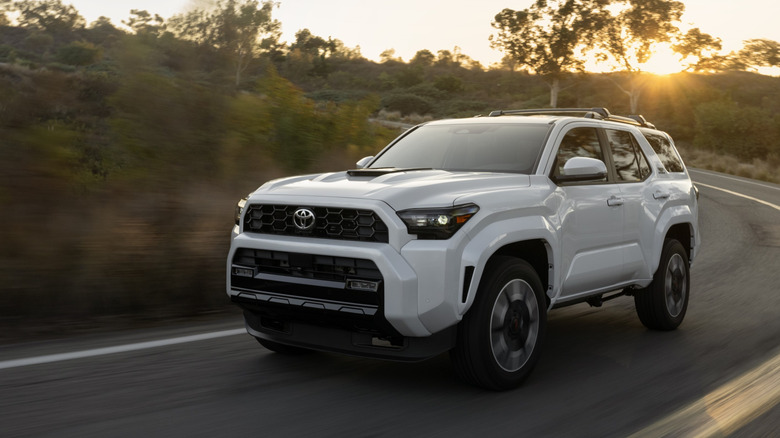
Toyota's lineup, like most automakers these days, is packed with SUVs, ranging from the compact and inexpensive Corolla Cross up to the full-size Sequoia. Two of the brand's more established models are the Highlander and 4Runner, and they're quite different from each other — despite having similar starting prices.
Both models come standard with a 2.4-liter turbocharged four-cylinder engine and can be optioned with a hybrid powerplant for an additional cost, but that's about where the similarities end. The Highlander is a three-row, unibody crossover designed primarily for hauling families in comfort. The 4Runner, meanwhile, is a rugged, body-on-frame SUV that trades on-road refinement and fuel efficiency for some serious off-road capability, as we found in our review of the 2025 4Runner Trailhunter.
Each of these SUVs has pros and cons that could push buyers in one direction or the other, but what about resale value? As with most Toyota models, both models hold their value better than the average SUV, but head-to-head, the 4Runner has a substantial advantage here. In fact, the Toyota 4Runner is generally considered one of the slowest-depreciating models outright, across vehicle type and automaker.
Good resale value versus incredible resale value
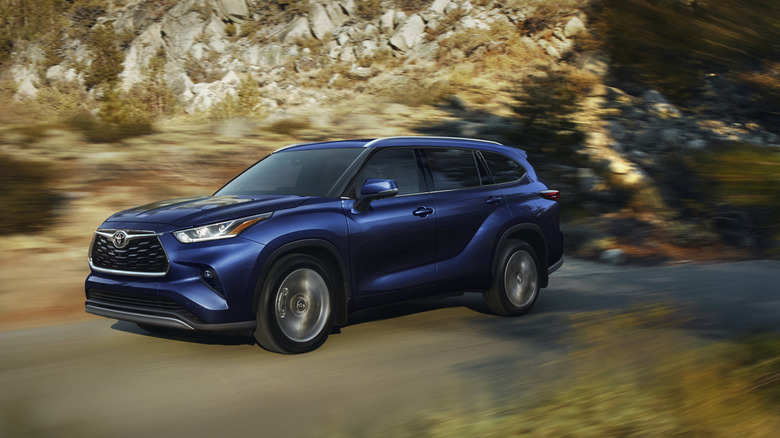
Toyota vehicles are known for having great resale value across the board. Based on the industry-standard five-year metric, iSeeCars shows a depreciation rate of 36.3% from new for the Highlander, compared to just 25.4% for the 4Runner. CarEdge also maintains extensive depreciation data, and it shows a slightly higher 40% depreciation figure for the Highlander versus 25% for the 4Runner. Looking at comparable 2025-model-year base trims of each model, Kelley Blue Book also gives the 4Runner SR5 the win. Based on 10,000 miles a year, the 4Runner SR5 would depreciate by $13,767 after five years, compared to $18,794 for a base-model Highlander LE.
Used car listings seem to back this data up. A CarMax listing for a 2021 Highlander LE with 73,000 miles has a price of $29,000, while a listing for a 2021 4Runner SR5 Premium with 71,000 miles has a price of $36,000. Moving to the higher trims like the 4Runner TRD Off Road and Highlander XSE, the price delta skews even higher towards the 4Runner.
Then there's the flagship 4Runner TRD Pro model, for which a low-mileage 2021 model has an asking price of $55,000. The Highlander doesn't have a TRD Pro equivalent, but the most expensive '21 Highlander CarMax currently has – a Limited Hybrid model — is priced at $46,000. Used car retail prices will vary, of course, but this gives a rough idea of the price difference between used Highlanders and 4Runners of similar age and mileage.
Two very different types of SUV
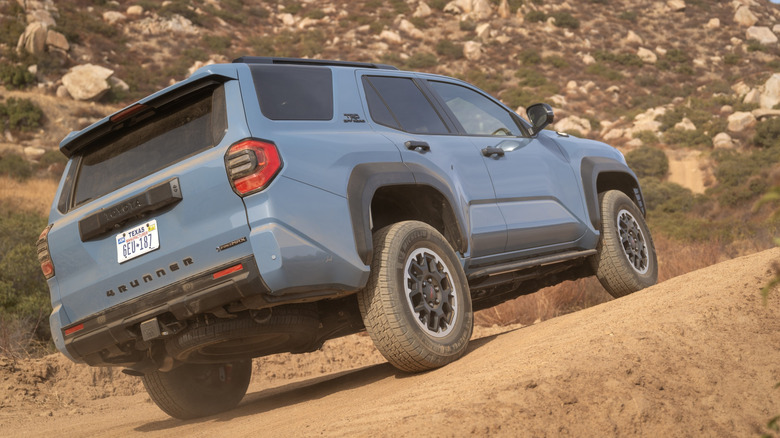
Does the 4Runner's notable edge in resale value make it the better choice compared to the Highlander? Not necessarily. The 4Runner's popularity on the secondhand market is due in big part to its rugged, truck-like nature. That's great if you plan to spend your weekends hitting the trails, but it might not be what you want in a family SUV, especially if you aren't planning to leave paved roads very often.
Our review of the 2024 Toyota Highlander found a three-row crossover that was sensible if not adventurous — but sensible is exactly what the majority of mainstream SUV buyers are looking for. With the Highlander, you get a more spacious interior, a smoother ride, and improved fuel efficiency compared to the 4Runner. These are all the expected benefits one gets from choosing a unibody crossover over a traditional body-on-frame SUV of any type, even if the crossover's resale value isn't as high.
The 4Runner might have the lower depreciation of the two, but it's not like the Highlander has poor resale value by any means. In fact, iSeeCars still has the Highlander ranked in the top five of all three-row SUVs when it comes to depreciation. Finally, we should also note that the real-world resale numbers will vary depending on the specific trim or options, as well as the individual vehicle's condition and the part of the country you are in.